

On Saturday, November 28, 2026, Hofu Tenmangu Shrine (防府天満宮) in Yamaguchi holds its 1,023rd Goshinkosai (御神幸祭), the procession of its deity. Locals call it the Hadakabo Festival (裸坊祭) after the hadakabo, the men who escort the shrine's palanquin, the Oajiro-koshi (御網代輿), through town.
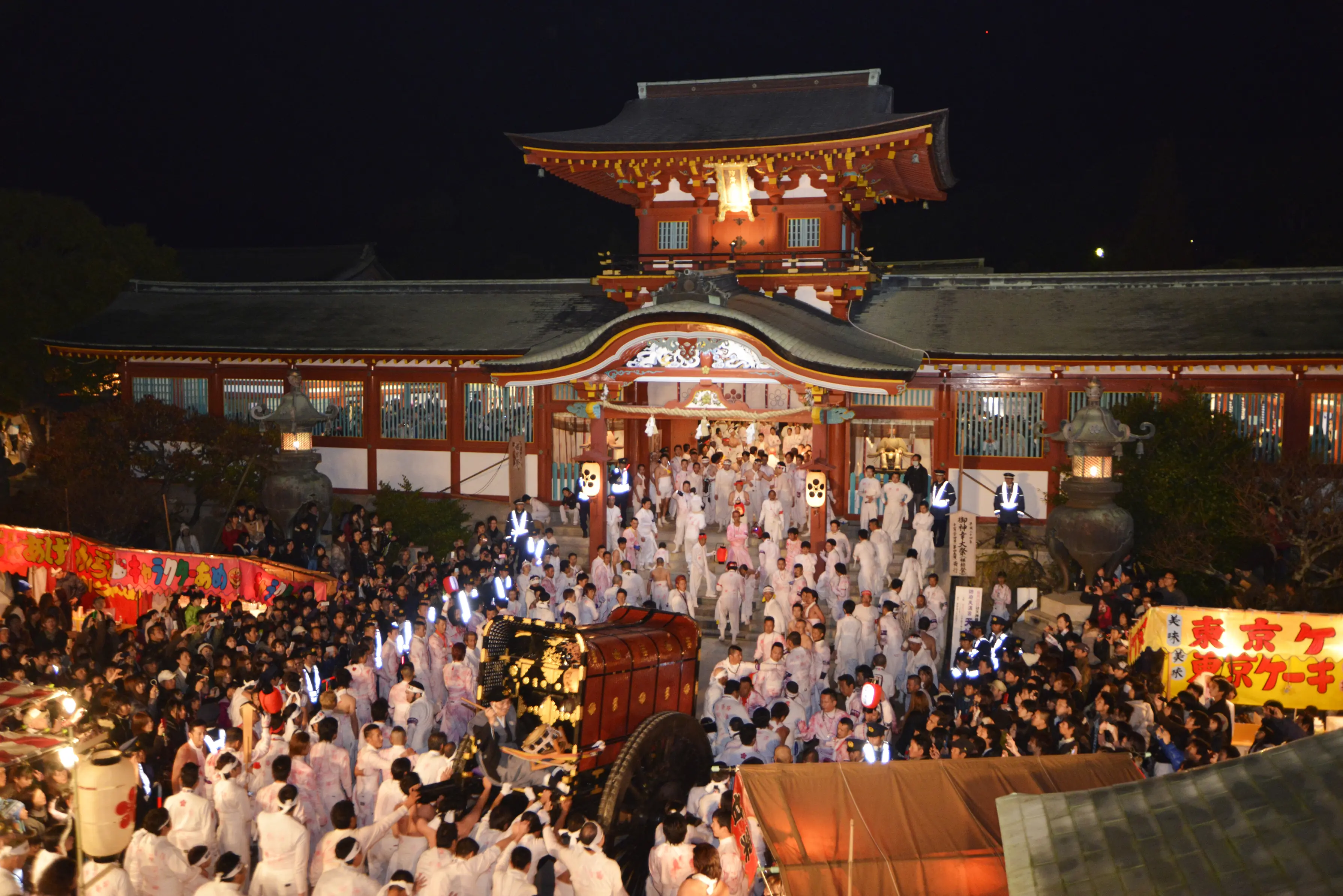
The part worth traveling for happens after dark. At 6 pm a signal firework goes off and the palanquin leaves the shrine.
It travels about 2.5 km to the otabisho (御旅所), the deity's resting place, where a rite is held, and is back around 9 pm. Watching costs nothing.
You can join in, too. On the afternoon of the 28th, a daytime walk sets off from Hofu Station, open to anyone with no sign-up. Wear something white or light-colored, meet at 2 pm, and you'll reach the shrine around 3 pm without carrying a mikoshi (portable shrine).
If you want to see the start, be at the shrine before the 6 pm firework. The palanquin doesn't get back until around 9 pm, so sort out your train home or a hotel before you go.
For more fall festivals around Japan, see our guide to Japan's autumn festivals.
Festival basics for 2026
Item | Details |
|---|---|
Date | Saturday, November 28, 2026 (held every year on the fourth Saturday of November). |
Main event | About 6 pm to 9 pm (timeline below) |
Venue | Hofu Tenmangu Shrine, 14-1 Matsuzakicho, Hofu, Yamaguchi |
Admission | Free |
Nearest station | JR Hofu Station (Sanyo Line), 15–20 minutes on foot |
Contact | Hofu Tenmangu, +81-835-23-7700 |
Hotels around Hofu: availability and rates
About 5,000 hadakabo take part. According to the Hofu Tourism and Convention Association (防府観光コンベンション協会), roughly 150,000 people visit the shrine over the festival's two days.
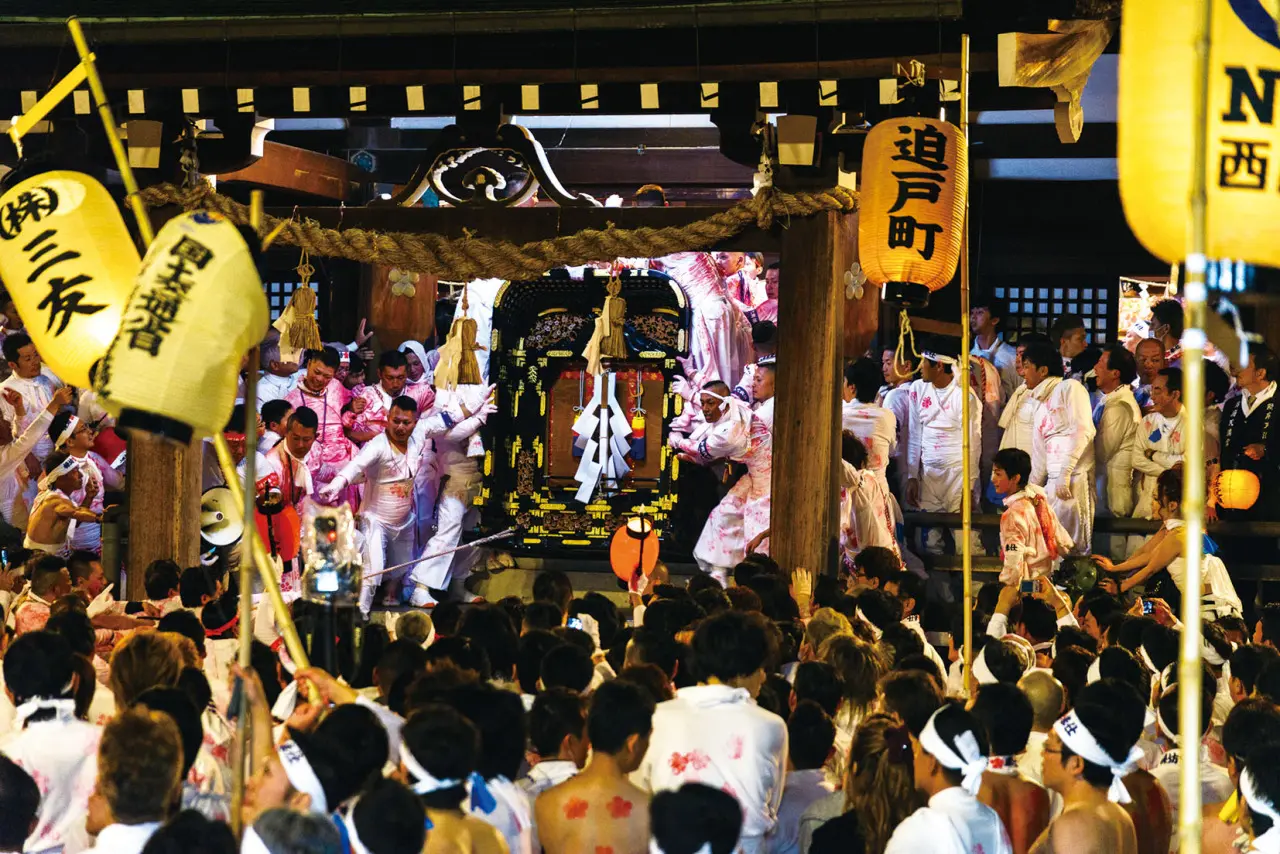
The Oajiro-koshi isn't one of the mikoshi the groups carry. It weighs around 500 kg, and the night procession is built around it. Separately, hadakabo groups carry their own mikoshi to the shrine as offerings, finishing by 5 pm.
The festival traces its origins to 1004. Sugawara no Michizane (菅原道真), the scholar now worshiped as a god of learning, had landed at Katsuma-no-ura (勝間の浦) on his way into exile in Dazaifu.
About a century after his death, an envoy from Emperor Ichijo came to the same shore to tell his spirit he had been cleared. The otabisho stands there today, and the Hamadono rite is still held on that spot.
Saturday evening timeline
Time | What happens |
|---|---|
By 5 pm | Hadakabo groups dedicate their mikoshi at the shrine and gather in its corridor |
6 pm | Signal firework; the hall doors open and the palanquin departs |
Around 7:30 pm | Hamadono rite (浜殿神事) at the otabisho at Katsuma-no-ura |
Around 9 pm | The palanquin returns to the shrine |
The two moments people come for are the palanquin going down the shrine's stone steps and coming back up them.
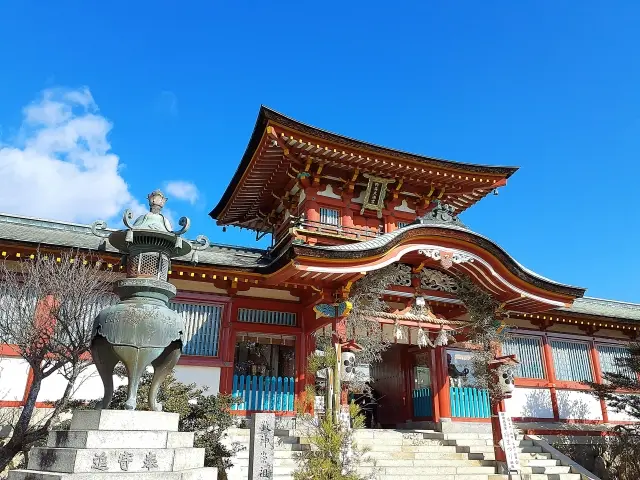
When the firework goes off, the hadakabo surge into the hall. Then the palanquin passes through the romon (楼門) gate and is lowered down the 58 stone steps into town.
On the way back, it rides a wheeled cart and is hauled up the same steps in a single rush. The shrine lists the return as around 9 pm, but the tourism association's paid packages schedule the return and wrap-up for around 10 pm. Leave yourself some slack.
Viewing, seating and restrictions
The tourism association's package with a special viewing seat (¥15,000 per person, including a night at a hotel with breakfast) is fully booked for 2026. No other seating has been announced.
The shrine's notice to the hadakabo says the steps are restricted from 5:30 pm. Nothing official says how close spectators can get to the steps, or what happens if it rains. If you want to plan where to stand, call the shrine.
Traffic restrictions are planned on both November 28 and 29. As of November 13, the roads and times haven't been announced.
Taking part as a visitor
There are three ways to take part. The daytime walk is the easy one. The night procession needs no sign-up, but check with the shrine first and expect a real commitment, and the paid package closes on November 14.
The daytime walk (no sign-up)
The Hadakabo 10,000 Project (裸坊1万人プロジェクト) runs this walk for people who want a casual taste of the festival and a chance to walk the shrine's main approach (表参道) as if they were part of it.
Meet at Mizukaze Hiroba (みずかぜ広場), the plaza at Hofu Station, at 2 pm on November 28 (look for the banners). The group sets off for the shrine as soon as people have gathered, so arrive a little early. Questions go to the tourism association (+81-835-25-2148).
Wear white or light-colored clothing. Headbands are provided while supplies last. Children need an adult with them, and anyone who has been drinking will be turned away.
There's no mikoshi to carry, and the walk ends at the shrine around 3 pm. It's a separate daytime event and doesn't lead into the 6 pm procession.
If you'd rather stay on for the evening, you can watch the procession from the roadside. Joining it takes some arranging with the shrine first (see below).
Joining the night procession
According to the shrine's Q&A flyer, you can join the night procession without registering. Registration for everyone, individuals included (they use the company form), closed at the end of October, so joining now means joining unregistered.
The shrine describes the outfit as white shorts, with the upper body either bare or wrapped in a sarashi (さらし, a long cotton cloth).
The 2026 rules ask participants to go bare-chested with a tasuki cord tied across the body where possible. The flyer says sarashi go on sale at work-wear shops and major supermarkets in town as the festival approaches.
There's no official word on where or when unregistered participants should report. The tourism association also tells anyone who wants to carry a mikoshi in a sarashi to contact the shrine (+81-835-23-7700), so call before you go.
The shrine's rules ask participants to stay with the procession from departure to return, never climb onto the palanquin or a mikoshi, and not carry glass bottles of alcohol. Once you're in, plan on staying to the end.
The paid mikoshi-bearer package
The tourism association's bearer package costs ¥30,000 per person. It includes a place as a hadakabo, the full costume, and a night at a hotel with breakfast. Interpreters for English, Chinese and Korean can be arranged for an extra fee.
Booking closes 14 days before the festival, which for 2026 means November 14. If you're reading this after that date, the package has closed for this year. If not, call the association (+81-835-25-2148) to check whether spots are left.
A note for women
The shrine's flyer says that because the procession can be dangerous, it's said that women don't take part. It suggests cheering from the roadside or joining Sunday's women's mikoshi instead. The daytime walk lists no gender requirement.
Sunday, November 29: women's mikoshi and the palanquin up close
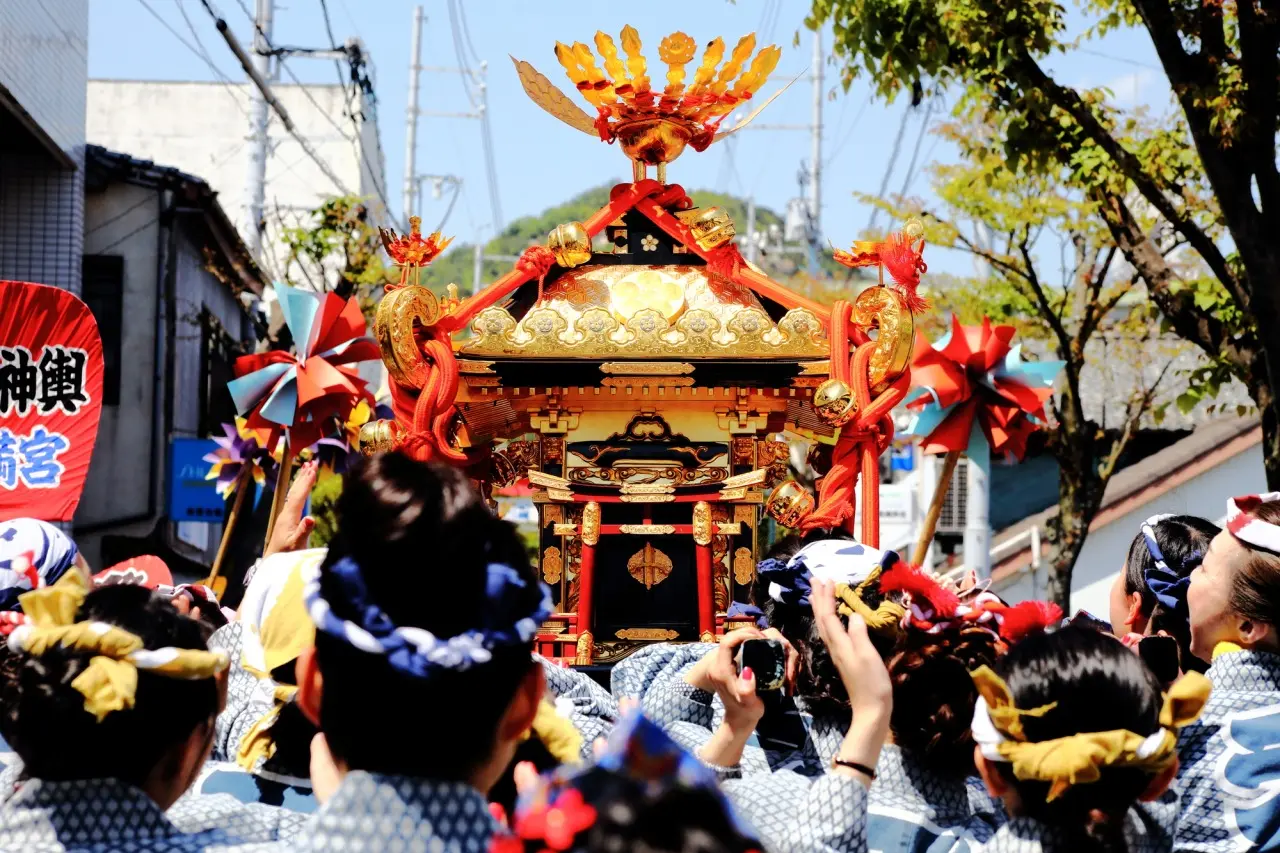
On Sunday, over 200 women carry two mikoshi in the Tenjin Onna Mikoshi (天神おんな神輿) parade. It leaves Lulusas Hofu (ルルサス防府) at 12:30 pm and winds through the shopping streets.
The parade reaches the shrine's romon gate around 3:20 pm and is scheduled to end with a rice-cake toss around 3:30 pm.
From the palanquin's return on Saturday night until 8 pm on Sunday, it rests in the shrine corridor, and visitors can pass beneath it to pray, a custom called Oajiro-kuguri (御網代くぐり). Miss the night procession and you can still see the palanquin up close the next day.
A special paper goshuin (shrine stamp, ¥700) is available from 8 am to around 9 pm on Saturday and 8 am to 8 pm on Sunday.
Getting there and getting back
Hofu Station is on the JR Sanyo Line between Shin-Yamaguchi and Tokuyama, both Shinkansen stops, and the shrine is 15–20 minutes' walk from the station. By car, it's about 10 minutes from the Hofu-higashi or Hofu-nishi interchanges of the Sanyo Expressway.
The shrine normally has public parking, but there's no official word on whether it can be used on November 28 or 29, or whether extra parking will be set up. With traffic restrictions on both days, the train is the safer bet.
If you leave as soon as the palanquin is back, expect to reach Hofu Station around 9:15 pm at the earliest, later if the return runs toward 10 pm.
Trains run after 9 pm in both directions, east toward Tokuyama (for Hiroshima) and west toward Shin-Yamaguchi (for Fukuoka), but only once or twice an hour. If you're heading back to either city, check your connection to the last Shinkansen on JR West's weekend timetable.
If you're coming from farther away, booking a room in Hofu lets you stay for the return without watching the clock.
This article was translated from the original Japanese with AI assistance and reviewed by our editorial team. The Japanese version is authoritative.