
If you’ve ever shopped in Japan as a tourist, you know the drill: flash your passport, skip the 10% consumption tax, walk out happy. It’s one of those small wins that makes a Japan trip feel even better. But starting November 1, 2026, that process is getting a major overhaul.
Don’t worry—tax-free shopping isn’t going away. You’ll still save that 10%. The difference is how and when you get the discount. Instead of paying less at the register, you’ll pay full price upfront and get the tax refunded after you leave the country. It’s a shift from instant savings to a refund-based system—and if you’ve ever shopped duty-free in Europe, it’ll feel familiar.
Here’s everything you need to know to keep your shopping game strong.
How It Works Right Now (Through October 31, 2026)
Japan’s current tax-free system is about as traveler-friendly as it gets. Walk into any store with the “Japan. Tax-free Shop” logo, show your passport, and the 10% consumption tax is removed right there at checkout. A ¥10,000 item rings up at ¥9,091. Easy.
The minimum spend is ¥5,000 (before tax) per store, per day. Items fall into two buckets: general goods (electronics, clothing, bags, watches) and consumables (food, cosmetics, medicine). Consumables are capped at ¥500,000 and have to be sealed in special packaging—those clear bags with the “do not open in Japan” stickers you’ve probably seen.
To qualify, you need to be a non-resident visitor with Temporary Visitor status, within six months of your arrival date. Student and work visas don’t count.
The New “Refund Method” : Starting November 1
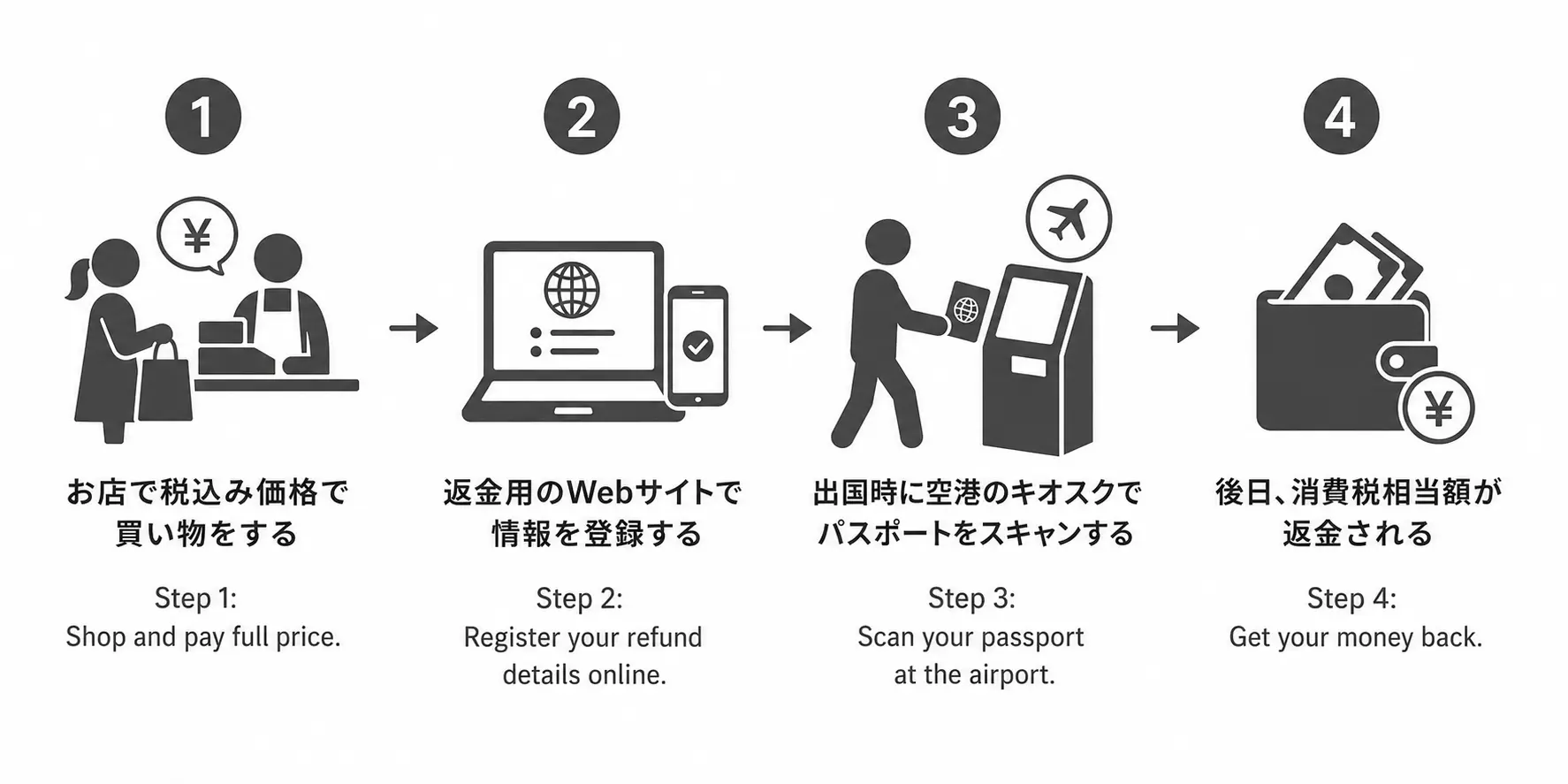
Here’s the big change: instead of getting the tax removed at the point of sale, you’ll pay the full tax-inclusive price and claim the refund when you leave Japan. The Japanese government calls it the “refund method”, and it brings Japan in line with the system used across most of Europe.
Step 1: Shop and pay full price. At the store, you’ll pay the regular tax-included amount just like any local customer. Show your passport so the store can log the purchase in the National Tax Agency’s system. No complicated paperwork on your end—the store handles the data entry.
Step 2: Check how your refund will be handled. Your refund isn’t issued by the government—it’s handled by each tax-free shop, or a refund service provider the shop works with. The refund method and how long it takes vary from shop to shop. Some shops may ask you to register or complete a step to receive it, so check the shop’s instructions when you buy.
Step 3: Scan your passport at the airport. Before you leave Japan, present your passport at a tax-free processing terminal (a self-service kiosk) near customs. The system checks that your purchases match the records and confirms you’re taking the goods out of the country. That’s it—your refund is locked in. At some airports, you may also be able to complete this step online through Visit Japan Web.
Step 4: Get your money back. After customs confirmation, the consumption tax is refunded to you. The refund method and how long it takes depend on the tax-free shop or the refund service provider it works with, so check with the shop where you bought your items for the specifics.
What’s Actually Better About the New System
Paying upfront might sound like a downgrade, but the new system actually fixes some genuinely annoying parts of the old one.
No more spending caps on consumables. The current ¥500,000 limit on consumable goods is being eliminated. If you want to stock up on high-end Japanese cosmetics or premium sake, there’s no ceiling anymore.
Simpler categories. The confusing distinction between “general goods” and “consumables” is being scrapped entirely. Everything falls under one set of rules, and the minimum spend threshold is now calculated as a combined total across all item types. Less confusion at the register, fewer awkward conversations with store staff.
A Few Things to Watch Out For
Budget for the upfront tax. Since you’re paying the full 10% at checkout, your in-store spending will be higher than before. If you’re paying in cash, factor in the extra amount so you don’t come up short on a big purchase.
The 90-day clock. You must leave Japan and clear customs within 90 days of your purchase to qualify for the refund. To be precise, the deadline is 90 days counted from the day after the purchase date (e.g., a purchase made on November 1 has a deadline of January 30). For most tourists on a one- or two-week trip, this is a non-issue. But if you’re on a longer stay, time your shopping accordingly.
Sort out how you’ll get your refund. How you receive the refund—and any steps you need to take for it—varies by shop. Ask at the shop where you bought your items so you’re not caught off guard when you leave.
Customs checks are per receipt—one missing item voids the whole refund. This is a big one. Customs verification is done on a per-receipt basis. If even one item on a receipt is missing—because you used it, consumed it, or lost it—you lose the refund on every item on that receipt, not just the missing one. For example, if you bought three items on a single receipt and ate one of the snacks during your trip, you can’t get a refund on the remaining two either. The sealed packaging for consumables is gone under the new system, but the rule that you can’t consume tax-free items in Japan still applies—and the penalty is now harsher since the entire receipt becomes ineligible. The safe move: keep items you plan to take home and items you want to use during your trip on separate receipts.
Separate shipping no longer qualifies. Under the old system, you could ship purchases overseas from the airport and still qualify for the tax exemption. This option was abolished in April 2025. Under the new system, only goods you personally carry out of Japan—in your hand luggage or checked baggage—are eligible for the refund.
Visiting Before November? You’re in Luck
If your Japan trip falls before November 1, 2026, you’ll still benefit from the current system: instant tax exemption at checkout, no refund apps, no waiting for your money. It’s straightforward and hassle-free.
That said, the new system has its own advantages. The spending cap on consumables is gone and the confusing category split is eliminated, which is good news if you’re planning to stock up on high-end cosmetics or sake. Either way, you’ll save the same 10%—it’s just a matter of when you see it.
Note: There is no transition period. The old and new systems will not run side by side. The switchover happens at midnight on November 1, 2026—any purchase made from that point on falls under the new refund method.
Pro Tips for Tax-Free Shopping in Japan
Consolidate your shopping. The ¥5,000 minimum applies per store, per day. Spreading small purchases across five different shops means none of them qualify. Hit up a big retailer like Don Quijote (Donki), Matsumoto Kiyoshi, or BIC Camera where you can grab everything in one trip.
Always carry your passport. A photo of your passport page won’t cut it. You need the physical document every time. Make it part of your daily carry.
Check the refund details early (for November onward). After your first tax-free purchase, ask the shop how the refund works and what, if anything, you need to do to receive it. Sorting it out early saves you a headache at the airport.
Japan’s tax-free system is evolving, but the bottom line stays the same: tourists save 10% on eligible purchases, and Japan remains one of the best places in the world to shop. Know the rules, plan a little, and you’ll walk away with great deals—and maybe a suitcase that’s a few kilos heavier than when you arrived.
※The information in this article is based on publicly available sources as of May 2026. Details of the new system are subject to change. Please check the official National Tax Agency and Japan Tourism Agency websites for the latest information.
▶ National Tax Agency — Refund Method Overview
▶ Japan Tourism Agency — Tax-Free Refund System for Travelers
▶ JNTO — Japan’s Tax Exemption
This article was translated from the original Japanese with AI assistance and reviewed by our editorial team. The Japanese version is authoritative.