
Search for Takachiho's "night kagura" (yokagura, 夜神楽) and two very different things come up. One is the nightly Takachiho Kagura, a one-hour performance staged for visitors all year. The other is the original yokagura, the all-night sacred rite that each hamlet offers through the winter.
This guide sorts out how the two differ, what each costs, whether you need to reserve, and how to check the winter dates. It also covers how cold it gets and how to reach Takachiho.
If you're pairing it with the gorge by day, see also How to reserve a rowboat at Takachiho Gorge.
The two share almost the same name, but they are not the same event. Which one you want decides whether you reserve a seat and how you track down the dates, so settle that first.
Two kinds of night kagura
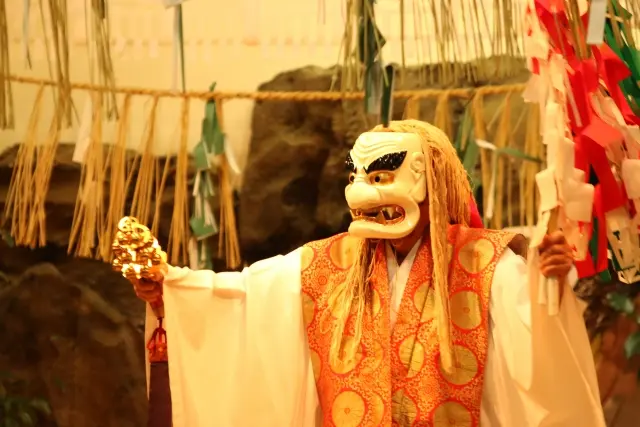
Here is how the two break down.
Item | Nightly Takachiho Kagura (for visitors) | Winter village yokagura (the original rite) |
|---|---|---|
When | Every night, year-round | Mid-November to early February |
Where | Kagura hall at Takachiho Shrine | Around twenty hamlets across the town |
Dances | 4 representative dances of 33 | All 33 dances |
Length | 8–9 p. | Afternoon through to the next morning (varies by hamlet) |
Cost | ¥1,000 per person | An offering ("goshinzen") at the door |
Nature | A performance for travelers | A sacred rite the community keeps (nationally designated) |
The nightly kagura at Takachiho Shrine (8 p.m.)
The easy one to build into a trip is the nightly kagura at Takachiho Shrine (高千穂神社). It is held in the shrine's tatami-floored kagura hall, where performers present four of the thirty-three dances:
- Tajikarao (手力雄): the dance of the strong-armed god
- Uzume (鈿女): the dance of the goddess who lures Amaterasu out
- Totori (戸取): the dance of pulling open the cave door
- Goshintai (御神体): the dance of the enshrined deities
Here are the basics.
Item | Details |
|---|---|
Time | Every night, 8–9 p. |
Admission | ¥1,000 per person; free through elementary school; ¥900 each for groups of 20 or more |
Closed | December 31 and January 1, plus November 22 and 23 every year |
Parking | About 100 spaces, free |
Photos | Still and video are fine (no flash) |
November 22 and 23 are dark because the "Takachiho Yokagura Festival" is held on those two days. You may bring a chair or cushion, but leave food and alcohol behind (drinking water is fine).
Reserving vs. a same-day ticket
The nightly kagura runs on two tracks: online reservation and a same-day ticket. Seating is first-come on both, and once the hall is full you may not get in.
- Online reservation: 230 seats. Booking opens around 10 a.m. thirty days before the performance and closes at 5 p.m. on the day. Payment is by credit card only. Doors open at 7 p.m., and these seats are at the front.
- Same-day ticket: 50–60 seats. Sold at the window of the Takachiho Shrine kagura hall. Doors open at 7:30 p.m., and these seats are at the back.
With only 50–60 same-day seats, book online from thirty days out if you have a fixed date or are visiting on a weekend. Online bookings carry a cancellation fee: 10% up to two days before, 50% the day before, and 100% on the day.
For a weekend or holiday, book online as soon as reservations open, around 10 a.m. thirty days before the performance.
You can check availability and details on the official page.
Official site: Takachiho Kagura reservations and information (Takachiho Tourist Association)
The winter village yokagura (the original rite)
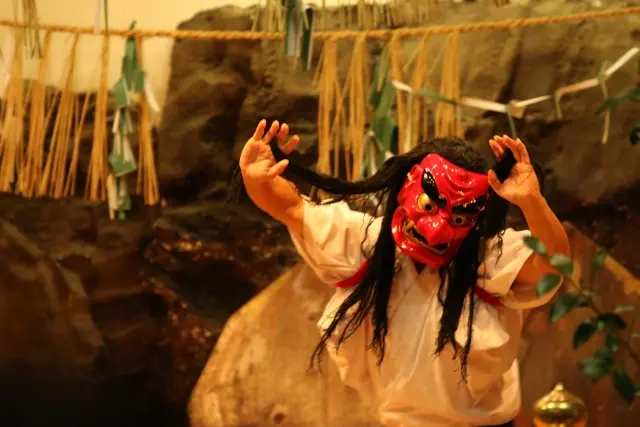
The other kagura is the sacred rite itself, carried on by the hamlets. From mid-November to early February, it is offered in around twenty communities across the town.
It starts around 2 p.m. and runs through all thirty-three dances until morning; the start time, the program, and the dates vary from one hamlet to the next.
This is a world apart from the visitor performance, in both setting and meaning. It is the community's own act of prayer, and visitors attend as guests rather than as an audience. In 1978 it was designated an Important Intangible Folk Cultural Property of Japan.
Visitors are welcome, but the rite calls for the care you would bring to any act of worship.
How to check the 2026–27 schedule
The winter yokagura dates are set hamlet by hamlet and listed together on the Takachiho Tourist Association's "yokagura schedule" page. Only the hamlets that choose to publish appear there, and those still undecided are added as their dates firm up.
As of October 26, 2026, the 2026–27 schedule (November 2026 to February 2027) has not yet been posted. What you see on the schedule page is last season's listing.
Nothing has been canceled; it simply has not been announced yet. Wait for it to appear, and always confirm the latest dates before you go.
For questions, contact the Takachiho Town Planning and Tourism Division (0982-73-1212). Note that this is a different number from the nightly kagura line (0982-73-1213); only the last digit differs, so take care not to misdial.
Official site: Yokagura schedule (Takachiho Tourist Association)
Etiquette, the offering, and keeping warm
The village yokagura is a local rite. Leaving an offering ("goshinzen") at the door is the customary way to take part. No set amount is published, so follow the guidance you find on site.
The rules on photos, leaving partway through, and getting around at night aren't spelled out publicly. Because the rules vary by hamlet, ask each community or the tourist association ahead of time if any of it matters to you.
Warm clothing is essential at either kagura. Takachiho sits in the hills at about 350 meters. On winter nights and early mornings from November to early February, the average low runs from below freezing to the mid single digits in Celsius.
If you're visiting in November, our guide to what to wear in Japan in autumn helps with layering; for the deep-winter nights from December into February, pack warmer still.
The tourist association also suggests bringing warm layers, a drink, and a snack to the village yokagura. Wrap up well for the all-night rite, of course, but also for the 8 p.m. hall.
Getting to Takachiho
No railway reaches Takachiho, so the bus is the main way in. The limited-express "Takachiho-go" (Kyushu Sanko Bus and Miyazaki Kotsu) links Kumamoto and Nobeoka with two round trips a day (four runs in all).
Takachiho is partway along that Kumamoto–Nobeoka route, and the full end-to-end run takes about four hours and twenty minutes.
Seats are assigned. Some sections require a reservation while others do not, so book ahead through the operators for the section you plan to ride.
You pay by contactless credit card (Visa, Mastercard, JCB, and others) or cash; nationwide transit IC cards such as Suica and ICOCA cannot be used. Have cash or a credit card ready before you board.
Takachiho-go fares will be revised on November 1, 2026, so check each operator's official page for the current fare before you travel.
From the Takachiho Bus Center it is about a 15-minute walk to Takachiho Shrine. Note that the "Asochiho-go," which links JR Aso Station with Takachiho, is a separate route.
Official site: Limited-express Takachiho-go (Kyushu Sanko Bus)
For the nightly kagura, book from thirty days out; for the winter village rite, wait for the schedule to be posted and confirm the date before you go.
This article was translated from the original Japanese with AI assistance and reviewed by our editorial team. The Japanese version is authoritative.