

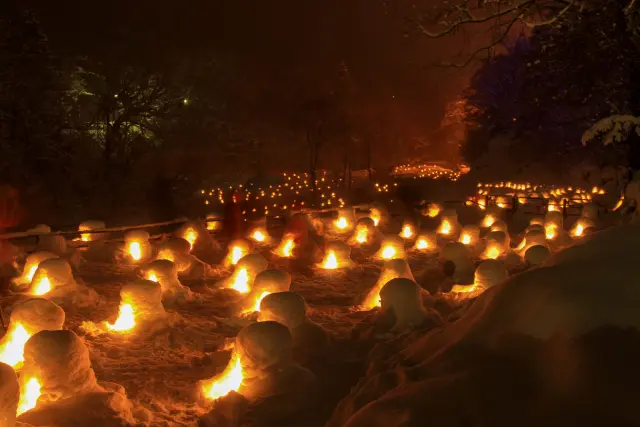
The Yunishigawa Onsen Kamakura Festival (湯西川温泉かまくら祭) in Nikko, Tochigi, runs January 29 to February 28, 2027. The draw is a riverbank of several hundred mini kamakura, small snow huts that glow like snow lanterns after dark, but only Friday to Sunday, 5:30 to 9 p.m.
In 2026, the last bus out was a Friday-to-Sunday festival extra leaving Yunishigawa Onsen village at 7:20 p.m., long before the huts go dark at 9.
In 2026, close-up photos near the huts started at 7 p.m., so leaving on the last extra bus (7:20 p.m.) gave you only about 15 minutes. To stay until the lights go off at 9 p.m., you need a car or a room in Yunishigawa Onsen.
2027 Dates, Hours and Admission
The 2027 dates and Friday-to-Sunday lighting hours are posted on the Nikko City Tourism Association (日光市観光協会) festival page (in Japanese, checked November 18, 2026).
Dates | January 29 (Fri) – February 28 (Sun), 2027 |
|---|---|
Riverbank snow huts (沢口河川敷) | Lit Fridays, Saturdays and Sundays during the festival, 5:30–9:00 p. |
Heike no Sato snow huts | Lit 5:30–9:00 p. |
Admission | Riverbank: free. |
Main venues | The riverbank site; Heike no Sato (1042 Yunishigawa, Nikko, Tochigi) |
Organizer | Yunishigawa Onsen Kamakura Festival Executive Committee |
Inquiries | Nikko City Tourism Association (0288-22-1525) |
Riverbank Lighting: 15 Fri–Sun Nights
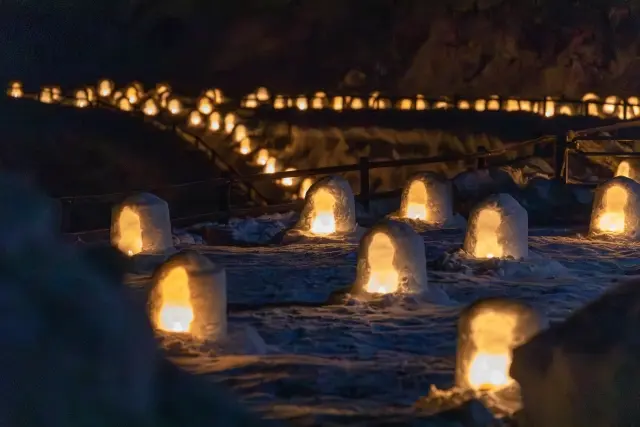
Between January 29 and February 28, 2027, there are 15 Fridays, Saturdays and Sundays, and those are the only nights the riverbank huts are lit.
- January 29 (Fri), 30 (Sat), 31 (Sun)
- February 5 (Fri), 6 (Sat), 7 (Sun)
- February 12 (Fri), 13 (Sat), 14 (Sun)
- February 19 (Fri), 20 (Sat), 21 (Sun)
- February 26 (Fri), 27 (Sat), 28 (Sun)
Two public holidays fall in the festival: February 11 (Thursday, National Foundation Day) and February 23 (Tuesday, Emperor's Birthday). The listing says "Fridays, Saturdays and Sundays only" and is silent on holidays, so ask the association before planning around either date.
The huts are made of snow, so the program can change with the snowfall. In 2026, the final weekend (February 27 to March 1) was scaled back, with some program changes, because of snow conditions. If your dates are flexible, I'd go on a weekend by mid-February.
The 2026 flyer also warned that weather could change the dates or program, or cancel the event. The 2027 listing doesn't say anything about weather yet (as of November 18, 2026).
The Two Venues: Riverbank and Heike no Sato
The riverbank site (沢口河川敷) is about a 5-minute walk from the bus terminus in the village. Locals hand-build the several hundred mini kamakura here every week.
The festival's flyer and feature page bill it as a Japan Night View Heritage site and one of the "Three Great Night Lights of Kanto," a designation it received in 2023.
In 2026, visitors could get close to the huts for photos from 7 p.m. Whether 2027 works the same way hasn't been announced, so follow the signs and staff on the night.
Heike no Sato (平家の里), where old thatched-roof farmhouses line the grounds, is right next to the bus terminus. Mini kamakura and larger snow huts are built on the grounds, and in 2026 you couldn't go inside the large ones.
Admission is ¥700 for adults and ¥300 for elementary and junior high school students. There's only a one-day ticket, with no evening-only option, and same-day re-entry is allowed.
Heike no Sato's huts are lit 5:30–9 p.m. from January 29, 2027. In 2026 it was open daily, 9 a.m. to 9 p.m. (last entry 8:45 p.m.), so you could see mini kamakura there even on nights the riverbank was dark.
The 2027 listing doesn't say which days Heike no Sato will be lit, so if you're going Monday to Thursday, call Heike no Sato (0288-98-0126) first.
The 2026 extra buses (5:55 p.m. in, 7:20 p.m. out) ran Friday to Sunday only. Before a weekday trip by bus, check the evening departures on Nikko Kotsu's timetable.
Friday–Sunday Bus and Train Times (2026)
Two names to keep straight: Yunishigawa-Onsen Station (湯西川温泉駅) is the train station, and the bus terminus in the village, about 25 minutes away by Nikko Kotsu (日光交通) bus, is just "Yunishigawa Onsen." Below, they're "the station" and "the village bus stop."
From Asakusa in Tokyo, the Revaty Aizu (リバティ会津) limited express runs straight to the station over Tobu and Yagan Railway (野岩鉄道) lines. Every seat is reserved, so you need a limited express ticket. Also buy your fare to Yunishigawa-Onsen at Asakusa, as Tobu asks.
The adult bus fare to the village is ¥1,050 (since June 2026). The 2027 festival bus schedule isn't out yet, so the table uses 2026 bus times and the March 2026 train timetable.
Time | What happens |
|---|---|
1:30 p. | Revaty Aizu from Asakusa (dep. |
3:45 p. | Bus leaves the station, reaching the village bus stop at 4:10 p. |
5:04 p. | Revaty Aizu from Asakusa (dep. |
5:15 p. | Bus leaves the station, reaching the village bus stop at 5:40 p. |
5:30 p. | Riverbank snow huts are lit (Friday to Sunday) |
5:50 p. | Bus leaves the village bus stop, reaching the station at 6:15 p. |
5:55 p. | Festival extra bus leaves the station, reaching the village bus stop at 6:20 p. |
6:27 p. | Revaty Aizu leaves the station: last direct limited express to Asakusa (arr. |
7:00 p. | Close-up photos near the huts allowed (2026 rule) |
7:20 p. | Festival extra bus leaves the village bus stop: last bus of the night (station 7:45 p. |
8:05 p. | Last train toward Tokyo from the station (to Shin-Fujiwara) |
9:00 p. | Riverbank lights go off |
One bus-and-express day trip that works: the 11:00 a.m. train from Asakusa (in at 1:30, so a two-hour wait) and 3:45 p.m. bus in (village 4:10), then the 5:50 p.m. bus and 6:27 p.m. express back (Asakusa 9:05).
That gives you about 15 minutes of lights after 5:30.
On the 2:30 p.m. train, the 5:15 bus arrives at 5:40, too late for the 5:50 plan. Staying for the 7:20 p.m. bus gives you about an hour and a half.
Ride the festival extra from Kinugawa-Onsen Station (5:25 p.m.) and you get about 50 minutes on site after the 10-minute round-trip walk, only about 15 of them after 7 p.m.
The station's ticket window (roughly 8:30 a.m.–5:30 p.m.) is closed by the 6:27, so buy your return express ticket in advance; see Tobu's limited express ticket page (in Japanese).
The 7:20 p.m. bus misses the last express from Kinugawa-Onsen (7:28 p.m.), so get off at the station (7:45) for the 8:05 p.m. train to Shin-Fujiwara (新藤原) and local trains after that.
There's no express connection, so check the route to Tokyo on Tobu's timetable search beforehand.
If 2027 keeps the 2026 times, miss the 7:20 and there's no later bus to the station. The association warns that buses can get crowded, so get to the stop with time to spare.
Yagan Railway doesn't take IC cards such as Suica or PASMO. After the window closes, buy your ticket from the conductor on board.
Driving to Yunishigawa in Winter
By car, it's about 60 minutes from Imaichi IC on the Nikko-Utsunomiya Road (日光宇都宮道路) to the riverbank and Heike no Sato. The tourism association says winter tires are a must.
Parking is limited and gets crowded, especially Friday to Sunday, so the association recommends coming by train and bus.
Temporary parking for 2027 hasn't been announced. In 2025, a January 17 notice on the association's website listed temporary lots and some road closures while the riverbank huts were lit.
If you're not used to snowy roads, the bus or an inn that offers pickup is the safer choice.
Day Trip or Overnight Stay
- Bus day trip: the only express home is the 6:27 p.m. (via the 5:50 p.m. bus), say after the 11:00 a.m. train and 3:45 p.m. bus in (2026 times). About 15 minutes of lights. The 7:20 p.m. last bus means local trains.
- Driving day trip: you can stay until the lights go off at 9 p.m., then face about 60 minutes of snowy night roads back to Imaichi IC.
- Overnight: you get the huts until 9 p.m. without watching the bus clock.
In the association's two-day model itinerary, you finish dinner at your inn, then head out to see the mini kamakura. It notes that some inns offer pickup but doesn't say which, so ask when you book.
You could also stay in Kinugawa Onsen, but on the 2026 timetable the last bus back is the 7:20 p.m. extra (Kinugawa-Onsen Station 8:15), so you'll miss the 9 p.m. finish. For comparing areas, see Where to Stay in Nikko, which covers last-bus times for each area.
I'd stay in Yunishigawa Onsen. It lets you stay until the lights go off at 9 without driving.
This article was translated from the original Japanese with AI assistance and reviewed by our editorial team. The Japanese version is authoritative.