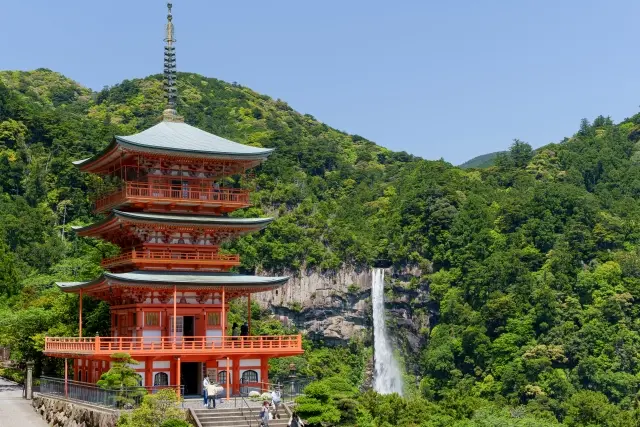

At Kumano Nachi Taisha (熊野那智大社) in Wakayama Prefecture, you can walk straight through a sacred tree. The great camphor tree, known as the Okusu (大樟), is estimated to be about 850 years old. Its hollow trunk is wide enough for a person to walk through.
Nachi Taisha is one of the three grand shrines of the Kumano Sanzan, alongside Kumano Hongu Taisha and Kumano Hayatama Taisha. Its buildings and grounds became part of the "Sacred Sites and Pilgrimage Routes in the Kii Mountain Range" World Heritage Site in 2004.
The ritual is called tainai-kuguri (胎内くぐり), literally "passing through the womb." You write a wish and your name on a goma prayer stick (¥300) or an ema plaque (¥500), then hold it as you walk through the trunk.
The shrine doesn't publish a separate closing time for tainai-kuguri. Its office is open roughly 8:00 to 16:30, so in practice, aim to reach the tree well before 16:30.
Walking up from Daimonzaka? Leave Kii-Katsuura Station on the 11:50 bus or earlier for a relaxed day; the 13:05 is the last one I'd count on. The last bus back from Nachi-no-taki-mae leaves at 18:06, all year.
Tainai-kuguri: fees and steps
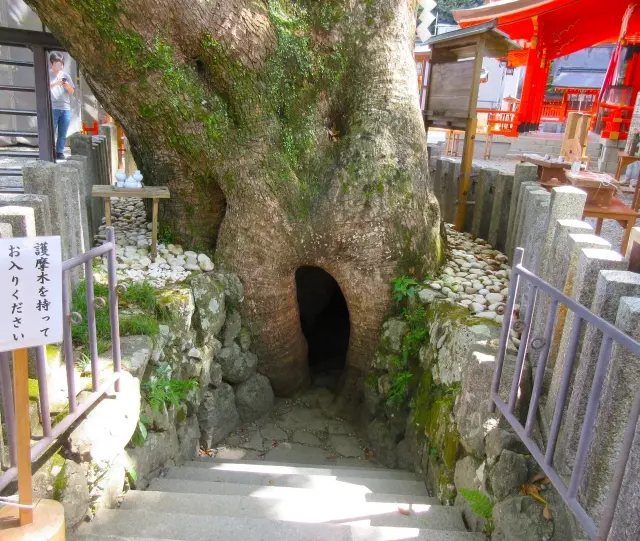
The Okusu stands on the right in front of the worship hall (礼殿). The shrine lists it at 27 meters tall with a trunk about 8.5 meters around. Tradition says Taira no Shigemori, a samurai commander of the late Heian period, planted it, and it's enshrined as Shoreisha (樟霊社).
The shrine's grounds guide describes three steps:
- Get a goma stick (¥300) or an ema plaque (¥500).
- Write your wish and your name on it.
- Hold it in your hand as you walk through the hollow trunk.
Best route: shrine first, falls last
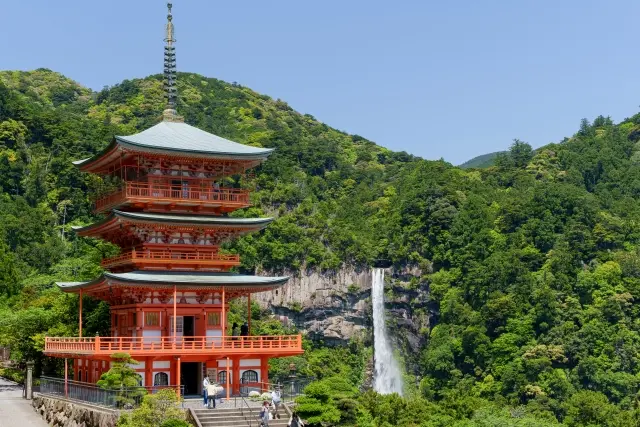
The easiest order is uphill first. Climb to the shrine for the tree, step next door to Seiganto-ji Temple (青岸渡寺) and its three-story pagoda, then walk down to Nachi Falls and catch the bus home from the Nachi-no-taki-mae (那智の滝前) stop.
Leaving the falls for last means you never climb the same stairs twice.
Seiganto-ji is the first of the 33 temples on the Saigoku Kannon pilgrimage. The shrine's guide puts it about a minute's walk from the main shrine, and the pagoda about three.
To the left of the worship hall is Miagatahiko-sha (御縣彦社), a shrine to Yatagarasu, the three-legged crow, where a bronze statue of the bird also stands.
Nachi Falls (那智の滝) is itself the object of worship at Hiro Shrine (飛瀧神社), a branch shrine of Nachi Taisha. It drops 133 meters and is a nationally designated Place of Scenic Beauty.
For a closer view, adults can enter the Otaki Haisho Butai (御瀧拝所舞台), a viewing platform near the falls, for ¥500. It's about a three-minute walk from the entrance, and there you can drink enmeisui (延命水), the falls' "long-life water."
The walking times below come from the Wakayama Prefecture Tourism Federation's model course. From Seiganto-ji to the falls takes about 15 minutes, and from the falls to the Nachi-no-taki-mae bus stop about five.
Daimonzaka or Nachisan: where to get off the bus
The number of stone steps you climb depends on where you get off the bus.
- Daimonzaka (大門坂): 267 stone steps up a cedar-lined stretch of the Kumano Kodo, then a street of shops, then the main approach of about 470 more steps to the shrine. The Daimonzaka slope itself is about 500 meters long and climbs about 100 meters. Allow about 35 minutes from the bus stop.
- Nachisan (那智山), the last stop: Only the main approach, about 470 steps, roughly 10 minutes from the shopping street to the shrine. Pick this if you want fewer stairs.
The full route from the Daimonzaka bus stop through the shrine, temple and falls to Nachi-no-taki-mae is about 2.7 kilometers, or roughly an hour on foot. With sightseeing, the federation suggests allowing three to four hours.
Visitors with disabilities and families with small children can drive up instead. A toll road (¥800) leads to the shrine's 30-space lot below its office. From there, ask shrine staff about using the elevator up to the grounds.
Fees and hours at a glance
I checked these on the official sites of Kumano Nachi Taisha and Seiganto-ji on November 11, 2026.
Place | Fee | Hours |
|---|---|---|
Tainai-kuguri (camphor tree) | Goma stick ¥300 / ema ¥500 | Shrine office about 8:00–16:30 |
Otaki Haisho Butai (falls platform) | Adults ¥500 / elementary and junior high ¥200 / preschoolers free | Hiro Shrine office about 8:00–16:30 |
Treasure hall | Adults ¥300 / children ¥200 / preschoolers free | 8:30–15:30 (closed Wednesdays and some other days) |
Seiganto-ji grounds | Free | 7:00–16:30 |
Seiganto-ji pagoda | Adults ¥500 / elementary and junior high ¥300 / younger children free | 9:00–16:00 (last entry 15:40) |
For one adult, the tree (with a goma stick), the falls platform and the pagoda add up to ¥1,300 (¥300 + ¥500 + ¥500).
Seiganto-ji says its gate hours can change over the New Year holidays and on the first of each month, and the pagoda's hours can change with the weather.
Nachisan bus from Kii-Katsuura: timetable and fares
Kumano Gobo Nankai Bus (熊野御坊南海バス) runs the Nachisan line from JR Kii-Katsuura Station (紀伊勝浦駅). On the timetable revised April 1, 2026, it's 18 minutes to Daimonzaka and 26 minutes to the Nachisan terminus.
The line runs all year. The trips in parentheses below, 12:40 from Kii-Katsuura and 13:27 from Nachisan, run only from March 1 to November 30.
- From Kii-Katsuura Station: 6:45, 7:35, 8:25, 9:05, 9:50, 10:25, 11:05, 11:50, 12:20, (12:40), 13:05, 13:50, 14:25, 15:05, 15:50, 16:35, 17:35
- From Nachisan: 7:16, 8:10, 9:07, 9:47, 10:32, 11:07, 11:42, 12:32, 13:02, (13:27), 13:57, 14:32, 15:07, 15:42, 16:27, 17:12, 18:04
Buses from Nachisan pass Nachi-no-taki-mae about two minutes later. From December through February the two trips in parentheses drop out, leaving 16 round trips a day (17 the rest of the year). The last bus leaves Nachisan at 18:04 and Nachi-no-taki-mae at 18:06, reaching Kii-Katsuura at 18:30.
Adult one-way fares are ¥630 from Kii-Katsuura to Nachisan and ¥480 to Daimonzaka. The company has applied to raise the Kii-Katsuura–Nachisan fare to ¥700 from February 25, 2027, pending government approval. Commuter passes, multi-ride tickets and its other special tickets would also be repriced at the same time.
Suica, ICOCA and other IC transit cards don't work on this bus. You can pay in cash, or tap a Visa, Mastercard, JCB or other contactless credit card when you board and again when you get off.
If you're relying on cash, see Using ATMs in Japan with a foreign card.
The ticket office in front of Kii-Katsuura Station sells the Nachi Area World Heritage Free Pass (那智エリア世界遺産フリー乗車券). It costs ¥1,260 for adults and is valid on the day of purchase.
It covers boarding at Kii-Katsuura Station, with unlimited rides between Nachi Station and Nachisan. At current fares, the pass costs the same as two one-way tickets to Nachisan, so it's worth it mainly if you plan to hop on and off along the way.
The office is open 8:00–10:30 and 11:30–17:00. A digital version is sold in Norikae Annai (乗換案内), a Japanese transit app.
Which bus to catch: working back from closing time
Plan around two deadlines: last entry to the pagoda at 15:40, and the shrine office at the falls, your last stop, closing around 16:30.
Take the 13:05 from Kii-Katsuura and you reach Daimonzaka at 13:23 and the shrine around 14:00 on foot. After tainai-kuguri and the pagoda, walk down to the falls in time for the 16:29 bus from Nachi-no-taki-mae.
That gives you about three hours on the mountain, the low end of the federation's three-to-four-hour estimate. Leave on the 11:50 instead (Daimonzaka at 12:08) and you have four full hours before 16:30.
The 11:50 and 13:05 departures from Kii-Katsuura run in winter too. Only the seasonal 12:40 from Kii-Katsuura and 13:27 from Nachisan drop out.
The 13:05 plan leaves almost no slack, and the next bus after the 16:29 is the 17:14, so on a short winter day I'd take the 11:50 or earlier.
Hotels around Kumano Nachi Taisha for an early start: availability and rates
Before you go
The shrine asks visitors not to visit after dark. Hiro Shrine at the falls isn't wheelchair accessible.
Buses can run late in traffic and may be canceled if a natural disaster makes service unsafe. The bus company also warns that Kumano-area buses sometimes fill up and leave passengers behind. If you miss the 16:29 from Nachi-no-taki-mae, the next one is at 17:14.
Official site: Kumano Nachi Taisha
Bus timetable: Kumano Gobo Nankai Bus
This article was translated from the original Japanese with AI assistance and reviewed by our editorial team. The Japanese version is authoritative.