
Every December, Kyoto marks the year-end season with Kaomise (顔見世), the grand kabuki run at the Minamiza (南座) theater beside the Kamo River. In 2026 it runs from December 1 to December 24.
The full title is "Kyo no Nenju Gyoji: Ataru Hitsujidoshi Kichirei Kaomise Kogyo," and the banners carry the zodiac sign of the coming year, 2027, the Sheep (未).
This year's centerpiece is a shūmei (襲名), the formal ceremony in which an actor inherits a prestigious stage name. Here, Onoe Sakon takes the name Onoe Tatsunosuke III (三代目尾上辰之助).
If kabuki is new to you, our guide to booking tickets at the Kabukiza in Tokyo explains how seats and programs work.
General tickets go on sale on Monday, November 9, 2026 at 10:00. The Minamiza has no single-act gallery seats, so you book a reserved seat for either the matinee or the evening program.
This year's highlight and the plays
On performance days there are two separate programs with different plays: a matinee and an evening show.
The draw this year is the shūmei of Onoe Tatsunosuke III, and both programs carry a naming-ceremony piece, so you will see it whichever one you choose. In the matinee it is "Otowagadake Danmari"; in the evening, "Shinpan Utazaimon: Nozaki-mura."
The matinee also stages "Ehon Taikoki" and "Kochiyama," and the evening includes "Kobikicho no Adauchi." Casting for "Kochiyama" alternates on certain days, so if you're hoping to catch a particular actor, check the official cast schedule before you book.
How to buy tickets, including in English
The general sale opens on November 9, 2026 at 10:00, online and by phone. Every seat is reserved, and some days sell only one program, so it pays to book on the first day once you know the date you want.
Online, the main outlet is Ticket Web Shochiku; you can also use Ticket Pia, e+ (eplus), and Lawson Ticket. These checkout flows are in Japanese, so if you need English, see the option below.
For visitors, Shochiku runs a Multilingual Online Ticket service (through Etix) in English and Simplified Chinese. As of early October, the December Kaomise was not yet listed there, so check again around the on-sale date to see whether English booking has opened.
Some performances also offer an English captioning device or an English earphone guide. Whether the 2026 Kaomise is covered has not been announced, so treat it as a maybe for now.
Prices and seats
All seats are reserved, in six tiers. The Minamiza doesn't sell single-act seats, the cheap "watch one scene" tickets you may know from the Kabukiza in Tokyo.
Seat tier | Price (tax incl. |
|---|---|
4th class | ¥6,000 |
3rd class | ¥8,000 |
2nd class B | ¥10,000 |
2nd class A | ¥13,000 |
1st class | ¥26,000 |
Special seat | ¥28,000 |
You can check the layout on Minamiza's official seating chart before you book. The view changes a lot by tier: how close you are to the hanamichi (the raised walkway actors use through the audience), and whether you sit on the first or second floor.
Matinee or evening?
The matinee starts at 10:30 and the evening program at 16:00. Both include a naming-ceremony piece, so if that is your main reason to go, either one works.
Choose based on your day. A matinee leaves your evening free to explore Kyoto. The evening program lets you spend the day elsewhere, but it ends late, so check your onward travel or your hotel plans first.
Days you can't go: dark days and buyouts
On a few days, one or both programs are not sold to the public, either because the theater is dark or because the day is bought out by a group. Every other day runs both programs as normal.
Date | Matinee | Evening |
|---|---|---|
Dec 9 | ✗ | ✗ |
Dec 12 | ✗ | ✓ |
Dec 17 | ✗ | ✗ |
Dec 18 | ✓ | ✗ |
Dec 19 | ✗ | ✓ |
Dec 20 | ✗ | ✓ |
December 9 and 17 are dark days with nothing on. The rest are group buyouts.
Among the weekends, it's the later matinees that go: December 12, 19, and 20 are closed in the afternoon. The earlier weekends are fine, so for a weekend matinee, aim for December 5, 6, or 13; otherwise shift to a weekday or the evening program.
Getting there and the maneki boards
The Minamiza stands at the east end of Shijo Bridge in Kyoto's Higashiyama ward. It is right by Exit 6 of Keihan Gion-Shijo Station and about a three-minute walk from Exit 1 of Hankyu Kyoto-Kawaramachi Station. From JR Kyoto Station it is roughly 15 minutes by taxi.
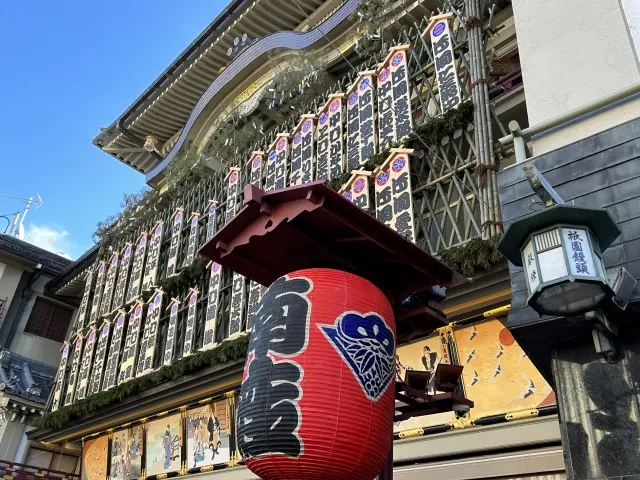
Before the run opens, the theater hangs maneki (招き) across its facade, wooden boards painted with the performers' names in bold calligraphy.
This maneki-age (招き上げ) is one of the signs that winter has arrived in Kyoto. It usually takes place in late November, and the 2026 date will be announced closer to the run.
The evening program ends late, so if you want an early start on temples or year-end sightseeing the next morning, staying in the city makes those mornings easier.
This article was translated from the original Japanese with AI assistance and reviewed by our editorial team. The Japanese version is authoritative.