
Nada no Kenka Matsuri (灘のけんか祭り), the "fighting festival" held every autumn at Matsubara Hachiman Shrine in Himeji, Hyogo, is one of Japan's most physically intense festivals. Three portable shrines (mikoshi) are slammed head-on into one another, while seven ornate floats (yatai) are hoisted and paraded by teams of bearers. It's designated an Important Intangible Folk Cultural Property by Hyogo Prefecture.
The dates are fixed every year: October 14 and 15. In 2026, October 14 falls on a Wednesday (the eve, yoi-miya) and October 15 on a Thursday (the main day, hon-miya). The catch is that the two days are very different, so what you see depends on which day you choose. In short: go on the 15th (hon-miya) for the head-on mikoshi clash, or the 14th (yoi-miya) for the floats and the evening lights at a calmer pace.
For where this festival sits in the autumn calendar, see our Guide to Japan's Autumn Festivals.
The "fighting" in the name refers to the three mikoshi being smashed together. The seven yatai floats are carried and jostled, not crashed, on both October 14 and 15; here, yatai means a festival float, not a food stall.
The Basics for 2026
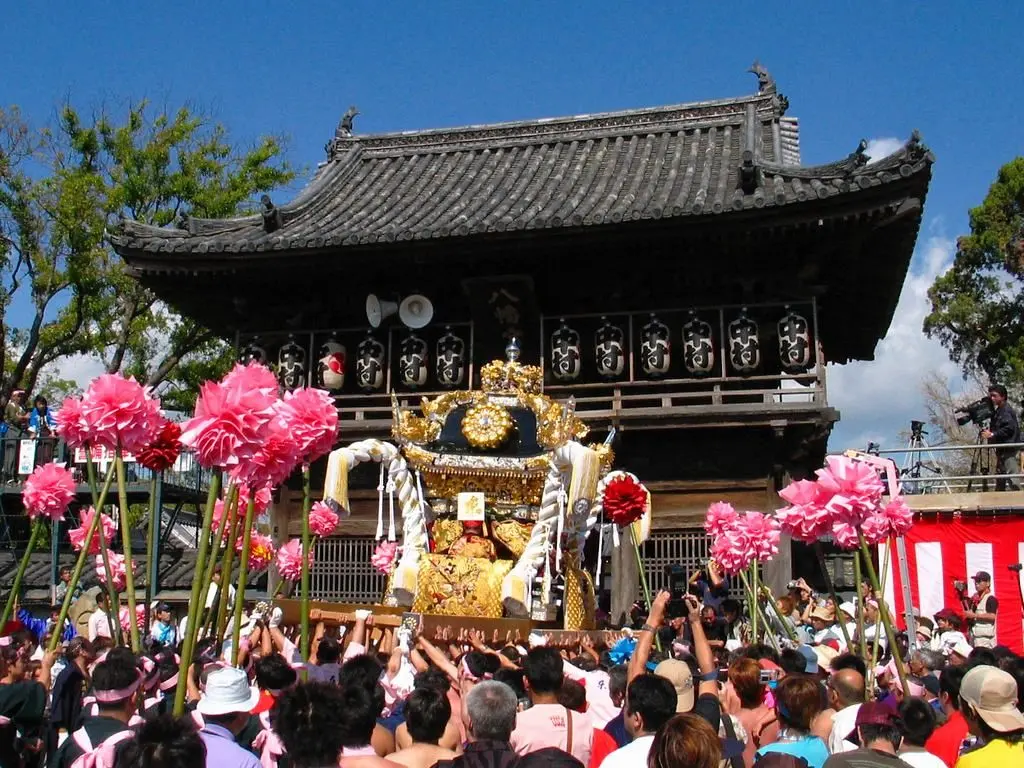
Here are the essentials before you plan the trip. The official name is the autumn grand festival of Matsubara Hachiman Shrine, and because the dates are always October 14 and 15, both fall on weekdays in 2026.
Item | Details |
|---|---|
Dates | Wed, Oct 14, 2026 (yoi-miya / eve) & Thu, Oct 15, 2026 (hon-miya / main day) |
Venue | Matsubara Hachiman Shrine (399 Ko, Shirahama-cho, Himeji, Hyogo) |
Climax of the main day | Otabiyama, a low hill with a terraced parade ground |
Nearest station | Sanyo Electric Railway "Shirahama-no-miya," about a 5-minute walk south |
Parking | None (organizers ask visitors to come by train) |
This year's "nenban" (the district that takes the lead role in rotation) is the Matsubara district. Note that the shrine has not yet posted a dedicated 2026 announcement, so specifics such as seating and road closures for October 14-15 are best confirmed on the official site closer to the dates.
Day One: Yoi-miya (October 14)
The eve is the day the floats gather at the shrine. From around 9 a.m., each district brings its yatai out of storage and heads for Matsubara Hachiman Shrine, led by tall banners, with lion-dance districts bringing their shishi-danjiri (lion-dance floats) along too.
The districts enter the shrine grounds one after another, roughly from 11 a.m., with the procession winding down around 2 p.m. In front of the tower gate the floats are paraded and hoisted again and again. As evening falls on the 14th, three of the floats, from the Higashiyama, Yaka, and Usazaki districts, light up with electric decorations.
The posted times are only a guide and can shift as the day unfolds. Yoi-miya suits anyone who wants to take in the pageantry and the float-hoisting at a calmer pace than the main day.
Day Two: Hon-miya (October 15)
The mikoshi clash is what made the festival famous, and it takes place on the main day. The day opens with two early-morning rites: a purification "tsuyu-harai" led by the Matsubara lion float around 5 a.m., followed by a "shiokaki" rite around 6 a.m., when bearers from the lead district wade into the sea to purify themselves.
Through the morning, seven villages enter the shrine in turn, with the lead district last. Then comes the highlight: three mikoshi dedicated to Emperor Ojin, Empress Jingu, and Himegami are carried back and forth between the front of the hall and the great torii gate, then slammed together head-on.
The clash generally happens from around midday, after the morning entries wrap up, into the early afternoon. Exact timing is listed in each year's schedule, so if this is what you came for, check the official timetable in advance.
In the afternoon the procession moves to Otabiyama. The floats and mikoshi climb the hill in turn and descend toward evening for a final round of hoisting. The parade ground is flanked by terraced fields that fill with spectators like a natural grandstand, and the sight of the floats hoisted into the dusk is a fitting finale.
Which Day to Choose
Since the two days offer such different experiences, pick your day by what you most want to see. If the head-on mikoshi clash is the draw, go on the main day (the 15th). If you'd rather enjoy the floats and the evening lights at a steadier pace, the eve (the 14th) is the better fit.
If you have the stamina and the time, the ideal is to watch yoi-miya in the evening, then continue through Otabiyama on the main day. But the main day is a full day, running from dawn rites to an evening descent, and Otabiyama gets especially crowded. If it's your first time, spending just the afternoon of the main day, from the mikoshi clash to Otabiyama, still captures the heart of the festival.
Getting There by Train
Come by train. The nearest stop is Shirahama-no-miya on the Sanyo Electric Railway, about a 5-minute walk south of Matsubara Hachiman Shrine, and on festival days limited-express and direct-express trains make special stops there.
Otabiyama, the stage for the main day's climax, is about a 15-minute walk west from either the shrine or Shirahama-no-miya station, or about 10 minutes southeast from Mega station (another stop on the Sanyo line). There is no parking, so leave the car behind. If you'd rather base yourself in a bigger city, Kobe is about 40 minutes away by train: check hotel availability and rates in Kobe.
Road closures are in place around the venue on both days, October 14 and 15. A map of the restricted area is posted each year on the official access page, but it does not list the hours of the closures (the current version is the 2025 map; the 2026 one is not out yet). If you need to drive nearby, check the map for the closed streets and consult that year's notices from Himeji City or the Himeji police for exact times.
Check hotel availability and rates in Kobe
Seating, Weather, and Watching Safely
We could not confirm any paid grandstand seats sold to the general public. The stands at Otabiyama and in front of the shrine are handed down within local families and are not offered as tickets to visitors, so most people watch for free from the roadside or the hillside. To ask about seats, call Matsubara Hachiman Shrine (079-245-0413) directly.
The shrine has not published a wet-weather policy for the festival itself. If heavy rain is forecast, check the official site or call that morning to confirm the festival is still on before you set out.
Finally, put safety first. The mikoshi are slammed together and the floats are hoisted at full force by their bearers, so the front row and anywhere near their path can be dangerous. If you have small children with you, watch from a spot with room to spare.
This article was translated from the original Japanese with AI assistance and reviewed by our editorial team. The Japanese version is authoritative.