
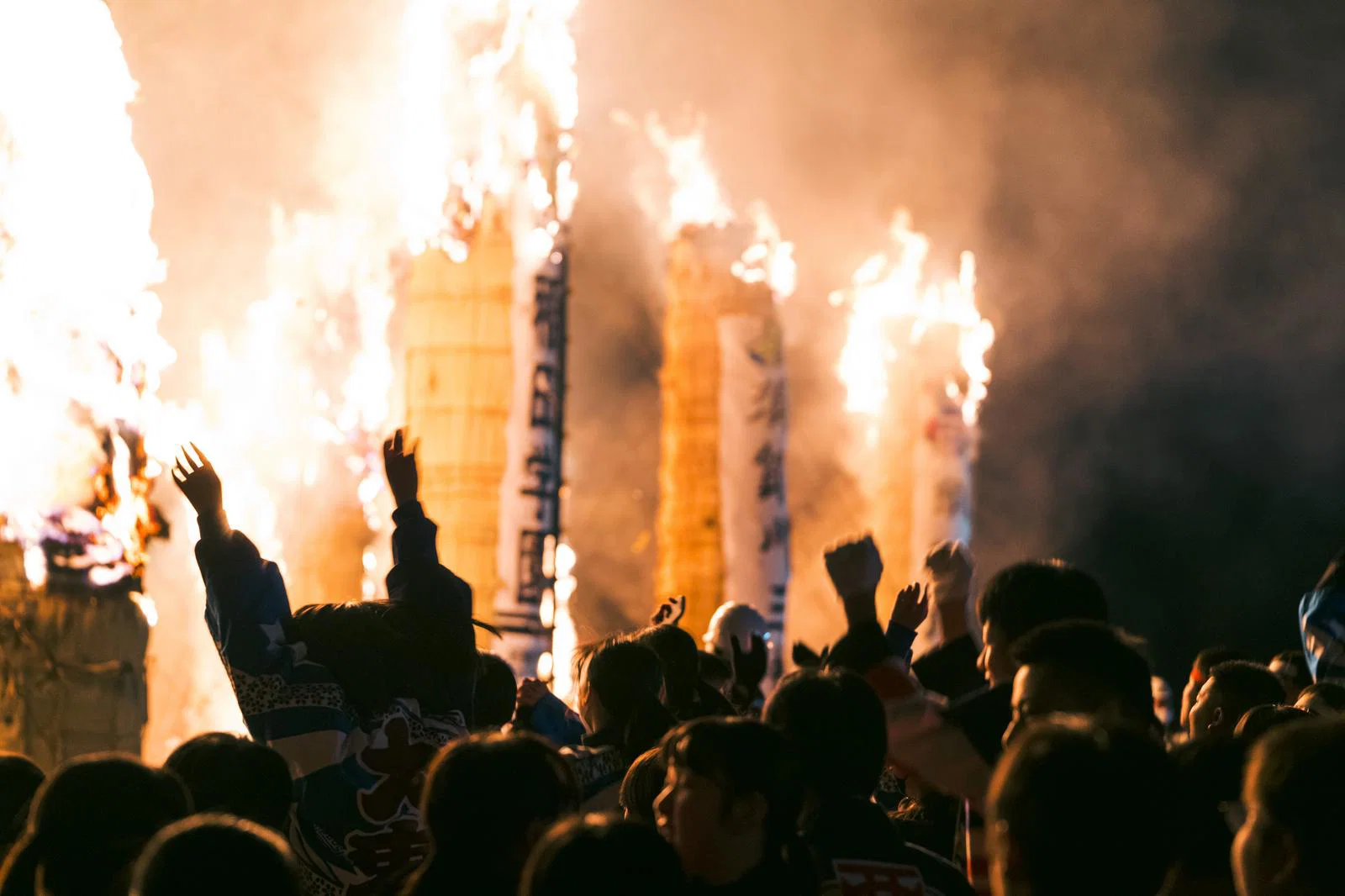
Sukagawa Taimatsu Akashi (須賀川松明あかし) is a fire festival in Sukagawa (須賀川), Fukushima, where a great torch (大松明) about 10 meters long and around 20 main torches (本松明) are set alight after dark. Fukushima Prefecture's tourism pages describe it as one of Japan's three great fire festivals.
In 2026, the festival takes place at Goroyama (五老山) on Saturday, November 14, with the torches scheduled to be lit at 6:30 PM. Admission is free, and no ticket is required.
For 2026, we have pulled together the date and timetable, how to reach the site by shuttle or car, advice for the trip home, and how to prepare for a cold November night. The details come from official Sukagawa City and organizing-committee pages, plus the Japan Meteorological Agency.
If you are planning around other autumn events, see our guide to Japan's autumn festivals as well.
Roads around Goroyama close to traffic on festival day, so most visitors take the paid shuttle bus from JR Sukagawa Station or the Botan-en (牡丹園) parking lot. The fare is ¥200–¥220 each way, and you pay again for the trip back. If you drive, use a free temporary parking lot.
The 2026 festival at a glance
Item | Detail |
|---|---|
Date | Saturday, November 14, 2026 |
Eve | Friday, November 13, 2026 |
Venue | Goroyama, inside Suizugaoka Park (翠ヶ丘公園), Sukagawa City |
Lighting | 6:30 PM (planned) |
Admission | Free (no tickets sold) |
Organizer | Taimatsu Akashi Executive Committee |
The festival is usually held on the second Saturday of November, which in 2026 is the 14th. On the evening before, Friday, November 13, a memorial service is held at Iwase Hachiman Shrine (岩瀬八幡神社).
The timetable on the day
The lighting is at night, but on festival day (November 14) the great torch is carried through town along Taimatsu Street (松明通り) from early afternoon, and food stalls open well before dark. The main official schedule is below (parts may change depending on weather).
Time | What happens |
|---|---|
11:00 AM | Food court (おもてなしフードコート, lawn plaza in Suizugaoka Park) |
1:00 PM | The great torch procession sets off along Taimatsu Street (near Miyasaki-cho) |
2:00 PM | Processions carrying torches built by local schools set off |
~2:30 PM–9:00 PM | Food stalls along Taimatsu Street (November 14) |
4:30 PM | Small-torch procession leaves Myoken Children's Park for Goroyama |
6:00 PM–7:45 PM | Taiko drum performance (stage on Goroyama) |
6:30 PM | Lighting on Goroyama; the great torch first, then around 20 main torches in turn |
The viewing path up to the top is one-way when crowded, and visitors must keep moving, so follow the stewards' directions.
Depending on how busy it gets, access up the hill may be restricted, nearby roads may be closed, or viewing may not be possible at all.
Tripods aren't allowed at the site, and drones generally aren't permitted either.
Getting there by paid shuttle bus
Because roads around the site close to traffic, the organizers recommend public transport. On festival day, paid shuttle buses run to the venue from JR Sukagawa Station and the Botan-en parking lot.
Route | One-way fare |
|---|---|
JR Sukagawa Station ⇄ Venue | ¥220 |
Botan-en parking lot ⇄ Venue | ¥200 |
The shuttles run from 4:00 PM to 9:00 PM, roughly every 15 minutes, with separate "Sukagawa Station" and "Botan-en" stops at the venue for the ride back.
The official notice lists no reservation system or day pass. Pay the one-way fare when boarding, and budget ¥400–¥440 per person for the round trip.
If you're coming for the daytime events, such as the great torch leaving at 1:00 PM, the shuttle isn't running yet, so walk or use a temporary parking lot. It's about a 15-minute walk from JR Sukagawa Station to Goroyama.
By bullet train, change at Koriyama (郡山) on the Tohoku Shinkansen to the local Tohoku Main Line for Sukagawa; the trip takes roughly 1 hour 40 minutes from Tokyo and about 1 hour from Sendai.
Parking if you drive
If you come by car, use the temporary lots set up around the site. Most are free, but spaces are limited. If a lot is full, plan a backup: the shuttle after 4:00 PM, or the 15-minute walk from JR Sukagawa Station.
Parking lot | Spaces | To the venue |
|---|---|---|
JA Yumeminami head office (P1) | 100 | 20-min walk |
Fukushima Hospital (P2) | 100 | 5-min walk |
Botan-en (P3, large buses OK) | 1,000 | 10 min by shuttle |
Abukuma Elementary School (P4) | 100 | 20-min walk |
Citizens' Sports Ground (P5) | 150 | 10-min walk |
City Hall (P6) | 250 | 15-min walk |
Botan-en (P3) has the most spaces; it sits a little way from the venue, so the paid shuttle runs from there. Every lot except City Hall (P6) is free, and street parking is not allowed.
City Hall (P6) is the one paid lot, but parking is free for up to nine hours if you enter between noon and 9:00 PM. Its underground level closes to entry and exit after 6:00 PM, so avoid it if you plan to stay for the lighting.
The central area closes to traffic from 11:00 AM to 10:00 PM, and other timed restrictions apply too. For the exact extent of the closures, check the official venue map.
Official site: Taimatsu Akashi (Sukagawa City)
Watching, heading home, and staying warm
After the lighting on November 14, the food stalls remain open and the shuttle buses keep running until around 9:00 PM.
For a close view, head up early. Right before the lighting the viewing path gets especially crowded, and it's hard to watch at your own pace.
The return rush starts as soon as the torches are lit. The shuttles run about every 15 minutes, so to skip the initial queues, look around the grounds and wait a little before boarding.
Bullet-train day-trippers should check the last connection through Koriyama in a current timetable before heading out.
Sukagawa sits inland, and November nights here turn quite cold. At Koriyama, the nearest observation point, the average daily low in November is 3.8°C (Japan Meteorological Agency).
Since you'll be standing outdoors before the 6:30 PM lighting, wear a heavy coat, gloves, and comfortable shoes, and bring disposable hand warmers for the wait.
There's no official word on whether rain cancels or postpones the festival. The flyer and venue map only note that "parts of the schedule may change due to weather and other circumstances."
If the weather looks like it's turning, check the latest from Sukagawa City or the executive committee before you set out.
The story behind Taimatsu Akashi
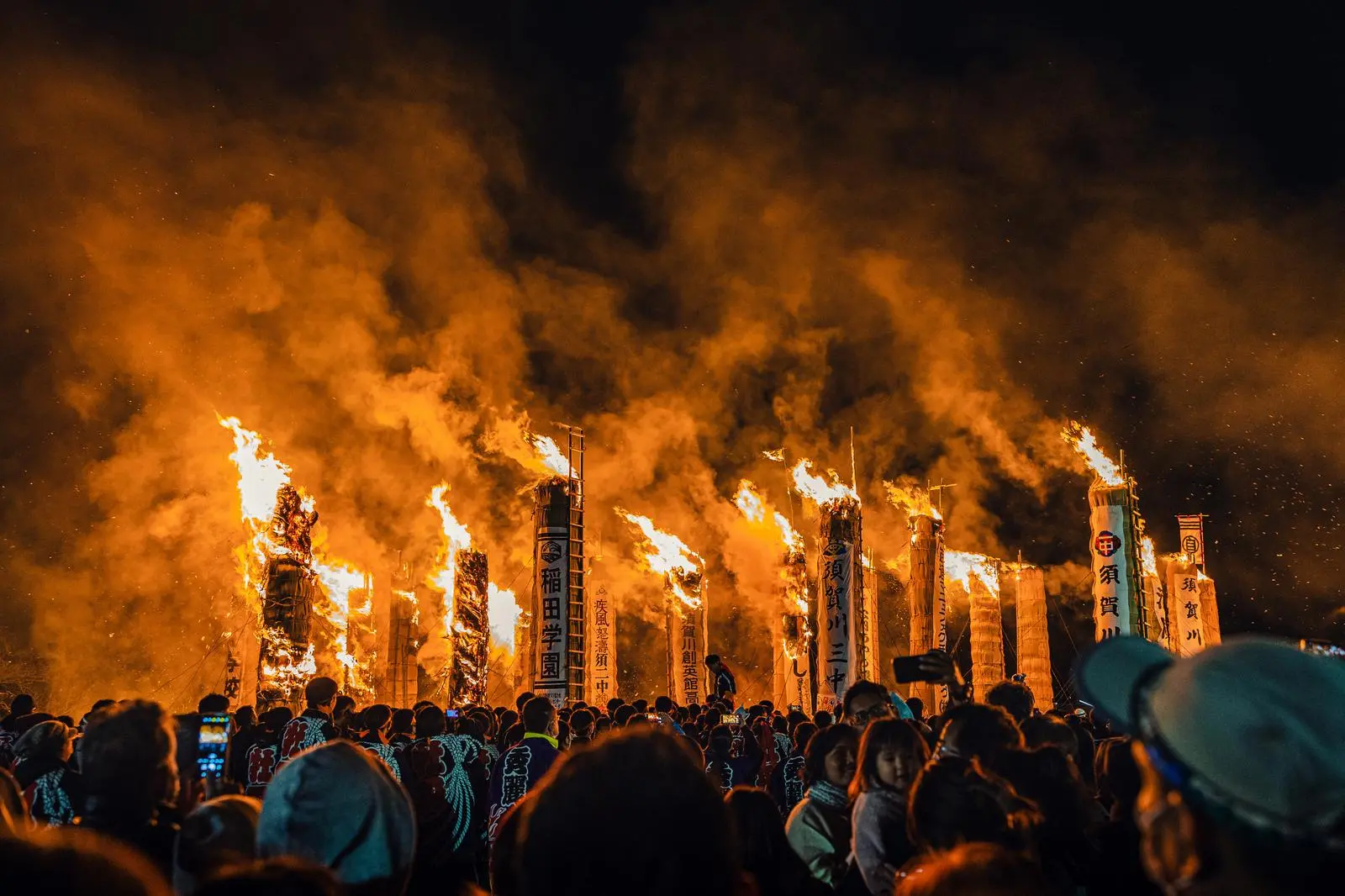
In the Japanese haiku tradition, "Taimatsu Akashi" is a kigo, or seasonal term, for winter.
The origins of Taimatsu Akashi go back to 1589 (Tensho 17), during the Warring States period. After subduing the Aizu region, Date Masamune (伊達政宗) invaded Sukagawa, and when Sukagawa Castle fell, many on the defending Nikaido (二階堂) side lost their lives.
In the years that followed, people began lighting fires in the tenth lunar month to mourn those who died in the battle, and the custom developed into today's Taimatsu Akashi.
Even now the fires are lit on Goroyama to honor the war dead of both the Nikaido and Date sides, and to thank those who have kept the festival alive.
This article was translated from the original Japanese with AI assistance and reviewed by our editorial team. The Japanese version is authoritative.