
In early July, the grounds of Sensō-ji Temple in Asakusa are filled with the vivid orange-red of hōzuki, ornamental ground cherries, and the delicate chime of Edo glass wind bells. Shimanrokusennichi and Hōzuki-ichi — the 46,000-Day observance and Hōzuki Market — is one of old Tokyo's signature summer traditions, held for just two days each year: July 9 and 10.
What makes these two days so special is that July 10 is the most important “merit day” of the year at Sensō-ji. Visit the temple on that day, and you're said to receive the equivalent of 46,000 days — roughly 126 years, or a whole human lifetime — of merit from a single visit. That's where the name shimanrokusennichi, literally “46,000 days,” comes from.
This guide covers the 2026 dates and hours, what the “46,000-day” tradition actually means, the story behind the ground-cherry market, and the special talismans offered only on these two days — including the thunder-warding kaminari-yoke fuda. It's an easy, atmospheric add-on to any day of sightseeing in Asakusa.
Note: Hours and the lineup of temple talismans can change from year to year. Check Sensō-ji's official website before you go.
When It Happens in 2026: Dates, Hours & Location
In 2026, Shimanrokusennichi & Hōzuki-ichi falls on Thursday, July 9 and Friday, July 10. The dates are fixed every year — it's always July 9 and 10, whatever the day of the week.
The ground-cherry stalls are generally up from morning until around 9 p.m. (a rough guide; times vary). Come evening, lanterns and lights make the ground cherries glow an even deeper red — a completely different mood from the daytime bustle.
The setting is the precincts of Sensō-ji in Taitō Ward, Tokyo. The Main Hall is open 6 a.m.–5 p.m. Pass under the Kaminarimon Gate, walk down Nakamise shopping street, and the stalls spread out across the grounds beyond the Hōzōmon Gate.
What Does “Shimanrokusennichi” (46,000 Days) Mean?
A “merit day” (kudoku-bi) is a day on which a single visit is said to earn the merit of many ordinary days — 100, or 1,000, and so on. The custom dates to the late Muromachi period (mid-1500s), and today Sensō-ji designates one merit day a month, twelve a year.
July 10 is the greatest of them all, worth 46,000 days of merit — about 126 years, the length of a human life. There are several theories about the number. One holds that a shō (a traditional measure) of rice contains roughly 46,000 grains, a pun on shō (“measure”) and shō (“a lifetime”) — though the temple itself notes the true origin isn't certain.
In the Edo period, eager worshippers started arriving the day before to be first in line, so the 9th came to be observed alongside the 10th. Both days have been celebrated ever since.
The Ground-Cherry Market: Origins and How to Enjoy It
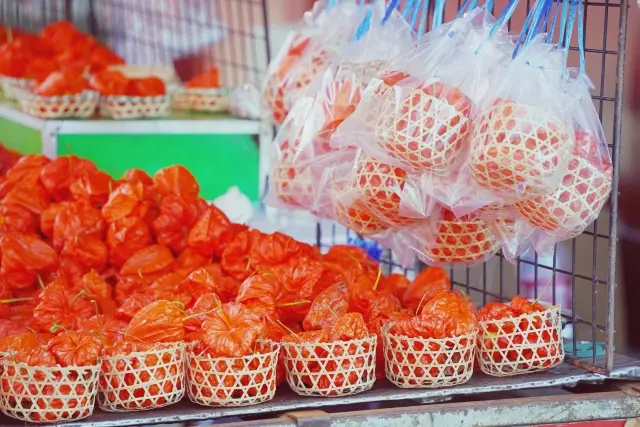
The market traces back to the Meiwa era (1764–72). It began at Atago Shrine in Shiba, where ground-cherry vendors gathered for the 46,000-day fair. A folk belief held that swallowing a ground cherry whole would ease chronic ailments in adults and calm a child's upset stomach, and crowds came to buy them. Sensō-ji — the original home of the 46,000-day observance — soon had a market of its own.
That, of course, is an old Edo-era belief: ornamental hōzuki are not food and shouldn't be eaten. Today, people mostly enjoy potted hōzuki as summer decorations or as offerings for Obon altars.
In a typical year, roughly 100 to 120 hōzuki stalls fill the grounds, along with food and other stalls, and vendors call out from morning to night. Many potted plants come paired with an Edo wind bell, whose gentle chime takes a bit of the edge off the summer heat. Prices vary from stall to stall, so ask the vendor if something catches your eye.
Two Talismans You Can Only Get on These Two Days
Shimanrokusennichi comes with talismans unique to the occasion. One is the kaminari-yoke fuda, a triangular paper talisman on a bamboo skewer said to protect against lightning, offered only on July 9 and 10.
Its origin is unusual. Red corn was once sold here as a lightning charm, but around the early Meiji era (about 1868) a crop failure left none to be had. When troubled worshippers asked the temple for protection, Sensō-ji began offering the triangular talisman instead — and that practice continues today. It's a small window into how much people once feared summer thunderstorms.
For these two days only, the temple also offers the kifuda, a prayer talisman wrapped in yellow paper. Both are available only once a year, which is part of why the crowds start early.
Crowds, Heat, and Visiting Tips
The festival draws people from morning to night. For a calmer visit, come early in the day; if you'd rather soak up the atmosphere, return after dusk, when the lantern-lit stalls and the wind bells are at their best.
Early July in Tokyo is hot and humid, often right around the end of the rainy season. You'll get hot walking the grounds, so bring a hat or parasol and some water, and drink often. For where to pick up summer cooling gear, see our Japan summer heat survival guide.
A potted ground cherry makes a lovely keepsake, but it's awkward to fly home with, and live plants face quarantine limits when leaving Japan. For a travel souvenir, a wind bell, a photo, or one of the temple talismans is the easier choice.

Getting There
The nearest station is Asakusa, served by the Tokyo Metro Ginza Line, Toei Asakusa Line, Tobu Skytree Line, and Tsukuba Express — all about a 5-minute walk away. Pass under Kaminarimon, follow Nakamise street, and you'll arrive right in front of the Main Hall.
If you're hopping on and off trains, a Suica or PASMO IC card makes getting around much easier. See our related guides for how to buy one and top it up.

You Might Also Like


This article was translated from the original Japanese with AI assistance and reviewed by our editorial team. The Japanese version is authoritative.