
Every August, Daisen City in Akita — up in northern Japan — hosts the National Fireworks Competition (全国花火競技大会). Nobody calls it that. It's Omagari Hanabi (大曲の花火), and pyrotechnicians selected from across the country come here to compete for the Prime Minister's Award. The 98th competition is Saturday, August 29, 2026.
Here's the part that catches people out. This is not a show you can wander down to the riverbank and watch: every viewing area inside the venue is ticketed, and there is no free seating.
There are also no same-day tickets for the August competition, and for now tickets can only be bought inside Japan. Show up in August and you're shut out twice over: the deadline has passed, and you couldn't have bought from home anyway. At that point a travel agency package is the only route left.
Buying on your own means the second sales round, and it closes at 11:59 p.m. on July 31.
For how August 29 fits with the rest of this summer's festivals, see Japan Summer Festival Guide 2026: Food Stalls, Yukata, Etiquette and Where to Go.
2026 at a glance
Event | 98th National Fireworks Competition (Omagari Hanabi) |
|---|---|
Date | Saturday, August 29, 2026 |
Gates open | 3 p. |
Daytime fireworks | 5:10 p. |
Evening fireworks | 7 p. |
Venue | Omagari Hanabi Park (「大曲の花火」公園), Omono River bank, Daisen City, Akita |
Shells | About 18,000 |
Competing companies | 28 |
Food stalls | Yes |
Organizers | Omagari Chamber of Commerce and Daisen City |
Official site: 夏に開催する日本最高峰の「全国花火競技大会」。日本中から花火師が集結し技を競います。昼花火の競技大会は国内唯一です。
開催概要|全国花火競技大会「大曲の花火」
A competition that starts in daylight
Omagari is judged, not just staged, and the judging begins while the sky is still bright.
The daytime round runs from 5:10 to 6 p.m., and companies are scored on the color and shape of the smoke as it spreads across a lit sky. Each entry is a set of five 5-go shells (五号玉, go-go-dama).
The evening round runs from 7 p.m. to 9:30 p.m., with 28 companies taking the river one at a time. Each brings three entries: one 10-go shell in the required category, shin-iri warimono (芯入割物), one 10-go shell of the entrant's own choosing (自由玉, jiyu-dama), and a free-form creative piece of up to two and a half minutes.
The pyrotechnicians fire their own shells rather than handing them to a crew. At this scale, that's rare.
History of the competition: 日本最高峰の花火競技大会「大曲の花火」の歴史と魅力をご紹介します。音と花火による総合芸術「創造花火」は大曲発祥です。大曲の花火とは|大曲の花火 公式サイト
Paid seats only: no free viewing, no same-day tickets
Paid blocks cover the whole viewing area. There is no free seating — not a corner of the park, not a strip of the levee.
As a rule, nothing is sold on the day itself either. A small number of same-day tickets are sometimes released for the spring and fall events, but the August competition is not one of them.

No official guidance on watching from outside
Daisen City lists saving a spot inside Omagari Hanabi Park as prohibited, along with pitching tents and lighting fires directly on the ground.
Neither the official site nor the city's portal describes anywhere outside the venue to watch from. Take that silence as the answer: if you travel to Daisen City without a ticket, do not assume there is a reliable place to see the show.
Daisen City FAQ (Japanese): 会場周辺の宿泊施設は?市内宿泊施設案内をご覧のうえ、直接各施設へ空室状況等をご確認ください。宿泊・温泉についてシャトルバスはありますか?大仙市大曲地域は全面的に交通規制エリアとなり、交...
よくあるご質問 - 大曲の花火ポータルサイト
Seats and prices
Prices are per block, not per person, so a block costs the same whether or not you fill it. Only the Chair Seat and Photographer Seats A–C hold one person each. Shipping and handling fees are charged on top of the seat price for every category.
The per-person column below assumes the block is filled to capacity.
Seat type | Capacity | Price (per block) | Per person |
|---|---|---|---|
Platinum Pair Seat | 2 | ¥70,000 | ¥35,000 |
Deluxe Table Seat | 4 | ¥50,000 | ¥12,500 |
Table Seat | 4 | ¥38,000 | ¥9,500 |
Embankment Box Seat | 4 | ¥30,000 | ¥7,500 |
Leisure Sheet Seat | 4 | ¥15,000 | ¥3,750 |
Pair Seat (bench) | 2 | ¥13,000 | ¥6,500 |
Chair Seat | 1 | ¥8,000 | ¥8,000 |
Photographer Seat A (upper) | 1 | ¥25,000 | ¥25,000 |
Photographer Seat B (middle) | 1 | ¥18,000 | ¥18,000 |
Photographer Seat C (lower) | 1 | ¥13,000 | ¥13,000 |
What you actually get varies more than the price list suggests. The Platinum Pair Seat is on a raised stage about a meter (3 ft) up, with a table and its own toilet. Deluxe Table and Table seats come with a table too, in blocks of 230 × 230 cm (about 7.5 ft square) and 170 × 140 cm (roughly 5.5 × 4.5 ft).
The Embankment Box Seat is a block on the slope of the levee with two rows of plain benches. Pair Seats are two-person benches, Chair Seats are single chairs, and the Leisure Sheet Seat is a 180 × 180 cm mat (about 6 ft square) where you may bring your own folding chair. The official seating map (PDF) shows where each block sits.
One thing to settle before you book, if you're traveling with small children. Children under elementary school age are free only when they watch on a parent's lap; the moment a child takes up a seat, they count as one of the block's places.
That costs nothing extra in a block seat — you are paying for the block, so two adults and two children fit a four-person block for a single block price. In a one-person Chair Seat or Photographer Seat, though, a child who uses the seat needs a ticket of their own.
Official ticket page and seating map: 夏に開催する「全国花火競技大会」のチケット情報です。観覧席の種類・料金、購入方法、販売期間などをご案内します。チケット案内(一般販売)|全国花火競技大会「大曲の花火」
Second sales round: July 21–31, 11:59 p.m. cutoff
The first online round closed on June 23, and counter sales at the Omagari Chamber of Commerce ran until July 5. The second round opened at 10 a.m. on July 21 and closes at 11:59 p.m. on July 31, covering only the categories with seats left over. Wheelchair seats (four people, ¥28,000 plus ¥600 shipping) sold out back on May 27.
The two ticket sites don't carry the same stock. Lawson Ticket (ローソンチケット) handles everything except Photographer Seat C; e+ (イープラス) handles only the Table Seat and the Embankment Box Seat. Photographer Seats were always Lawson-exclusive, and only A and B made it into the second round.
Payment methods differ by site, so look before you commit. The organizers said on July 17 that a few seats remained, but stock moves daily, so check both sites the day you buy.
Booking through e+ has a catch: you register your companions' details and upload a face photo before you can buy, and tickets are issued digitally through e+'s Smachike app (スマチケ). If you're booking from overseas, that's the step most likely to stop you.
Resale and transfer are prohibited, and the official site lists no resale service. The organizers add that they may refuse entry to anyone holding a ticket bought outside the official channels, so a secondary marketplace is not a workaround.
No cancellations, changes, or reissues either — not for any reason on your side.
Second-round announcement (Japanese): 大曲の花火に関する最新ニュースやお知らせ、ニュースリリースを掲載しています。お知らせ|大曲の花火 公式サイト
Overseas purchase: Japan-only sales for 2026
For now, tickets can only be bought inside Japan. The Japanese FAQ adds that the organizers are preparing to accept overseas purchases, but no date is attached to that, so don't plan around it.
Which leaves anyone arriving in August with no practical way to secure a seat on their own. There is a separate allocation for travel agencies, but agency applications closed on March 24 for new bookings and May 26 for additional ones.
So if you're coming in August, your one remaining route is a tour from an agency that holds seats from that allocation. Check the agencies' own product pages for what each package covers.
Travel agency sales (Japanese): 旅行業者の方に向けた、夏に開催する「全国花火競技大会」のチケット情報です。観覧席の種類・料金、申込方法、受付期間などをご案内します。チケット案内(旅行業者向け)|全国花火競技大会「大曲の花火」
From Tokyo by Shinkansen, plus extra trains
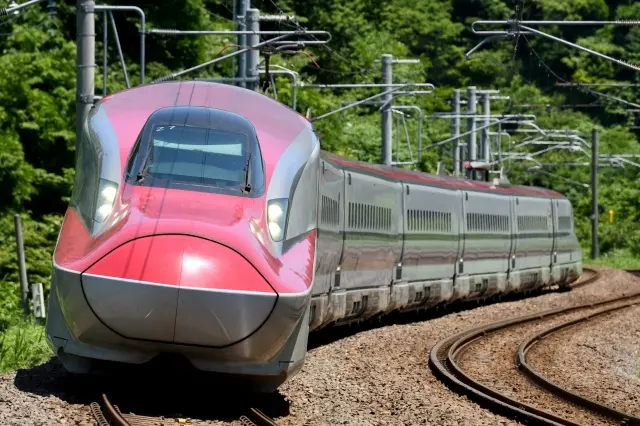
The Akita Shinkansen Komachi (秋田新幹線こまち) runs direct from Tokyo Station to Omagari Station. Journey times: JR東日本の駅の時刻表についてご案内しています。
時刻表:JR東日本
Extra trains run on some lines on the day of the event, but JR East still hasn't published the 2026 times or frequencies as of late July. That gap matters more than it might seem.
The evening round ends at 9:30 p.m., and it's a 30-minute walk back to the station from there. Whether you can reach Tokyo the same night depends on a last departure nobody can pin down until the extra-train schedule appears — so book a room and plan on staying over.
For the trip home, Daisen City says the trains can handle the expected crowds (page updated January 9, 2026). Going by train also keeps you out of the road congestion, which runs until the small hours.
Daisen City on recommended transport (Japanese): 全国花火競技大会「大曲の花火」開催時、開場周辺は非常に多くの方が訪れることから、場所によっては大会前日から当日深夜まで交通規制がかかります。交通規制範囲内にある駐車場に車を停めた場合、車を出すこと...
オススメ交通手段 - 大曲の花火ポータルサイト
Omagari Station to the venue: 2 km, about 30 minutes
The nearest station is JR Omagari. It's about 2 km (1.2 miles) from there to the center of the viewing area — call it 30 minutes on foot. According to the official access page, food stalls and side events line that route on August 29 — a consolation, but not a viewing spot.
What the official site does not say is whether there are stalls inside the venue, or whether you can leave and come back. On August 29, gates open at 3 p.m. and the evening round ends at 9:30 p.m., so buy food on the walk in rather than counting on finding it at your seat.
You can drop your bags before the walk. There are two luggage counters: one beside the police box at the west exit of JR Omagari Station, run by Sagawa Express, and one in front of the Omagari Chamber of Commerce at Hikario Plaza (ヒカリオ広場), run by Yamato Transport.
Both take bags from 10 a.m. to 11 p.m. on August 29, at a flat ¥1,000 per item including tax, whatever the size.
Daisen City on going by train (Japanese): 駐車場を気にせずに来ることが出来ます。増発列車もありますので、余裕をもった行動ができます。駅から会場まで最寄り駅はJR大曲駅です。JR大曲駅から観覧会場中心部分までは、徒歩約30分、約2kmです。途中に...
電車で行く - 大曲の花火ポータルサイト
Road closures: from 3 p.m. on August 28
According to Daisen City, the town-center area closes to vehicles from 3 p.m. on August 28, the day before, and the Nishine (西根) and Himekami (姫神) areas from 9 a.m. on August 29. Restrictions are scheduled to lift at midnight as August 29 ends (12 a.m. on August 30).
The official access page warns of heavy congestion from the afternoon until two or three in the morning.
Park inside the restricted zone and your car stays there until the closures lift at midnight as August 29 ends.
Daisen City sorts parking into five kinds. Four need a reservation: committee-run lots for ordinary cars (nine of them), lots for disabled visitors, lots for large buses, and privately run lots. The fifth kind is general parking — a limited number of spaces, no reservation needed.
The committee's reserved lots cost ¥6,000 per space, billed as an environmental maintenance contribution (環境整備協力金). Booking through the Ticket Pass site adds a 10% service fee (¥600), and you cannot pay on arrival. Reservations opened on June 12, so at this point don't count on anything being left.
There is no shuttle bus, and the city's loop bus doesn't run that day.
Daisen City recommends parking at one of four municipal offices instead and taking a local train into Omagari: Kamioka (JR Jinguji), Nakasen (JR Ugo-Nagano), Nishisenboku (JR Kariwano), or Kyowa (JR Ugo-Sakai).
Daisen City on reserved parking (Japanese): 第98回全国花火競技大会 予約専用駐車場の概要予約専用(有料)一般駐車場一覧駐車場番号駐車場名称観覧会場最寄りゲートまでのおおよその距離区画のサイズ収容可能台数予約方法備...実行委員会が管理する予約専用駐車場 - 大曲の花火ポータルサイト
Daisen City on the August 28 road closure map and parking (Japanese): オススメ交通手段花火大会当日、交通規制や渋滞により観覧会場付近への車での来訪は推奨していません。大仙市役所各支所駐車場と電車を利用したパークアンドライドをオススメしています。観覧会場付近の交通規...
車で行く・交通規制図 - 大曲の花火ポータルサイト
Daisen City on private reserved lots and the August 28 closure times (Japanese): 大会時には、実行委員会が管理する駐車場の他にも、民間の方が自らの所有する土地を活用して運営する駐車場が多く開設されます。そのうち、予約専用駐車場についての情報を以下に掲載しますので、駐車場所の事前...
民間の方が管理する予約専用駐車場(私設駐車場) - 大曲の花火ポータルサイト
Where to stay
Rooms around Daisen go months before the event. The organizing committee does not arrange accommodation, and suggests looking along the Akita Shinkansen, the Ou Main Line (奥羽本線), and the Tazawako Line (田沢湖線) if nothing is available in Daisen City itself.
The city also runs an event homestay program, but guest applications for 2026 closed at 11:59 p.m. on July 17 — and only one household was listed as of July 2. It was never much of a backup.
Daisen City Tourism Association on the 2026 homestay program (Japanese)
Packing list and banned items
The official visitor guide prohibits pets, handcarts, wagons, bicycles, drones, tents, parasols, anything involving fire, chairs and tables, and large camera equipment such as monopods and tripods.
There are exceptions. Chairs and tables are allowed in Leisure Sheet Seats and Photographer Seats as long as they fit inside the block, and monopods and tripods are permitted in Photographer Seats only.
Eating and drinking at your seat is fine; the organizers just ask you to be considerate of the people around you.
Umbrellas are another matter. The official FAQ asks people not to use them at the venue, since they block the view for everyone behind, and recommends rainwear instead.
Dress in something you can move in and don't mind getting dirty, with shoes you can walk 2 km in. Portable toilets are set up around the venue and the town, but the organizers don't stock them with toilet paper at the summer competition, so bring your own.
The venue is a riverbed, and Daisen City warns about scrub typhus mites (ツツガムシ) there, so use insect repellent. If you develop a headache, a fever, or an odd blister or scab roughly one week to ten days after the event, see a doctor right away.
Official site (Japanese): Visitor Guide
Rain and postponement: no reserve date
Light rain changes nothing. Heavy weather or high water can push the event back, but no reserve date is published — the organizers set a new date case by case once they have assessed the state of the venue.
Announcements go out through the official app, the top page of the official site, and the official social accounts on Facebook, Instagram, and X.
Refunds are given only if the event is canceled outright. If it is postponed, your existing ticket stays valid for the new date — which, if you have already flown home by then, means you get neither the fireworks nor your money.
Other Tohoku festivals this summer
Omagari falls at the very end of August, more than three weeks after the cluster of Tohoku festivals in early August. Seeing both on one trip means a long stay.
- Akita Kanto Festival 2026: August 3–6, What Changes Each Night, Paid Seats, Food Stalls and the Drone Show — same prefecture, August 3–6
- Tohoku's Three Great Festivals 2026: The Route That Works, and Why Aomori and Akita Cannot Both Be Seen — linking Aomori, Akita, and Sendai
- Nagaoka Fireworks 2026: Sold Out, No Free Seats (Resale Is Japan Residents Only) — Access and the Ride Home — Niigata, August 2–3, also with no free seating
- Obon 2026: When It Falls, August 13–16 Crowds, Shinkansen Bookings and What Stays Open — before you plan mid-August travel
This article was translated from the original Japanese with AI assistance and reviewed by our editorial team. The Japanese version is authoritative.


