
The Nagaoka Fireworks (Nagaoka Matsuri Daihanabi, 長岡まつり大花火大会), launched over the Shinano River in Niigata, are counted among Japan's three greatest fireworks displays. In 2026 they run across two nights, August 2 (Sun) and 3 (Mon), and this year marks 100 years since the first successful shakudama (正三尺玉), the giant three-shaku shell.
Before you start planning, there is one thing to know up front. In 2026 there are no free seats at the venue. Both nights are sold out, so this is not a show you can wander up to and watch from an open spot on the night.
This guide covers how to still aim for a seat, how to move on the day, and what these fireworks actually mean — all from official sources only. If you are hunting for other big summer events, see Japan Summer Festival Guide 2026.
There are no free seats in 2026, and the only official way to get one now — official resale — is open to Japan residents only.
2026 at a Glance
Event | Nagaoka Matsuri Daihanabi 2026 |
|---|---|
Dates | August 2 (Sun) and 3 (Mon), 2026 — two nights |
Launch time | 7:20 pm to 9:25 pm, both nights |
Venue | Shinano River banks, below Choseibashi Bridge (長生橋). |
Free seating | None; a paid seat is required |
Rain | Held in light rain (details below) |
A note on the finish time. Some information sites list 9:10 pm, but the Nagaoka Fireworks Foundation's official site says both nights run until 9:25 pm. This guide follows the official time.
No Free Seats, Both Nights Sold Out
This is the first thing to settle for 2026.
The Nagaoka Fireworks Foundation states plainly in its official FAQ that there are no free seats. The only people who can sit and watch with any certainty are those holding a paid viewing ticket.
Both August 2 and 3 are sold out. The first public lottery closed between May 25 and June 8, results have already gone out, and there is no same-day ticket.
There is also no official guidance about watching for free from outside the venue or from a distance. On the night, the roads around the venue are restricted, so do not count on edging close along a bridge or riverbank to catch the show — a paid seat is really the only reliable way to watch.
The Only Way In Now: Official Resale
If you still want a seat, one official route remains: the official resale, which opened on July 6. Ticket holders who can no longer attend release their seats, and you can pick them up legitimately online through Ticket Plus Trade (チケプラTrade) and Minna no Ticket (みんなのチケット, on Rakuten).
There is a catch that matters most to overseas readers: this official resale is open to Japan residents only, and the separate sales window for overseas visitors has already closed for 2026.
If you live abroad, that effectively puts a 2026 seat out of reach — short of having someone resident in Japan arrange one for you, and even then it is worth checking the ticket's entry conditions before you count on it.
The more realistic plan is next year. The dedicated window for overseas visitors opens ahead of the event, so watch for it and book as soon as it goes live.
And one more thing. Reselling for profit without the organizer's consent is prohibited, and a ticket from unauthorized resale will not get you in. Purchases cannot be cancelled, either. Steer well clear of unofficial listings on social media or flea-market apps.
Paid Seat Types and Prices
Paid seats are split between A-site (right bank, Nagaoka Station side) and B-site (left bank, Nagaoka IC side), in a range of formats, from single chairs to a masu box (桝) for a group.
Note that every price below is sold out this year and cannot be bought now. Treat them as a rough guide to what seats normally cost, and as a reference for planning next year. Figures are the general-sale prices, tax included.
Seat type (site) | People | General price |
|---|---|---|
Chair seat (A-site) | 1 | ¥5,000 |
Table seat (A-site) | 1 | ¥10,000 |
Masu box (A-site) | 6 | ¥32,000 |
Phoenix area seat (A-site) | 1 | ¥4,000 |
Shakudama chair seat (A-site) | 1 | ¥5,000 |
Area seats (B-site, Kita-1 and others) | 1 | ¥2,000–4,000 |
Chair seat (B-site) | 1 | ¥5,000 |
Masu box (B-site) | 6 | ¥30,000 |
Prices vary by location and comfort. A chair or table seat suits one person; a masu box works for a group. For the sweep of the Phoenix, choose a Phoenix-area seat; for the punch of the shakudama up close, a shakudama seat. Yakatabune (屋形船) river boats and sajiki (桟敷) raised terrace seating are not listed publicly and are handled by direct inquiry.
Getting There (Shinkansen; ~30-Minute Walk from Nagaoka Station)
The nearest station is JR Nagaoka, a stop on the Joetsu Shinkansen. A-site is about a 30-minute walk from the station. JR East adds extra Joetsu Shinkansen services for the event, so for most people arriving from far away the bullet train is the natural way in.
How | Rough guide |
|---|---|
JR Nagaoka Station to A-site | ~30-minute walk |
Shinkansen | Joetsu Shinkansen; extra trains on the day |
Parking for B-site | Echigo Kyuryo Park (~1,800 spaces), ~25-minute shuttle; Nanbu Industrial Park (~1,500 spaces), ~10-minute bus |
Official parking is by lottery for paid-seat holders only, and that has closed as well. Both the station and the area around the venue get very crowded, so pick up drinks and a light meal near Nagaoka Station well ahead of time.
Official site (access and parking): https://nagaokamatsuri.com/access/
Traffic Controls and the Ride Home (August 2 and 3)
On August 2 and 3, traffic controls are in place around the venue. Bridges such as Otebashi (大手橋) and Choseibashi (長生橋) are subject to traffic restrictions at certain hours. The exact times are published by the organizer as a "traffic control map," so check the latest one before you set out.
The trip home needs real care. After the finale, the roads toward the Nagaoka IC jam badly most years; in some years traffic has barely moved for three hours or more over about 4.4 km.
If you drive, use a different interchange; if you take the train, allow plenty of time for crowded stations and services. Sorting out how you'll get home in advance takes a lot of the sting out of the night.
The way home jams badly toward the Nagaoka IC most years, so decide how you will get back — and leave time for it — before you go.
Rain Policy
Nagaoka Fireworks are held in the rain. Light rain will not stop the launches.
A postponement or cancellation only happens when heavy rain swells the Shinano River enough to affect the launch tubes, or when typhoon-strength winds risk carrying the shells off course. The call is made around 7 a.m. on the day. If the weather looks doubtful, check the official site for the latest decision before you leave.
100 Years of the Shakudama, and the Meaning of the Phoenix
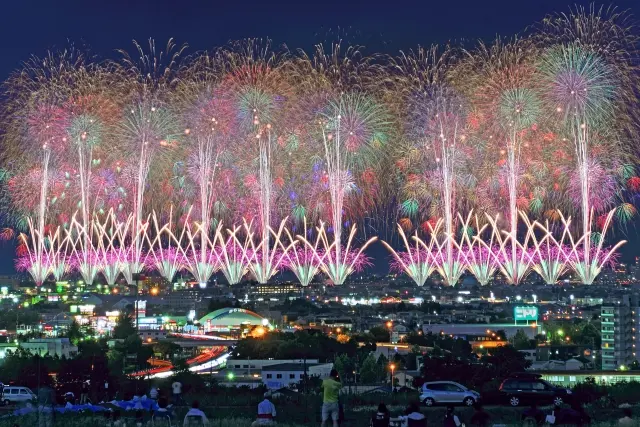
These fireworks are about far more than scale.
The festival was born out of war. The Nagaoka air raid of August 1, 1945 burned 80 percent of the city and took 1,489 lives.
The next year, on August 1, 1946, the city held a reconstruction festival; in time, August 1 became a day to mourn the war dead, with the fireworks held on the 2nd and 3rd. Remembrance and recovery are the foundation of this show.
2026 marks 100 years since the first successful shakudama, the display's signature shell. The shakudama is 90 cm across and weighs about 300 kg, opening roughly 650 m up in the sky. The number launched varies each night: two on August 2, four on August 3.
The other signature piece, the Phoenix, began in 2005 as a wish for recovery from the 2004 Chuetsu earthquake and as thanks for the support that came from across the country. Golden fireworks sweep across the night sky about 2 km wide. Set to music, it carries a meaning all its own for the people of Nagaoka.
The Bottom Line, and Next Year
Nagaoka in 2026 is a milestone, 100 years of the shakudama, and also a hard ticket, with no free seats and both nights sold out. From here the only route is official resale, and only for Japan residents. Accept that, plan your movements and the ride home, and you'll come away with few regrets.
If you cannot get a seat this year, the fireworks return every August 2 and 3. If you are coming from overseas, put next year's overseas-visitor sales window on your calendar and be ready to book the day it opens.
For other nationwide summer events, see Japan's Three Great Tohoku Festivals 2026, or, for reserved-seat fireworks you watch sitting down, Jingu Gaien Fireworks 2026.
Official site (tickets): https://www.nagaokahanabi.jp/
This article was translated from the original Japanese with AI assistance and reviewed by our editorial team. The Japanese version is authoritative.


