
Karato Market (唐戸市場, Karato Ichiba) is a seaside market in Shimonoseki, Yamaguchi, a city long known for fugu (pufferfish).
On Fridays, Saturdays, Sundays, and public holidays, rows of seafood stalls fill the ground floor for an event called Ikiiki Bakangai (活きいき馬関街), better known by its nickname: the "sushi battle."
Here is what trips up most first-time visitors: the stalls appear only on those days, and there is no sushi battle from Monday to Thursday. So the day you choose to go matters.
The sushi battle runs only on Fridays, Saturdays, Sundays, and public holidays, roughly 8–10 a.m. to about 3 p.m.; it is closed Monday through Thursday. Go soon after opening, when the choice is widest. If a holiday falls on a Monday, check before you go.
Sushi battle: Fri, Sat, Sun & holidays only
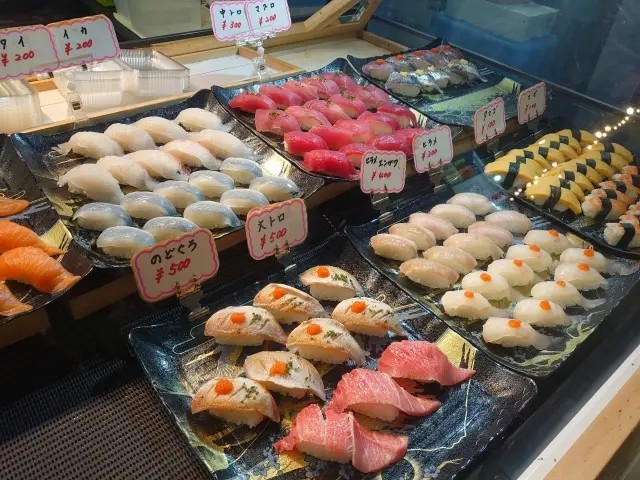
Ikiiki Bakangai is the name of this ground-floor event, and Karato Market's own website calls it the "sushi battle."
Each shop turns the morning's catch into nigiri and rice bowls, and fugu nigiri is part of the mix. Prices, portions, and the way you order vary from shop to shop, but in every case you eat on the spot.
The official site says flatly that there is "no event from Monday to Thursday." The Yamaguchi tourism federation and Karato Market both list public holidays among the open days.
The site does not spell out what happens when a public holiday or substitute holiday falls on a Monday.
The event is also closed over the New Year holidays (per the Yamaguchi tourism federation).
If your visit lands on one of those closed days, or on an ambiguous one like the Monday holiday above, it is worth a quick call to the Karato Market vendors' cooperative (083-231-0001) before you set out.
One more point: even from Monday to Thursday, when the stalls are gone, the market's fishmongers and eateries stay open. The sushi-battle buzz is confined to the stall days, but fugu and fresh seafood are on the menu on weekdays too.
Opening hours and the best time to go
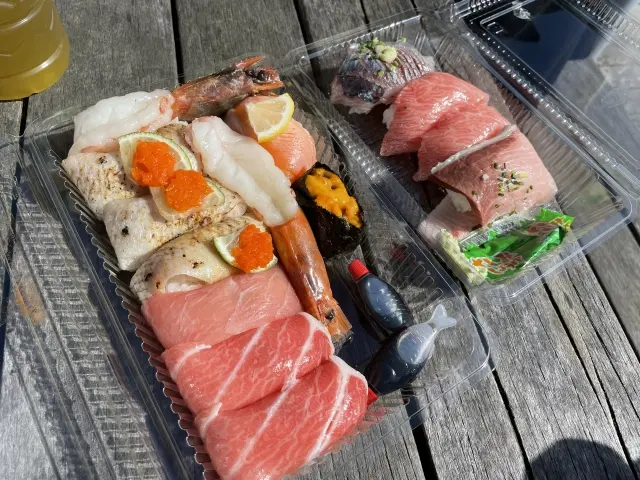
Opening times shift with the day of the week. On Sundays and holidays the stalls begin around 8 a.m.; on Fridays and Saturdays, around 9–10 a.m. Closing is about 3 p.m. in every case.
Even so, opening and closing hours differ by shop and depend on each day's supply. When a popular item sells out, that shop may close up early.
In practice, the selection is widest right at opening. If you want first pick of the day's fish, arrive in the morning, soon after opening.
Day | Sushi-battle hours |
|---|---|
Fri & Sat | ~9–10 a. |
Sun & holidays | ~8 a. |
Mon–Thu | Closed |
The market itself opens 8 a.m.–3 p.m. on Fridays and Saturdays and 7 a.m.–3 p.m. on Sundays and holidays (hours can shift with the day's supply). It gets going a little before the stalls do.
Tasting Shimonoseki fugu at the market
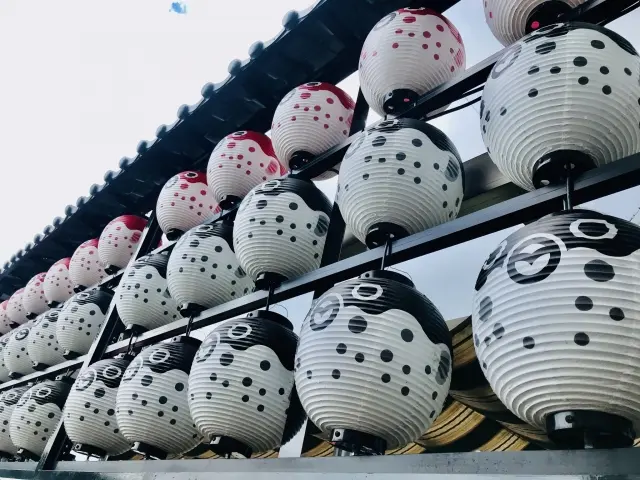
In Shimonoseki, fugu is called "fuku." The name echoes the words for good fortune (福) and happiness (幸福), and locals have long preferred the luckier-sounding name.
The stalls carry fugu nigiri, fugu karaage (deep-fried fugu), and fugu soup on Friday through Sunday and public holidays.
Beyond the sushi battle, the diner Yoshi (よし) serves a "fuku-fuku set" (ふくふく定食), which pairs fugu sashimi with fugu karaage. Inside the market, you will also find a "fugu gacha" (ふぐガチャ) and a fugu vending machine selling "fugu chazuke" (ふぐ茶漬け) and more.
Fugu is at its best in winter. Torafugu (tiger pufferfish) is in season from roughly October to February, and Hagi mafugu from about February to April.
Haedomari: the fugu auction market vs. Karato
Shimonoseki is also home to Haedomari Market (南風泊市場, Haedomari Shijō), described as Japan's only wholesale market dedicated to fugu. The Yamaguchi tourism federation and outlets such as CNN call it "the only one in Japan."
Trading uses a distinctive "bag auction," in which buyer and seller clasp hands inside a cloth bag to settle the price.
Haedomari, however, is a wholesale market where professionals trade fugu, separate from the visitor-friendly Karato Market, and the two are some distance apart. A simple way to keep them straight: Karato for eating fugu, Haedomari for fugu auctions.
Getting there without a car (bus and the Kanmon ferry)
Karato Market is easy to reach even without a car. There are two main ways to arrive by public transport.
The simplest is the bus from JR Shimonoseki Station. Take a Sanden Kotsu bus and get off at the "Karato" stop.
The ride takes about 7–10 minutes, and the market is a few minutes' walk from the stop. Fares were revised in August 2025, so check the Sanden Kotsu website for the current fare.
Coming by Shinkansen, transfer to the JR local line at Kokura. It is about 15 minutes to Shimonoseki Station, where you catch the same bus.
The other option is the Kanmon ferry, which crosses the strait from Mojiko (in Kitakyushu) to Karato. Kanmon Kisen runs the boats; a one-way adult fare is 400 yen (200 yen for children) and the crossing takes about 5 minutes.
It also makes for a nice outing: wander the retro Mojiko waterfront, then cross by boat. The market is right by the Karato pier. Note, though, that some sailings are suspended on Sundays and holidays, so check the Kanmon Kisen website for times before you leave.
Mode | Route | Adult fare | Time |
|---|---|---|---|
City bus | JR Shimonoseki Stn – Karato | See official site | ~7–10 min |
Kanmon ferry | Mojiko – Karato | 400 yen | ~5 min |
Planning your visit
What makes Karato Market special is the pairing of its sushi-battle stalls, on Friday through Sunday and holidays, with Shimonoseki's signature fugu. Plan your visit for one of those days and arrive in the morning, while the selection is at its widest.
Even without a car, you have options: the bus from JR Shimonoseki Station or the ferry from Mojiko. Visit in midwinter, when fugu is in season.
This article was translated from the original Japanese with AI assistance and reviewed by our editorial team. The Japanese version is authoritative.


