
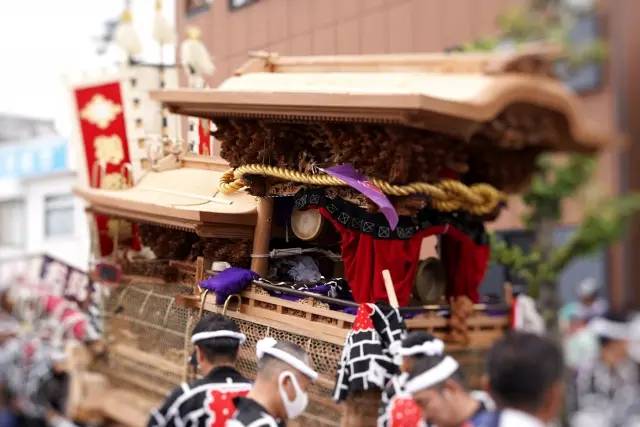
A danjiri (だんじり) is a float weighing more than four metric tons. Each float belongs to a neighborhood, and its crew pulls it through the streets.
In Kishiwada, the crews take corners at a right angle, at a run. The move is called yarimawashi (やりまわし), and the organizer of the paid seating calls it the festival's biggest draw.
Kishiwada (岸和田) is a coastal city in Osaka Prefecture, on the Nankai Main Line (南海本線). Block out Saturday, September 19 and Sunday, September 20, 2026.
Paid grandstands are run by a private company, not by the city. The cheapest seat is ¥3,300 (tax included), and sales opened on July 3, 2026. The release text names only that ¥3,300 floor, and the ticket page doesn't break prices down by day or by slot.
If you're buying a seat and can only make one day, make it the eve (September 19) — it's the only day with a dawn-pull slot and a parade slot. The main day (September 20) sells just two afternoon slots and nothing for the morning shrine entries, so if the shrine entries or the Konakara-zaka slope climb are what you came for, that's a roadside day.
For general festival etiquette and what to bring, see A Guide to Japanese Summer Festivals (Matsuri) in 2026: Food Stalls, Yukata, Etiquette, and Where to Go. This article covers Kishiwada on September 19 and September 20.
September 2026 schedule: trial pulls, eve, main day
Date | Event | Pulling hours |
|---|---|---|
Sun, Sep 6 | Trial pull (試験曳き) | 2:00–4:00 p. |
Fri, Sep 18 | Trial pull | 2:00–4:00 p. |
Sat, Sep 19 | Yoimiya (宵宮), the eve | 6:00 a. |
Sun, Sep 20 | Hongu (本宮), the main day | 9:00 a. |
Those are the hours Kishiwada City publishes for 2026. Four words do most of the work here. A trial pull is a rehearsal before the festival proper, and the dawn pull (曳き出し) is the first run of the eve.
A shrine entry (宮入り) is a neighborhood taking its float in to its shrine. Lantern pulling (灯入れ曳行) is the evening run, with lanterns fitted to the float.
Two districts take part in September: Kishiwada (岸和田) and Haruki (春木). Other districts hold their own danjiri festival in October, so check whether the dates you find online are September or October.
Nobody publishes what happens in the rain. According to the city, the timing and the route are decided by the nenban (年番), the stewards each neighborhood elects, and neither the city nor the Kishiwada Tourism Promotion Association has said where a same-day call would be posted.
Eve vs. main day: dawn pull, parade, shrine entries
Two different organizations publish the running order. The tourism association posted the 2026 order for the Kishiwada district back in May. The city posts its own later, on separate pages: Kishiwada district and Haruki district.
In 2025 the city's lists came out on September 1, so if those pages still show 2025, don't read last year's order as this year's.
Neither of them has published the Haruki running order for 2026.
- The dawn pull happens only on the eve. The city hasn't published a separate window for it in 2026; in 2025 it ran from 6:00 to 7:30 a.m. There's a 6:00 a.m. paid slot too.
- The parade is also only on the eve. For 2026 the Kishiwada district is listed as "parade and afternoon pulling" from 1:00 to 5:00 p.m., with the first float at 1:00 and the last of the 22 at 2:45 p.m., about five minutes apart.
- Shrine entries happen only on the main day. The association's heading for the Kishiwada district as a whole is 9:00 a.m. to 12:30 p.m.
- Lantern pulling happens on both days. No 2026 time has been published. In 2025 it ran from 7:00 to 10:00 p.m.
Under that heading, the first float into Kishiki Shrine (岸城神社) is Miyamotocho (宮本町) at 9:30 a.m. Kamimachi (上町) follows at 9:38 and Gokenyacho (五軒屋町) at 9:46 — about eight minutes apart. The last one listed is 11:22 a.m.
Entries into Kishiwada Tenjingu (岸和田天神宮) start with Numacho (沼町) at 10:00 a.m., and the list ends at 11:15 a.m.
One float goes in at 7:00 a.m. At Yasaka Shrine (弥栄神社), the entry listed as "extra no. 1, Haruki-minami" (番外1番 春木南) is set two hours before the 9:00 a.m. start published for the main day. It was 7:00 a.m. in 2025 as well.
Yasaka Shrine is where the Haruki district floats go in, and this single float appears as one extra line on the Kishiwada district list. The shrine is in Yahatacho (八幡町), a 15-minute walk from Haruki Station (春木駅) on the Nankai Main Line.
In 2025 the rest of the Haruki floats went into the same shrine between 8:30 a.m. and noon, and no 2026 times have been published for Haruki. Watch the 7:00 float and leave, and you'll miss the rest.
The dawn pull and the shrine entries fall on different days, so seeing both means two trips. And neither the city nor the association says where to stand for the dawn pull.
Yarimawashi viewing spots: Kankanba and Konakara-zaka
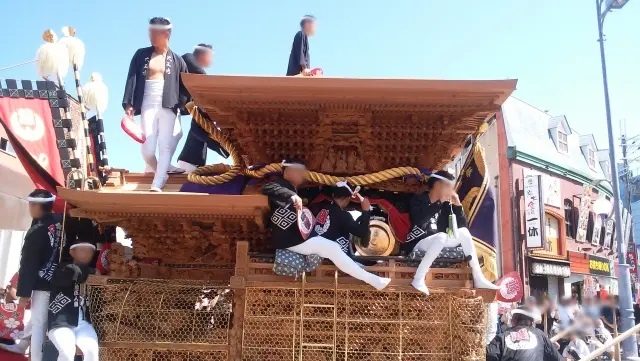
The city singles out two places.
Kankanba (カンカン場) is a 10-minute walk from Kishiwada Station (岸和田駅) on the Nankai Main Line. The city's own guide calls it a famous spot for spectacular yarimawashi. The name comes from the scales — kankan — that weighed cargo at the harbor that once stood here.
Konakara-zaka (こなから坂) is the slope in front of city hall, 15 minutes on foot from Kishiwada Station. The city writes that on the day before Respect for the Aged Day, floats heading into Kishiki Shrine charge up this slope and swing toward the castle.
Respect for the Aged Day falls on Monday, September 21 in 2026, so the day before is the main day, September 20. The association's list gives 9:30 to 11:22 a.m. for entries into Kishiki Shrine, which is the rough window — though nobody publishes whether those times mark the shrine gate or the foot of the slope.
The parade is a separate matter. The 2026 venues haven't been announced. In 2025 the Kishiwada district paraded in front of Kishiwada Station and the Haruki district in front of LaPark Kishiwada (ラパーク岸和田), right by Haruki Station.
The association's list carries no venue names, so check the city's pages closer to the date.
The paid grandstands: "Viewing Seat 2026"
The seating is run by TryHard Japan Co., Ltd. Kishiwada City's site says nothing about it. There are two stands, both around Kankanba in the Okitacho (大北町) area: a hill-side stand in the parking lot of Co-op Kishiwada, and a sea-side stand at Kishiwada CanCan Bayside Mall. "Hill side" here means inland.
The organizer describes the hill-side stand as facing Kankanba head-on, close enough to feel the yarimawashi. The sea-side stand, it says, gives you more room while still putting you in the middle of the crowd and the energy. Seats start at a ¥3,300 bench (tax included) and top out at a sofa VIP seat with a sunshade.
Seating is offered on three days, September 18–20. The September 6 trial pull has no slot at all.
Date | Slots on sale (start time) | Applications close |
|---|---|---|
Fri, Sep 18 — trial pull | 2:00 p. | Wed, Sep 16, 6:00 p. |
Sat, Sep 19 — eve | 6:00 a. | Thu, Sep 17, 6:00 p. |
Sun, Sep 20 — main day | 1:00 p. | Fri, Sep 18, 6:00 p. |
In its release the organizer names the slots "trial pull," "dawn pull," "parade," "afternoon 1," and "afternoon 2." On the ticket page, though, only three carry a name: the trial pull on the 18th, the 6:00 a.m. dawn pull on the 19th, and the 9:30 a.m. parade. The 1:00 and 3:30 p.m. slots on both days are listed by time alone.
On the eve, no 2026 time has been published for the morning pulling; in 2025 it ran from 9:30 to 11:30 a.m. The parade and afternoon pulling are published for 2026, from 1:00 to 5:00 p.m. On the main day the afternoon pulling ran from 1:00 to 5:00 p.m. in 2025.
The paid slots overlap those hours, but the organizer doesn't say which stage of the day the 1:00 and 3:30 p.m. slots cover.
The release does describe the 9:30 a.m. "parade" slot as the stretch when all 22 floats pass in front of the stands. The association, however, lists the 2026 Kishiwada-district parade from 1:00 p.m., so the two times don't match.
The stands are around Kankanba, in the Kishiwada district, so this is not the Haruki parade either. Ask the organizer before you pick a slot.
No evening slots are sold, even though the lantern pulling runs until late on both days. With no morning slot on the main day either, watching the shrine entries means standing along the route. All of the city's spectator guidance assumes you're at the roadside, and it never mentions an admission fee.
Tickets are sold online through e+ (eplus), first-come rather than by lottery, and delivered as smartphone tickets. e+ says you have to register your companions and a photo of your face before you apply, so don't leave it until the closing day. There are no refunds or exchanges once you've bought.
For prices by seat type, whether same-day tickets exist, and what happens in the rain, contact TryHard Japan at 06-4708-6470. The same number can tell you whether there's any way to buy other than online.
Trains, stations, and parking
Kishiwada City asks people not to come by car. The only lot it announces for the festival is a paid one at Kishiwada CanCan Bayside Mall, and that takes tour buses only, by prior application.
The city warns that Kishiwada Station gets very crowded and points people to Takojizo (蛸地蔵) or Izumi-Omiya (和泉大宮) Station instead. Both are on the Nankai Main Line. That advice is about congestion around Kishiwada Station, though — it says nothing about which station to use for Haruki.
The Kankanba and Konakara-zaka walking times above are from Kishiwada Station. No times have been published from Takojizo or Izumi-Omiya.
The 2026 closure dates and sections hadn't been published as of August 2, 2026. In 2025 they came out on August 1.
Check the city's traffic restriction notice before you set out — and check the year at the top of it, because the page may still be showing the 2025 edition. For the sections and hours under restriction, call the traffic division at Kishiwada Police Station, 072-439-1234.
Spectator rules: ladders, umbrellas, smoking, and giving the float room
These are the rules the city puts in writing.
- Don't stand on stepladders or step stools. The city's wording is emphatic: absolutely do not.
- Don't watch from under an umbrella. The city calls it very dangerous and asks you to bring a raincoat.
- Don't smoke while watching.
- Give the float room. A danjiri is steered from the rear with a lever called an ushiro-teko (後梃子), and that takes about twice the width of the float itself. When one comes at you, step back and leave the road clear.
Do what the staff and officers tell you. Mid-September in Kishiwada is still hot; in its 2025 newsletter the city asked spectators to watch out for heatstroke.
Food stalls on September 19 and September 20
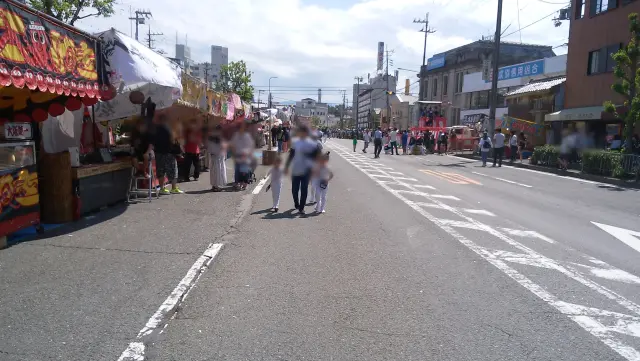
The 2025 festival ran on September 13 and September 14, and stalls lined the route. The Kishiwada City Fire Department announced that it had inspected stalls using open flame.
Neither the city nor the tourism association publishes where the stalls stand or how many there are, and neither has said anything about September 19 and September 20, 2026. Don't pick your day around the food.
So settle the day first — the eve for the dawn pull and the parade, the main day for the shrine entries. Then check two pages before you leave home: the city's traffic restriction notice and the running order for the district you're heading to. If you want a seat rather than a spot on the curb, the main-day applications close at 6:00 p.m. on September 18.
This article was translated from the original Japanese with AI assistance and reviewed by our editorial team. The Japanese version is authoritative.