
The Kurama Fire Festival (鞍馬の火祭, Kurama-no-hi-matsuri) returns on Thursday, October 22, 2026. Held at Yuki-jinja Shrine (由岐神社) in the mountain village of Kurama, north of Kyoto, it is one of Kyoto's three most unusual festivals, and after dark the narrow lanes fill with giant flaming torches.
Getting there is the hard part. Kurama is a tiny village on a single rail line, and on festival day the roads close and cars are shut out entirely. This guide sticks to what you actually need to decide: can you see it, how do you get in, and how do you get back. The nights up here in late October are cold, so it is worth checking what to wear in Japan in autumn before you go.
You cannot drive to Kurama. Every parking lot is closed and the road shuts from 3 p.m. until about 1 a.m. Eizan Railway is your only way in and out, and it caps how many people can board, so plan around the train, not the fire.
The basics for 2026
Item | Details |
|---|---|
Date | Thursday, October 22, 2026 |
Hours | 6:00 p. |
Place | Yuki-jinja Shrine / Kurama-dera temple gate, Kurama, Sakyo-ku, Kyoto |
Access | About a 6-minute walk from Kurama Station (Eizan Railway) |
Reserved seating | None announced (see below) |
The festival is the annual rite of Yuki-jinja, a shrine that guards Kurama-dera temple. It dates to the year 940, when villagers welcomed a deity to Kurama with raised torches, or so the story goes. In 1983 the festival was listed as a Kyoto City intangible folk cultural property.
What happens on the night
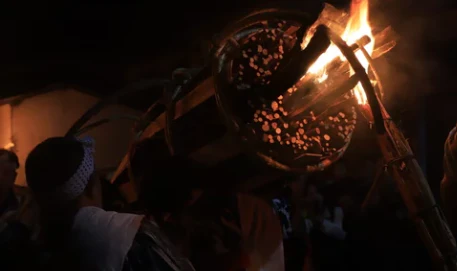
The timings below reflect a typical festival night rather than an official schedule for 2026, so treat them as a rough guide. Around 6 p.m., bonfires are lit in front of the village houses. Children carry small torches through the lanes, and then adults shoulder huge torches, chanting "sai-rei-ya, sai-ryo" as they go.
Late in the evening the torches gather at the temple gate and the fire seems to swallow the stone steps. A sacred rope is cut, portable shrines (mikoshi) appear, and bearers carry them down the steep steps. The festival reaches its climax with the mikoshi procession around midnight and ends with a ceremony marking their return the next morning.
There is no reserved seating, so you watch from the roadside. The temple gate and the upper steps are roped off as sacred ground just before the mikoshi procession begins, so you watch from a little further back along the lane.
Getting there and the road closures on October 22

From central Kyoto, take the Keihan Main Line to Demachiyanagi and change to the Eizan Railway Kurama Line, riding it to the last stop, Kurama. Leave extra time: the Eizan platform gets very crowded on the evening of the festival. From 3 p.m., cars are barred on the stretch between Kibuneguchi and Kurama Onsen, and the old Kurama road itself becomes the stage.
You cannot reach the village by car or taxi. Every nearby parking lot is closed for the day, and Kyoto City asks everyone to come by public transport. The roads remain closed and security staff stay on duty until about 1 a.m.
Just before the mikoshi procession, the ground above the temple gate is closed off, and the shrine office shuts around 4:30 p.m. The narrow lanes get packed with people, so follow all instructions from the police and staff.
The last train home
Getting home takes the most planning. Eizan Railway runs a special "fire festival timetable," but only one line serves Kurama, and when it is busiest the station limits boarding, which means long waits and some people who simply can't get on. In heavy crowds, service toward Kurama can even be paused on police instruction.
For reference, in 2025 the last train from Kurama toward Demachiyanagi left at 11:24 p.m. The climax comes around midnight, so if you stay to the very end, the last train is already gone.
If you want to get home by rail, plan to peel off partway through the climax and head for the station well before that last departure. If you want to see it through, plan on a night nearby or another way back. Eizan Railway posts the 2026 timetable just before the festival, so confirm the last train on their official site before you set out.
Before you go
- Reserved seats: Kyoto City and Yuki-jinja list no paid seating. You watch free from the roadside, within whatever areas are open on the day.
- Food stalls: On October 22, there is no official word on stalls or vendors, so pack your own food and drink before heading up to Kurama.
- Rain: Neither the city nor the shrine states whether the festival runs, is canceled, or is postponed in bad weather. If the weather looks bad, check for updates on the day.
- Crowds: About 4,600 visitors came in 2025. Torches pass close by and the lanes get very tight, so arrive before dark, dress warmly, and pick a safe spot and time if you are with small children or older family.
This article was translated from the original Japanese with AI assistance and reviewed by our editorial team. The Japanese version is authoritative.
