
Miyajima, the island of the famous "floating" torii gate near Hiroshima, turns brilliant red and gold every November. At the center of the color is Momijidani Park ("Maple Valley"), where around 700 maples cover the foot of Mt. Misen.
If you are planning a day trip from Hiroshima, a few things are easy to miss. The leaves peak for only a short window, the uphill ropeway needs an advance reservation on the busiest days, and there is a ¥100 visitor tax that started in 2023. Plan around them in advance, and the day trip goes far more smoothly.
Planning your wider autumn trip? Compare peak dates across the country in our guide to Japan's autumn leaves in 2026.
The Miyajima visitor tax is ¥100 per person. It is added to your ferry fare and collected once, on the way over.
Momijidani's peak: mid-to-late November
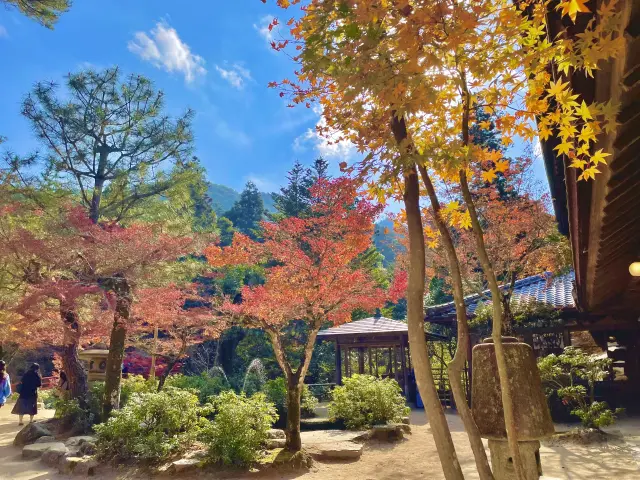
Momijidani Park usually reaches its best color from mid- to late November. That is the Miyajima Tourist Association's guideline, and the exact timing moves by a week or so with each year's temperatures. Japan's weather services begin publishing their forecasts in late September, so check them before you settle on a date.
The park has about 700 maples: roughly 560 iroha-momiji, 100 o-momiji, and around 40 others such as yama-momiji. When the iroha maples turn, the whole valley goes deep red.
There is no admission fee, and you can walk through the park during the day. It sits about a 5-to-10-minute walk from Itsukushima Shrine, or 20 minutes from the ferry pier along the Omotesando shopping street. The red bridge over the stream is one of the island's most photographed autumn spots, and the nearby temples of Daisho-in and Daigan-ji are easy to visit on the same walk.
Getting to Miyajima from Hiroshima
From Hiroshima you take a train to Miyajimaguchi on the mainland, then a ferry across.
The JR Sanyo Line runs directly from Hiroshima Station to Miyajimaguchi in about 30 minutes for ¥420. The Hiroden tram takes a little longer, around 35 minutes, but it runs frequently and you can board it right in the city center. Either station is a three-to-five-minute walk from the ferry terminal.
Two companies run the crossing, JR Miyajima Ferry and Miyajima Matsudai Kisen, at identical fares: ¥200 one way for adults and ¥100 for children, or ¥400 and ¥200 round trip. The ride takes about 10 minutes, and both accept the usual IC transit cards. JR sails about every 15 minutes through the day, while Matsudai runs every 20 minutes — though it steps up to about 10 during daytime hours. Extra sailings are added on a peak-season timetable. Driving is more trouble than it is worth here, since the roads around Miyajimaguchi get congested.
The ¥100 visitor tax, explained
Since October 2023, everyone crossing to Miyajima pays a visitor tax. It is ¥100 per person per visit, the same for adults and children, with a ¥500 annual option for frequent visitors.
Paying is simple. It is added to your ferry ticket and collected by the boat company. Because the tax is charged for entering the island, you pay it only on the way over, from Miyajimaguchi to Miyajima. A round trip still counts as a single entry, so there is no charge on the way back. Preschoolers are exempt.
Item | Adult | Child |
|---|---|---|
Ferry (round trip) | ¥400 | ¥200 |
Visitor tax (per entry) | ¥100 | ¥100 |
Miyajima Ropeway (round trip) | ¥2,000 | ¥1,000 |
Child fares are for ages 6 to 11; the visitor tax is ¥100 for everyone, and preschoolers are exempt. The ropeway also sells one-way fares (¥1,100 for adults, ¥550 for children).
The one-way trip takes roughly 45 minutes to an hour with the connection. For a full day from Hiroshima, budget about ¥1,340 per adult for round-trip transport (¥840 train, ¥400 ferry, ¥100 tax), plus ¥2,000 if you ride the ropeway, so about ¥3,340 in all.
The ropeway up Mt. Misen and its peak-day reservations
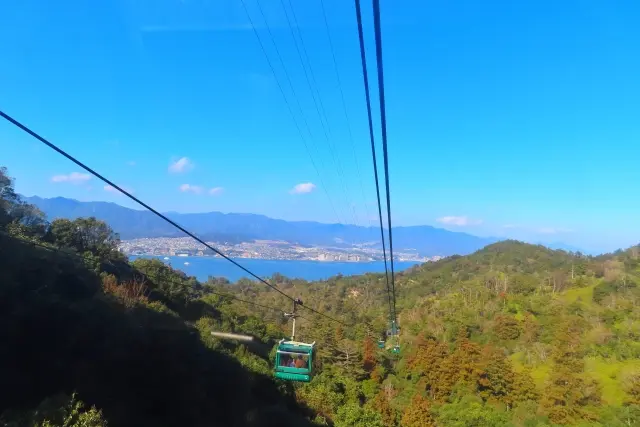
Behind Momijidani Park, the Miyajima Ropeway climbs partway up Mt. Misen. The base station is at the upper end of the park, about a 20-to-25-minute walk from the ferry pier. The line runs in two sections, and you change cars at a station along the way: about 10 minutes in a small gondola, then a few minutes in a larger car. Round-trip fares are ¥2,000 for adults and ¥1,000 for children.
The ropeway runs roughly 9:00 a.m. to 4:00 p.m. going up, with the last car down around 4:30 p.m. Those times shift by season, and it can stop for maintenance or weather, so check the official schedule before you go.
One detail is easy to miss: on the busiest autumn dates, the uphill ropeway is reservation-only. For November 2026 the designated dates are the 1st, 7th, 8th, 14th, 15th, 21st, 22nd, 23rd, 28th, and 29th, the weekends and the November 23 holiday that fall right on the peak. One holiday, November 3, is not on the list — though the operator can revise it, so check before you count on it. Online booking opens three months ahead, and the operator asks you to book in advance on those dates — treat a reservation as required, not optional. The list changes from year to year, so confirm the current dates and how to book on the Miyajima Ropeway site before your trip.
On peak-season designated dates (mostly weekends and holidays), the uphill ropeway is reservation-only. Booking opens three months ahead, and the operator asks you to reserve in advance — treat it as required.
The observation deck is a one-minute walk from Shishiiwa, the top station, and looks out over the islands of the Seto Inland Sea. The summit of Mt. Misen (535 m) is another 30 minutes on foot up the trail, through the primeval forest that is itself a Natural Monument and part of the Itsukushima World Heritage site.
One thing to know before you climb: Reikado, the hall near the summit that housed the “flame that never goes out,” burned down on May 20, 2026. The flame itself survived — the seed fire was carried out of the building, so the 1,200-year-old flame was not lost.
The mountain is open. The closure imposed after the fire was lifted the following afternoon, and the trails and the ropeway have run normally since. Rebuilding is expected to take more than a year, so there is no hall on the site at present, and the temple has not said whether the flame can be seen there in the meantime. Daisho-in is accepting donations toward the rebuild.
Miyajima after dark
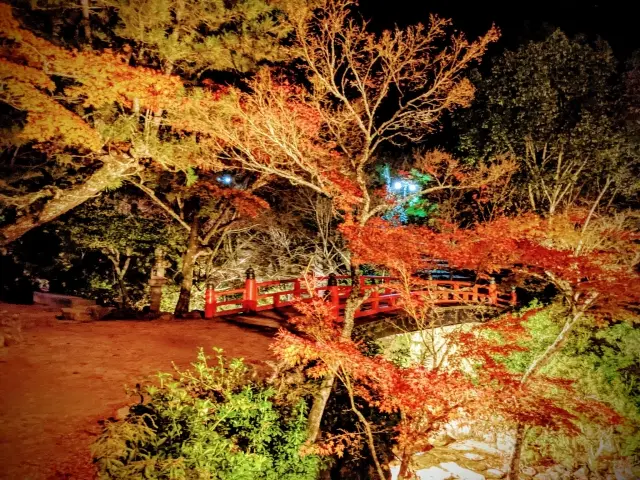
In some years, Momijidani Park is lit in the evening during the autumn season, and the maples stand out against the dark. For 2026 the one confirmed evening event is the Beni-Momiji Light-Up at Daisho-in Temple, listed by the Miyajima Tourist Association for November 17 to 29, 5:30 to 7:00 p.m., lighting the temple halls and the maples around them.
Bring cash. The association's listing says admission is free, but in 2025 it was ¥1,000 for adults, free for high-school students and younger. Daisho-in's regular hours end at 5 p.m., so a 5:30 p.m. start falls outside them. The temple has not posted its own 2026 notice, so budget about ¥1,000 to be safe.
The day-to-day detail is unpublished too. Nothing official says whether it runs every night in 2026; in 2025 it ran throughout the period, with Fridays and Saturdays extended to 9 p.m. There is no published wet-weather policy. No booking was needed in 2025.
Momijidani Park's own light-up is now on the Miyajima Tourist Association's events calendar for November 13 (Fri) to December 6 (Sun), 2026, and it's free. Lighting hours aren't listed yet, so check before you go; the contact is Hatsukaichi City's tourism section.
Another highlight after dark is Itsukushima Shrine. Its torii gate and halls glow almost every night, from about 30 minutes after sunset until around 11:00 p.m., though the shrine skips some nights for its own events. You cannot go inside the shrine buildings while it is lit, so visit the shrine itself during the day.
Beating the crowds on a day trip
Crowds on Miyajima swing hard by the hour: it fills up from late morning through the afternoon, and the early hours are the easiest walking. Weekday mornings are the quietest by far.
So for a day trip, take one of the first ferries and do Momijidani Park and the ropeway in the morning. Eat lunch early, before the rush, and you will walk straight into a restaurant. Just keep the ropeway reservation in mind if your date is a designated one.
In November, temperatures by the water and on Mt. Misen run cooler than in central Hiroshima, so pack a warm layer, especially if you stay into the evening. To catch the island after dark, ride up Misen first and come back down before dusk while the ropeway is still running, then walk through Momijidani Park and around the shrine grounds after dark. If you are there between November 17 and 29, work the Daisho-in light-up (5:30 to 7 p.m.) in first, then walk down to the shrine. Even in a year without the park lighting, the shrine is lit most nights (shrine events can interrupt it), so the evening is worth staying for. The last ferry back, run by JR Miyajima Ferry, leaves Miyajima around 10 p.m. (the Matsudai ferry stops earlier, around 8:15 p.m.), so there is no rush to leave before the light fades.
This article was translated from the original Japanese with AI assistance and reviewed by our editorial team. The Japanese version is authoritative.