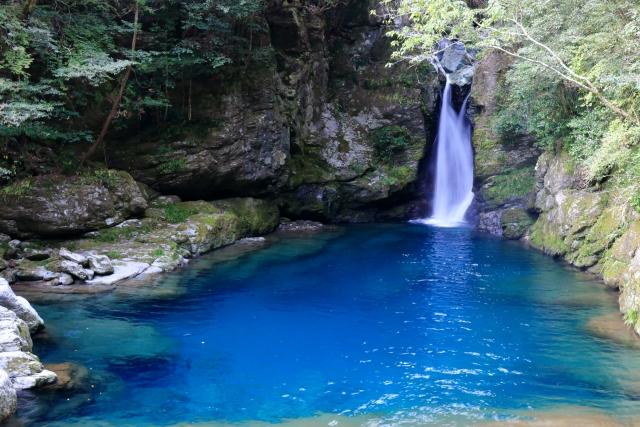
Niyodo Blue (仁淀ブルー) isn't a single destination. It's the name photographers and locals give to the striking blue of the Niyodo River (仁淀川) in Kochi Prefecture, on the island of Shikoku.
The color is most vivid at a handful of pools and gorges along the river, and three stand out: Nikobuchi (にこ淵), Yasui Gorge (安居渓谷), and Nakatsu Gorge (中津渓谷).
For the deep blue seen in so many photographs, head to Nikobuchi around midday, when the sun is high and its light reaches the water directly. For blue in any season, Yasui Gorge is the more dependable spot.
The three spots are more than 20 km apart, with very little public transport between them, so you'll want a rental car or a chartered taxi to see all three.
No car? You can still visit: the Niyodo Blue Tourism Council runs chartered taxis from central Kochi, with an English booking page. The 4-hour Nikobuchi course is about ¥7,400 per person for a group of four.
What "Niyodo Blue" Means
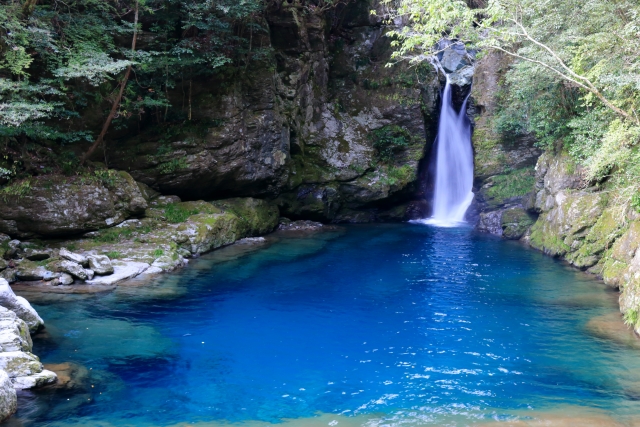
According to the Niyodo Blue Tourism Council, the name spread after the photographer Nobuyuki Takahashi (高橋宣之) began calling the river's color "Niyodo Blue."
One of Shikoku's great rivers, the Niyodo rises on Mt. Ishizuchi (石鎚山), the highest peak in western Japan, and runs 124 km to Tosa Bay.
The blue comes from unusually clear water reflecting short-wavelength blue light. A fast current keeps sediment from settling, cold water slows algae, and the green schist on the riverbed deepens the color.
Japan's land ministry has ranked the Niyodo among the country's cleanest rivers ten times.
Which Spot Is Bluest, and When
The blue changes by spot, by season, and by time of day. For the richest color, Nikobuchi is the place to start.
At Nikobuchi the water shifts between blue and green through the day, and the deepest blue comes when the sun sits high overhead (per the Kochi Visitors and Convention Association). Aim for late morning to early afternoon, while the light still reaches the pool.
Yasui Gorge, by contrast, holds its blue all year: fresh greenery in spring, higher water levels and more force in summer, and foliage in autumn. The water turns clearest in winter, which is the season to come if the blue itself is what you want.
Nakatsu Gorge, the third spot, is more about the gorge walk and autumn color than the blue itself.
The Three Spots Compared
Scenery, walking distance and parking all vary from spot to spot. Here they are side by side.
Spot | Town | Highlight | Walking time | Parking | In the water |
|---|---|---|---|---|---|
Nikobuchi | Ino | The blue pool | A short walk down the path | ~5 nearby lots + overflow | No entry or swimming |
Yasui Gorge | Niyodogawa | Suisho-buchi pool, Hiryu Falls | 1–2 hours | By Horaiso and beyond (count not published) | Asked to refrain from swimming and river play |
Nakatsu Gorge | Niyodogawa | Uryu Falls, Ryugu-buchi pool | ~1.5 hrs round trip | 3 at the entrance + ~30 at the old school ground | Deep, fast water; at your own risk |
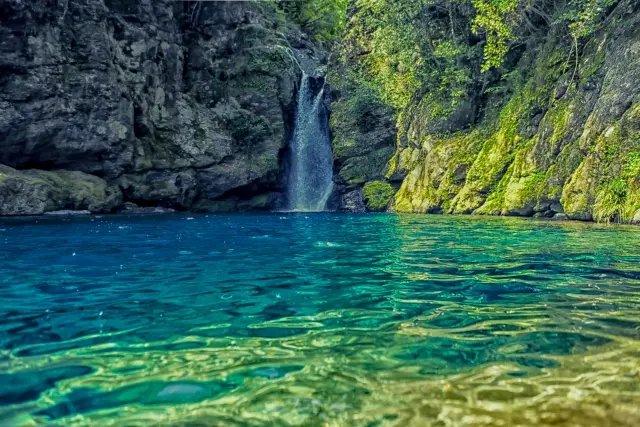
Nikobuchi (Ino Town) is a small mountain pool that holds a brilliant blue. The old approach meant about 100 steep steps, but a new path finished in 2025 starts as a gentle slope and ends in low, easy stairs.
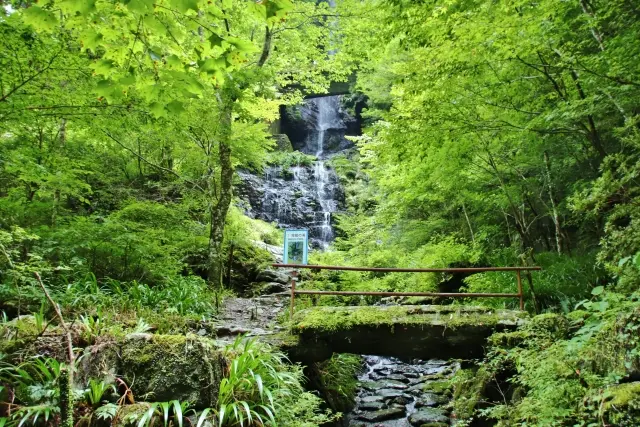
Yasui Gorge (Niyodogawa Town) spreads its highlights along the gorge: the Suisho-buchi pool, Hiryu Falls and others. Plan on at least an hour, ideally two. The paths get slick when wet, and at Suisho-buchi and the check dam you're asked to refrain from swimming, SUP and other river play.
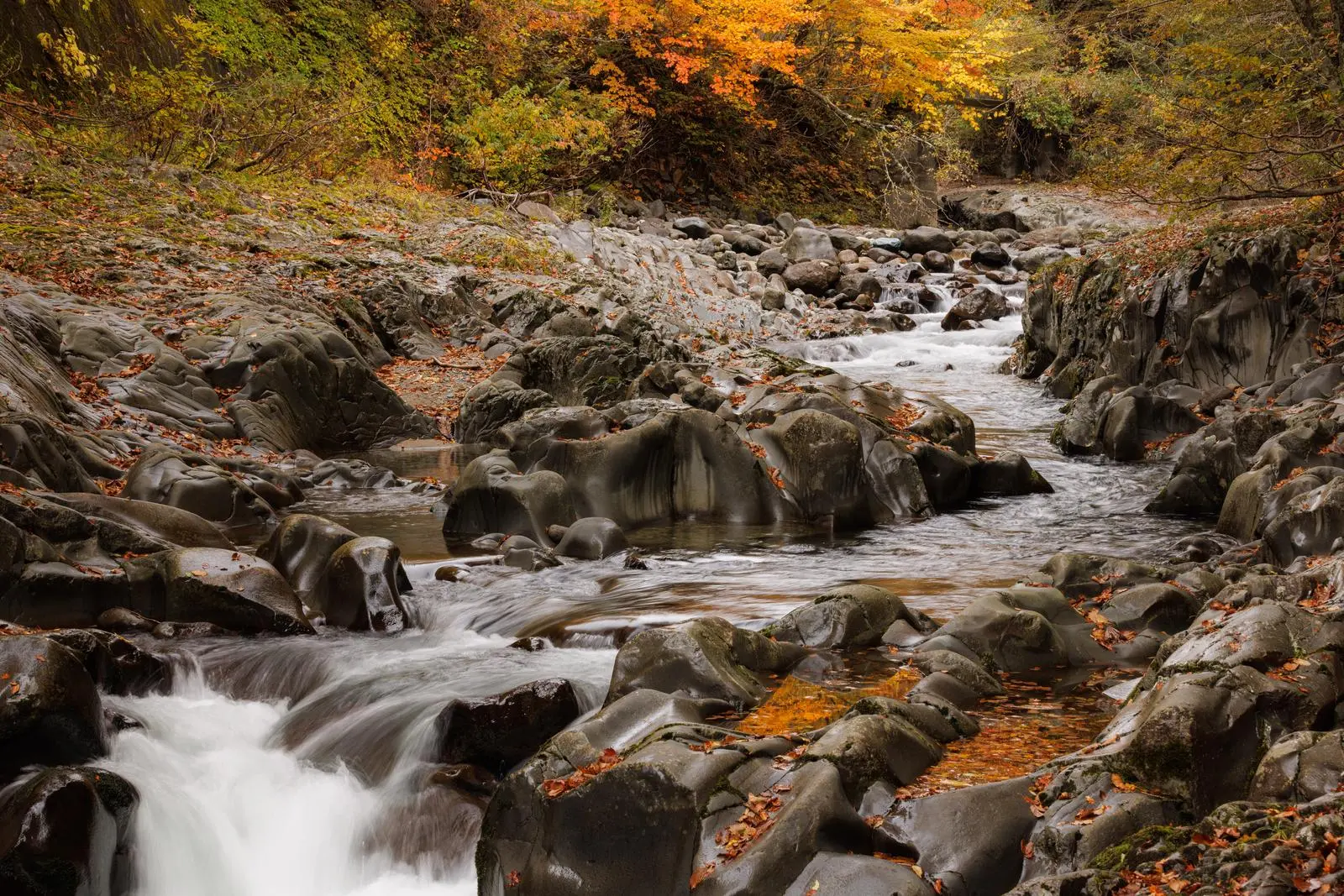
A walking path leads through Nakatsu Gorge (Niyodogawa Town) to Uryu Falls and the Ryugu-buchi pool. The round trip from the entrance, past the falls to the stone pillar (石柱) at the far end, takes about 90 minutes.
Swimming is not prohibited inside Nakatsu Gorge, but the water is deep and the current fast, so anyone who enters does so at their own risk. The path is slippery too, and falls have happened when visitors were focused on their photos, so watch your footing.
Nikobuchi: A Sacred Site With Strict Rules
Long before it drew photographers, Nikobuchi was held sacred as the home of a water deity. Entering the water, eating, and relieving yourself are all strictly forbidden, and swimming is not allowed (Niyodo Blue Tourism Council). The rocks are slippery, so don't get too close to the edge.
At the entrance to the path, visitors are asked for a small conservation donation (handled by the Ino Town Tourism Association). Pay whatever amount is posted on site.
There are about five parking areas nearby, plus overflow space, and a roadside monitor shows where spaces are open. Long weekends are reliably crowded, and guards sometimes direct traffic. You can't park anywhere that isn't marked.
Autumn Colors and the Winter Blue Glow
Yasui Gorge and Nakatsu Gorge are known for autumn color too, usually at its best from mid- to late November. Nakatsu Gorge normally holds an autumn festival in mid-November, but the 2026 dates haven't been announced yet, so check with the Niyodogawa Town Tourism Association.
If you're planning a trip around autumn color more widely, our Japan Autumn Leaves 2026: Peak Dates and 8 Best Spots guide lists peak timing across the country.
In autumn, the Niyodo Blue Experience Expo brings SUP, canoeing and other activities to the river basin. In 2026 it runs from September 26 to November 29, but each activity has its own set dates and needs a reservation.
During the foliage season itself, there is no evening light show.
The light-up that turns the river blue is a separate winter event, the Niyodo Blue Festa, held in front of Nakatsu Gorge Yunomori (中津渓谷ゆの森). The most recent run was January 2 to February 28, 2026, and the dates for the coming winter (2026–27) aren't out yet.
Yunomori, the venue, is a single inn that also offers day-use bathing. Rates and hours can change, so it's safest to call ahead (0889-36-0680) before you stop by.
Getting There
By car, Nikobuchi is about 70 minutes from central Kochi, 90 from Kochi Ryoma Airport, and 50 from JR Ino Station. Nakatsu Gorge is about 80 minutes from central Kochi.
To reach Yasui Gorge, turn from National Route 439 onto Prefectural Route 362; the final 8 km are narrow. If you aren't used to mountain driving, consider a taxi instead.
Traffic is heaviest around Golden Week and Obon, and on weekends and public holidays in November. At Yasui Gorge, access can be restricted on the busiest days depending on how crowded it gets, so leave early, allow extra time, or consider a taxi.
If you'd rather not drive, the Niyodo Blue Tourism Council runs chartered sightseeing taxis from central Kochi, with an English booking page. A 4-hour course to Nikobuchi is ¥28,700 for one person, or ¥7,400 each for a group of four (tax included, as a guide).
There's also an 8-hour course covering all three spots (¥58,900 for one, ¥16,400 each for four, lunch included). Book at least five days ahead, and check the latest fares and conditions on the Niyodo Blue Tourism Council's English booking page.
Public transport is limited. For Nikobuchi, take a Kenko Hokubu Kotsu bus (toward Nagasawa) from JR Ino Station or Kochi Station Bus Terminal to Hodono Iriguchi (程野入口), then walk 20–30 minutes; buses are few, so check the timetable in advance.
For Yasui Gorge, the Council itself advises against relying on the local bus.
Walking the Trails Safely
All three spots sit deep in the mountains, where the weather turns quickly. Wear shoes you can really walk in, and give yourself plenty of time. If you're coming for the winter blue, remember the valleys are cold and shaded — dress warmer than you would in the city.
This article was translated from the original Japanese with AI assistance and reviewed by our editorial team. The Japanese version is authoritative.