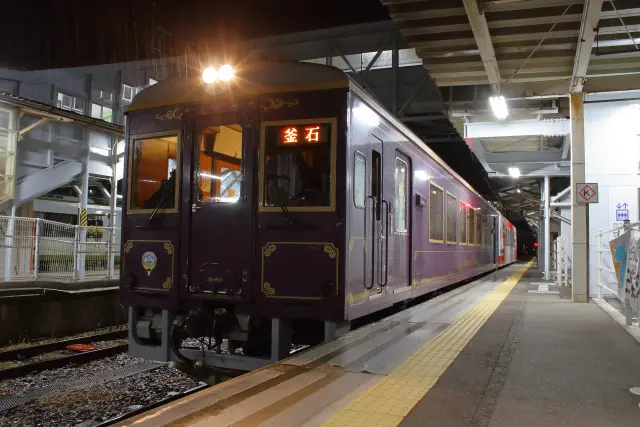

The Sanriku Railway kotatsu train (こたつ列車) runs on Saturdays and Sundays from December 19, 2026 to March 28, 2027, skipping March 20 and 21. A kotatsu is a low table covered with a quilt; on this train, you sit at one while the Pacific coast passes by outside.
Two versions run on the Rias Line between Miyako (宮古) and Kuji (久慈) in Iwate Prefecture: the classic Japanese-style train and a Western-style one. Each makes one trip a day.
You book a whole box for up to four people (10,000 or 14,000 yen) or a side-by-side pair of seats (6,000 yen), online only, no later than three days before you ride.
If a website or guidebook tells you to book by 1 p.m. two days ahead and pay a 300-yen seat fee, it's describing an older season.
Dates, timetable and Saturday vs. Sunday
Day | Miyako 11:40 → Kuji 13:30 | Kuji 12:45 → Miyako 14:40 |
|---|---|---|
Saturday | Western-style | Japanese-style |
Sunday | Japanese-style | Western-style |
So the day you pick decides the style. Starting from Miyako, ride on Sunday for the Japanese-style train or Saturday for the Western-style one. From Kuji, it's the other way around.
The trains run on 28 days in total. Weekday holidays such as Monday, January 11, aren't on the calendar, but the New Year weekend of January 2 and 3 is.
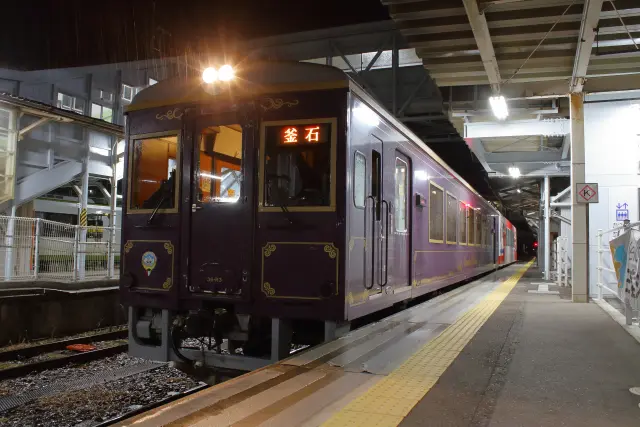
The Japanese-style train seats you on tatami around a kotatsu; the Western-style one is a retro, understated car fitted with Western-style kotatsu.
Since each train runs only once a day, plan it as a one-way ride along the coast. Starting at Miyako means coming in from Morioka and leaving toward Hachinohe; starting at Kuji is the reverse. Both routes are covered below.
Box and seat prices
Seat type | Price (tax included) |
|---|---|
Ocean-side box (up to 4 people) | 14,000 yen per box |
Unassigned box (up to 4 people) | 10,000 yen per box |
Unassigned pair of seats (side by side, 1-2 people) | 6,000 yen |
The page lists one set of prices for both trains. Only the ocean-side box guarantees an ocean-side seat. With the other two options you can't choose the ocean or mountain side, and the railway doesn't take seat-number requests.
The view counts most on the Osawa Bridge (大沢橋梁) and Akkagawa Bridge (安家川橋梁). Both stand about 30 meters high, and the train slows or briefly stops on them with the Pacific in sight.
The pair of seats works for one or two people, and a solo traveler pays the full 6,000 yen. Someone else may sit across the table from you.
Split four ways, the ocean-side box comes to 3,500 yen each and the unassigned box to 2,500 yen. Two people sharing a pair of seats pay 3,000 yen each, or 5,000 yen each if they book a whole unassigned box.
Neither the official page nor the booking screen says whether these prices include the train fare.
For reference, the regular one-way adult fare between Miyako and Kuji is 2,080 yen, according to a Sanriku Railway notice dated November 10, 2026. That's what you'd add if the box price turns out not to include it.
How to book: Japanese-only site
Booking is already open and is available only through Sanriku Railway's kotatsu train page. There are no phone bookings. The page and the booking screens are in Japanese only, so a browser translation tool helps.
On the page's calendar, tap 予約 (reserve) on your date and pick a train. That takes you to the booking and payment system, Zenryo Marutto Pay (全旅マルっとペイ).
Don't close that window until you've finished; if you close it partway, the booking won't be completed. Once it's complete, you'll get an email, and the details also appear on My Page (マイページ).
The first booking screen doesn't say which payment methods are accepted. If you'll be paying with an overseas card, or want to ask about the fare, child prices or bad-weather cancellations, email the railway's passenger sales department at reserve@sanrikutetsudou.com well before the deadline.
You can also call with questions (not bookings) at +81-193-62-2215, 9:00-17:00 Japan time.
The deadline is three days before your ride. The booking screen shows how many boxes and seats are left for each type, so check it before you settle on a date.
Cancellation fees (the same rates apply to bento orders):
- 3 to 2 days before: 30%
- The day before: 50%
- On the day, or no-show: 100%
Cancellations made on My Page outside office hours count from the next business day. Changing a booking may mean rebooking it from scratch.
Bento and on-board extras
Bento are optional, but if you want one, order it when you book your seats, by the same three-day deadline. Orders generally can't be changed afterward.
The train from Kuji offers four bento: scallop (1,500 yen), abalone (2,000 yen), sea urchin rice bowl (2,600 yen) and the Tairyo Funauta set (大漁舟唄御膳, 3,500 yen).
The train from Miyako offers three: seafood chirashi (2,000 yen), the kotatsu set (こたつ御膳, 2,600 yen) and Miyako's bin-don (瓶ドン) with fish soup (3,000 yen). Contents of any bento may vary slightly depending on supply.
Alcoholic and soft drinks, snacks and railway goods are sold on board, and a guide rides along to point out sights on the way.
The railway also says the Namomi (なもみ), figures from a Little New Year (小正月) custom in one part of the Sanriku coast, will appear on board, though it doesn't say on which trains or days.
Getting there and away
Times below come from the November 2026 JR East timetables and the joint JR and Iwate Kenpoku Bus timetable. Times on the March dates could change with JR's spring timetable revision. The No. 106 is Iwate Kenpoku Bus's route between Morioka and Miyako.
Miyako → Kuji (Western-style on Saturday, Japanese-style on Sunday)
Getting to Miyako for 11:40: On weekends, three connections from Morioka get you there in time. The JR Yamada Line leaves at 6:32 (arriving 9:01), and the No. 106 express bus at 7:40 (arriving 9:55).
The last one that works is the No. 106 limited express bus at 9:40, which gets in at 11:20 with 20 minutes to spare.
Hotels in Miyako for the night before: availability and rates
Leaving Kuji after 13:30: The 13:03 Hachinohe Line train leaves before you arrive, and on weekends the next one isn't until 17:00, about three and a half hours after you get in.
To fill that gap, Sanriku Railway sells a sightseeing bus tour from Kuji to Hachinohe for 5,000 yen per person. It leaves Kuji Station at 13:50, stops at Moguranpia (もぐらんぴあ), an underground aquarium (admission included), and reaches Hachinohe Station around 17:05.
It runs on weekends from December 19 to February 28. Book it online, separately from the train, at least two days ahead; train and bento costs are extra.
It needs at least 10 people and may be canceled if it falls short, in which case you'll hear at least four days before departure and can take the 17:00 train instead.
Kuji → Miyako (Japanese-style on Saturday, Western-style on Sunday)
Getting to Kuji for 12:45: From Hachinohe, the 9:29 JR Hachinohe Line train arrives in Kuji at 11:10.
Leaving Miyako after 14:40: A No. 106 limited express bus leaves from stop 6 outside Miyako Station, about a two-minute walk, at 14:45, five minutes after the train gets in, and reaches Morioka at 16:25.
After that, there's the JR Yamada Line at 15:54 (Morioka 18:21) or the 16:55 bus (Morioka 18:35).
No. 106 buses can fill up, and you may not get on once they do. If they run late, there's no compensation for a missed Shinkansen, so leave a buffer if you're catching one at Morioka.
JR EAST PASS and the kotatsu train
JR East's official pass page lists Sanriku Railway among the lines covered by the JR EAST PASS (Tohoku area). Neither JR East nor Sanriku Railway says whether the pass covers the kotatsu box and seat prices, so budget for them as an extra unless the railway tells you otherwise.
The joint bus timetable says unlimited-ride passes, such as the Seishun 18 Kippu, aren't valid on the No. 106 bus. The JR EAST PASS is also an unlimited-ride pass and isn't named either way, so be ready to pay the bus fare.
If you're coming up by Shinkansen to Morioka or Hachinohe, our guide to riding the Shinkansen covers tickets and seat reservations. For another winter train in Tohoku, see the Tsugaru Railway stove train.
This article was translated from the original Japanese with AI assistance and reviewed by our editorial team. The Japanese version is authoritative.
