
Setagaya Boroichi (世田谷のボロ市), a Tokyo street market held since 1578, takes place on four days this season: Tuesday, December 15 and Wednesday, December 16, 2026, then Friday, January 15 and Saturday, January 16, 2027.
Hours are 9 a.m. to 8 p.m. each day, though weather can shift them, and the market may be canceled in a storm. It runs along Boroichi-dori (ボロ市通り) in Setagaya Ward, a 3-minute walk from Kamimachi (上町) and Setagaya (世田谷) stations on the Tokyu Setagaya Line.
Only one of the four days falls on a weekend: Saturday, January 16. There is no parking, and traffic is restricted on the streets around the market from 7 a.m. to 10 p.m., so plan to arrive by train or bus.
Traveling in December or January? Here's what to book before you go: Japan in December 2026: Tickets and Trains to Book Before You Go and Japan in January 2027: On-Sale Dates for Ghibli, Sumo & Shinkansen.
Setagaya Boroichi 2026-27 at a Glance
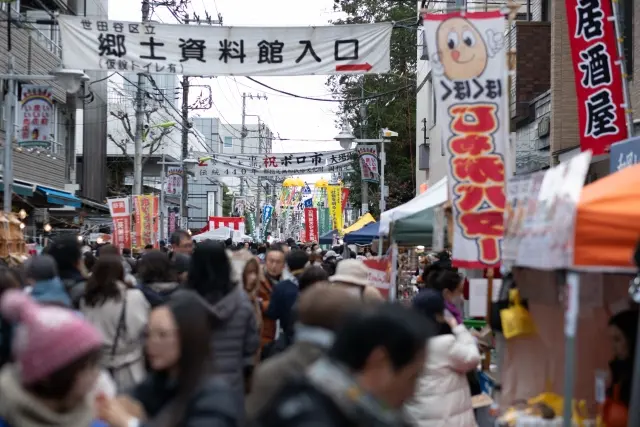
According to the Tokyo Metropolitan Board of Education, the market fills about 500 meters of Boroichi-dori and spills into the side streets around it. The street runs past the Setagaya Daikan Yashiki (世田谷代官屋敷), the old magistrate's residence. Setagaya Ward estimates daily attendance at about 200,000 people.
The ward's leaflet puts the number of stalls at 600 to 700. On all four market days (December 15–16 and January 15–16), expect antiques, secondhand tools, pottery, plants, clothing and household goods, plus pickles and other food.
Used clothing, which gave the market its name, is still sold here, along with kimono.
The market's signature food is daikan-mochi (代官餅), freshly pounded rice cakes, and the ward's leaflet says the line for them is long every year. The ward asks visitors to avoid eating in the market area when possible.
The Furusato Bussanten (ふるさと物産展), a regional products fair where towns with ties to Setagaya sell their local specialties, runs on the same four days in the parking lot of Setagaya Shinkin Bank's head office (1-23-3 Setagaya).
It's also open 9 a.m. to 8 p.m., though the hours may change with the weather. Participating towns are listed separately for December and January on the ward's Furusato Bussanten page (Japanese).
Item | Details |
|---|---|
Dates | Dec 15 (Tue) & 16 (Wed), 2026; Jan 15 (Fri) & 16 (Sat), 2027 |
Hours | 9 a. |
Location | Boroichi-dori and nearby streets, Setagaya 1-chome, Setagaya Ward, Tokyo |
Nearest stations | Kamimachi or Setagaya Station (Tokyu Setagaya Line), 3-minute walk |
Traffic restrictions | Boroichi-dori and nearby streets, 7 a. |
Parking | None |
Organizer | Setagaya Boroichi Preservation Society, supported by Setagaya Ward |
Tokyo hotels: availability and rates
Which Day to Go
Location and hours are identical on all four days, so the main difference is the day of the week: Tuesday, Wednesday, Friday and Saturday. If a weekday doesn't work for you, January 16 is your only option.
There's one more difference: the Setagaya Local History Museum (世田谷区立郷土資料館), on the grounds of the Daikan Yashiki, is scheduled to stay open until the market closes on December 15 and 16.
No extended hours have been announced for January yet, so if you want to visit the museum after browsing the market, choose December.
If the weather turns, the ward posts any change in hours or a cancellation on its Setagaya Boroichi page (Japanese) and on the X account of the Setagaya General Branch Office (世田谷総合支所). Check both before you head out.
Getting There on the Setagaya Line or by Bus
Kamimachi and Setagaya are both stops on the Tokyu Setagaya Line. From Shibuya, take the Tokyu Den-en-toshi Line to Sangen-jaya (三軒茶屋) and change there.
You can also transfer to the Setagaya Line at Yamashita (山下), next to Gotokuji Station (豪徳寺) on the Odakyu Line, or at Shimo-takaido (下高井戸) from the Keio Line.
By bus, Tokyu Bus routes Shibu 21 to Shibu 24 (渋21〜渋24) run from Shibuya Station via Sangen-jaya to the Kamimachi stop, a 1-minute walk from the market.
With about 200,000 visitors a day, Tokyu plans for crowds. Last season (December 2025 and January 2026), Tokyu Railways ran a special timetable every market day and warned it might restrict entry at the Sangen-jaya and Shimo-takaido ticket gates if crowds built up.
As of November 8, 2026, it hasn't announced any special service for this season yet.
Last season, Tokyu Bus warned that traffic on Setagaya-dori could keep Shibu 21 to Shibu 24 and other routes from running on schedule. Its notice for this season hasn't been posted yet (as of November 8, 2026). Allow extra travel time on market days.
Market Rules to Know
Don't eat or drink on private property, and take your trash with you, since there are no trash cans in the market area.
Children should be accompanied by an adult. If you're cycling, there's bike parking at Setagaya 2-chome Fureai Park (世田谷二丁目ふれあい公園), but space is limited.
Restroom locations are marked on the map in the ward's Boroichi leaflet (PDF, Japanese).
Daikan Yashiki and the Local History Museum
The Setagaya Daikan Yashiki, whose main house and front gate are nationally designated Important Cultural Properties, faces Boroichi-dori. Admission is free, hours are 9 a.m. to 5 p.m., and it's open on all four market days.
The Setagaya Local History Museum, on the same grounds, is also free. It's normally open 9 a.m. to 4:30 p.m., but on December 15 and 16, which fall during its special exhibition on Edo-period painting, it stays open until the market closes.
No eating or drinking is allowed anywhere on the grounds. The Daikan Yashiki and the museum are about a 5-minute walk from Kamimachi Station.
How a 1578 Market Became Boroichi
The market began in 1578 as a rakuichi (楽市), a market free of the usual trade restrictions, set up in Setagaya by the warlord Hojo Ujimasa (北条氏政).
It was first held six times a month, on dates ending in 1 and 6. By the Edo period, it had become an annual year-end fair on December 15.
When Japan adopted the Gregorian calendar in the Meiji era, a January 15 market was added. The current schedule, December 15–16 and January 15–16, was established later.
From the late 1880s into the 1890s, used clothing and rags made up much of what was sold, and people started calling it Boroichi, roughly "rag market." The name became official after World War II. In March 2007, it was designated an Intangible Folk Cultural Property of Tokyo.
The Daikan Gyoretsu (代官行列), a procession first held in 1968, takes place once every five years. The ward says the next one is planned for fiscal 2027 (April 2027 to March 2028), so it won't take place during this season's four days.
This article was translated from the original Japanese with AI assistance and reviewed by our editorial team. The Japanese version is authoritative.