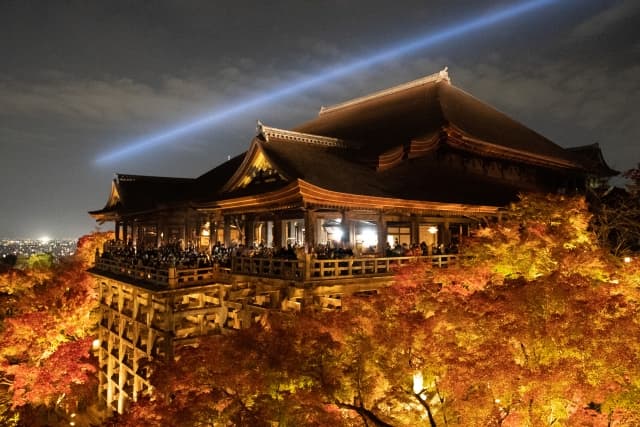
If you're planning a Kyoto trip around the fall colors, Tofuku-ji (東福寺) is one name you'll see again and again. The view from Tsutenkyo (通天橋), a covered wooden bridge that spans a maple-filled ravine, is one of the defining images of autumn in Japan.
But visiting Tofuku-ji at peak is not the same as visiting on a quiet spring afternoon. During the fall season the admission price goes up, the combined ticket disappears, the opening time shifts, and there are real rules about where you can and cannot take photos. Here's what to plan around before you go in autumn 2026, based on the temple's own guidance.
For the wider picture of Kyoto's foliage spots and timing, start with Kyoto Autumn Leaves 2026: Peak Timing and Beating the Crowds.
Tofuku-ji's "autumn season" runs November 14 to December 6 in 2026. During these dates admission rises to ¥1,000 per area, there is no combined ticket, and Tsutenkyo opens half an hour early, at 8:30.
Peak timing and choosing your day
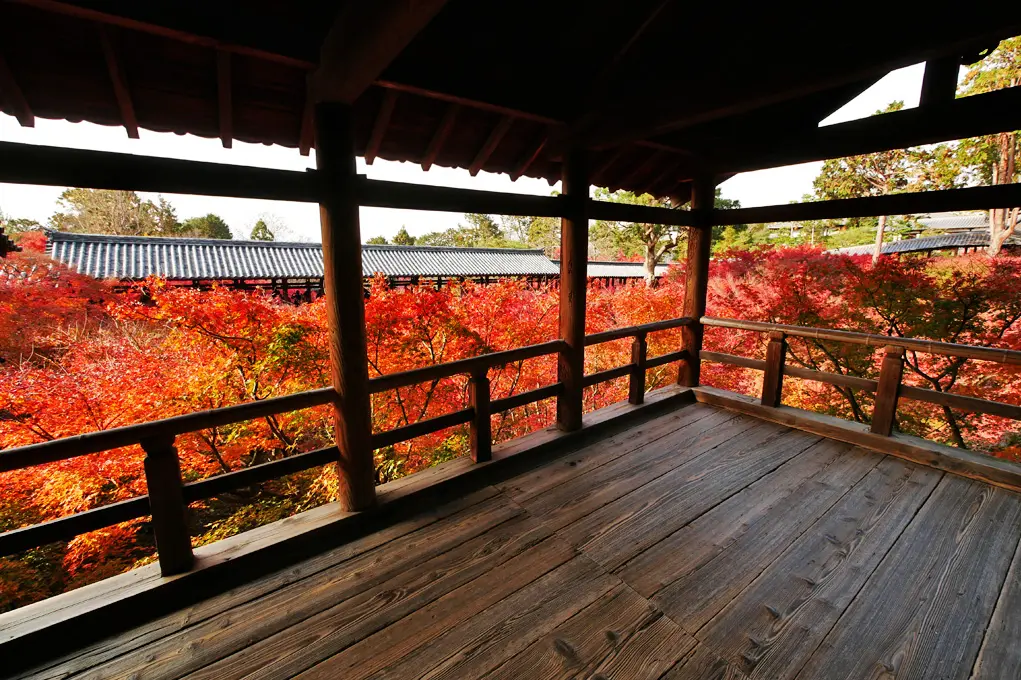
Around Tsutenkyo, the maples usually turn color from mid-November into early December, peaking in mid-to-late November. This is not a single-day event; you have a window of roughly two weeks to work with.
The official 2026 peak forecast is not out yet at the time of writing. The Japan Weather Association begins publishing that year's foliage forecasts around September, so if you are locking in dates, check the September update before you commit.
Tofuku-ji treats its fall opening as a separate "autumn season" with its own prices and hours. In 2026 that season runs from Saturday, November 14 to Sunday, December 6. It overlaps closely with the peak, and it is the three-week stretch when the cost, the hours, and the crowds all differ most from the rest of the year. Picking a weekday inside that window, rather than a weekend, is the single easiest way to give yourself more room.
What you'll see: Tsutenkyo, Gaunkyo, and the Hojo garden
Tsutenkyo is the centerpiece. It's a covered walkway across the Sengyokukan (洗玉澗) ravine, and the shot looking down over a valley packed with maples is what Tofuku-ji is known for.
A little downstream sits Gaunkyo (臥雲橋), a bridge on the approach path. The classic view here looks back up toward Tsutenkyo, and it's where most people stop for a photo. As you'll see below, though, this is exactly where photography is restricted at peak.
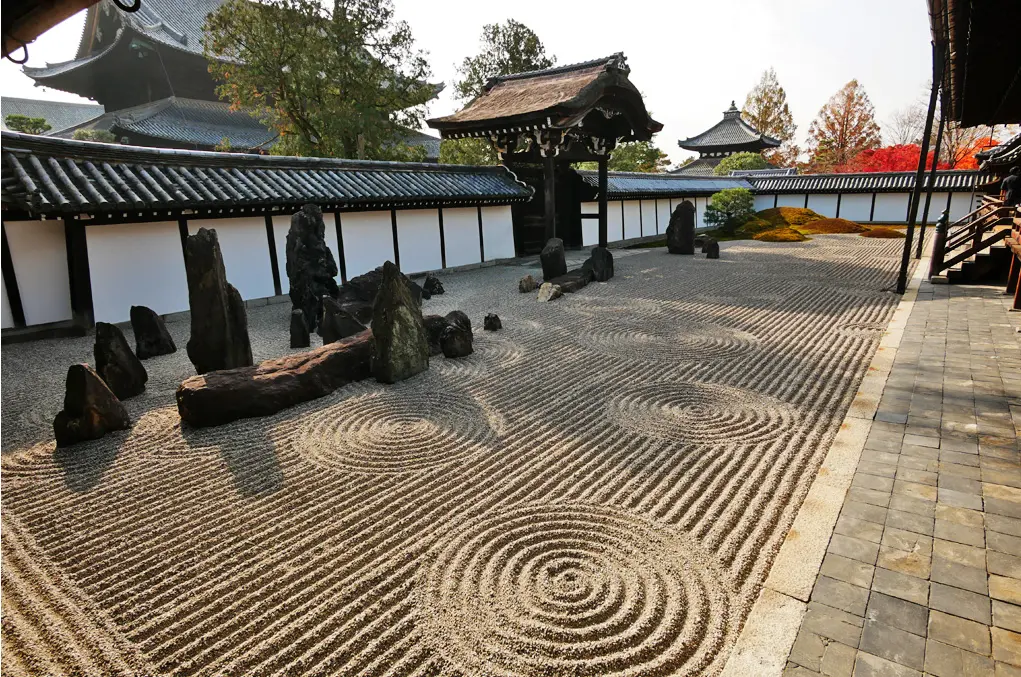
The other highlight is the Hojo garden (方丈), whose "Garden of Eight Views" (八相の庭) is a modern dry-landscape garden by Mirei Shigemori. He was one of Japan's leading garden designers of the twentieth century. The Hojo has its own entrance and ticket, separate from Tsutenkyo, so whether you do both comes down to your time and budget.
Autumn admission: ¥1,000 per area and no combined ticket
During the autumn season, Tsutenkyo and the Hojo garden are ticketed separately—¥1,000 for adults each.
Area | Regular (adult / child) | Autumn Nov 14–Dec 6 (adult / child) |
|---|---|---|
Tsutenkyo & Kaisando hall | ¥600 / ¥300 | ¥1,000 / ¥500 |
Hojo garden (方丈) | ¥500 (¥600 from Nov 1) / ¥300 | ¥1,000 / ¥500 |
Combined ticket | ¥1,000 / ¥500 | Not offered (buy each separately) |
The catch: the combined ticket goes away during the autumn season. In the regular season one ¥1,000 combined ticket covers both, but from November 14 to December 6 you pay ¥1,000 for Tsutenkyo and ¥1,000 for the Hojo garden separately. If you want both, budget the time and the money for it.
The Hojo garden's regular-season adult price also rises from ¥500 to ¥600 on November 1, 2026 (children ¥300).
Opening hours and the 8:30 head start
In the autumn season (November 14 to December 6), Tsutenkyo opens at 8:30 a.m. and the Hojo garden at 9:00. Last entry for both is 4:00 p.m., and the gates close at 4:30. Both open at 9:00 during the regular season, so Tsutenkyo simply opens thirty minutes earlier in autumn.
If you want the first light of the morning, plan around that 8:30 opening. There is no re-entry once you leave, so if you are doing both Tsutenkyo and the Hojo garden, decide your route before you exit.
The bridge photo ban, and other rules at peak
Tofuku-ji's own guidance warns that the fall opening gets very crowded. At peak, visitor numbers of around 35,000 a day were reported when the photo restriction was first introduced, back in 2016.
Because of that crush, since 2016 the temple has restricted photography on Tsutenkyo and Gaunkyo at the busiest times. When people stopped to take photos, foot traffic on the bridges came to a standstill, creating a safety risk.
The official wording is that visitors "may be asked to refrain" from photographing on Tsutenkyo and Gaunkyo during the special autumn opening, and it does not name the exact dates the restriction is in effect. Officially it is phrased as a request, but in practice, assume you won't be able to stop for that shot on the bridges at peak. If that photo is the whole reason for your visit, this is the thing to know before you arrive.
The temple also asks visitors not to eat inside the grounds or use a tripod, at any time of year. And with last entry at 4:00 p.m., a late-afternoon arrival leaves little time for both Tsutenkyo and the Hojo garden.
Early-morning and evening visits
You don't need an advance reservation or numbered ticket for daytime autumn viewing (the kanpū / 看楓 special opening); just pay at the gate.
Separately, Tsutenkyo has run small-group private early-morning and evening sessions in past years. These are reservation-only, booked through JR Central's travel site ("Sou da Kyoto, Ikou") rather than by the temple itself.
There is no general evening opening you can simply walk into. The 2026 dates, prices, and booking details for these private sessions had not been announced when this article was published; the temple usually posts them around November, so watch the official site as fall gets closer.
Getting there, what to wear, and your Kyoto autumn
Tofuku-ji is about a 10-minute walk from Tofukuji Station, served by both the JR Nara Line (one stop, about 3 minutes from Kyoto Station) and the Keihan Main Line. Roads around the temple clog up in foliage season, so come by train.
One practical note: late November in Kyoto swings from a cold morning to a mild afternoon, so if you go for the 8:30 opening, bring a layer you can take off later.
Getting around Kyoto in peak season is its own puzzle; we cover the trains and buses in Getting Around Kyoto in Autumn 2026: The Day Pass Is Gone—Use the Subway and Rail, and where to base yourself in Where to Stay in Kyoto 2026: Choosing Your Area by Purpose. To compare peak timing across the country, see Japan Autumn Leaves 2026: A Region-by-Region Peak Calendar and 8 Top Spots.
Tsutenkyo first thing, then the Hojo garden. There is no combined ticket in autumn, so if you want both, leave yourself time and budget for two ¥1,000 admissions.
This article was translated from the original Japanese with AI assistance and reviewed by our editorial team. The Japanese version is authoritative.