
Every winter the fir trees on Mount Zao in Yamagata disappear under wind-driven snow and ice until they look like a field of white giants. Locals call them juhyo (樹氷); everyone else calls them snow monsters, and the Zao Ropeway carries you straight into the middle of them at 1,661 meters.
This guide is built around the decisions that actually shape the trip: when to go, whether to see them by day or after dark, how to get up the ropeway, and what to wear so the summit doesn't cut your visit short. If a snowbound wildlife day appeals, our guide to the Jigokudani Snow Monkey Park covers another frozen-winter day out in the mountains.
The snow monsters peak roughly late January to late February. Seeing them after dark runs on specific dates only, not every night — so before you lock in a date, check that it's an operating night.
What the snow monsters actually are
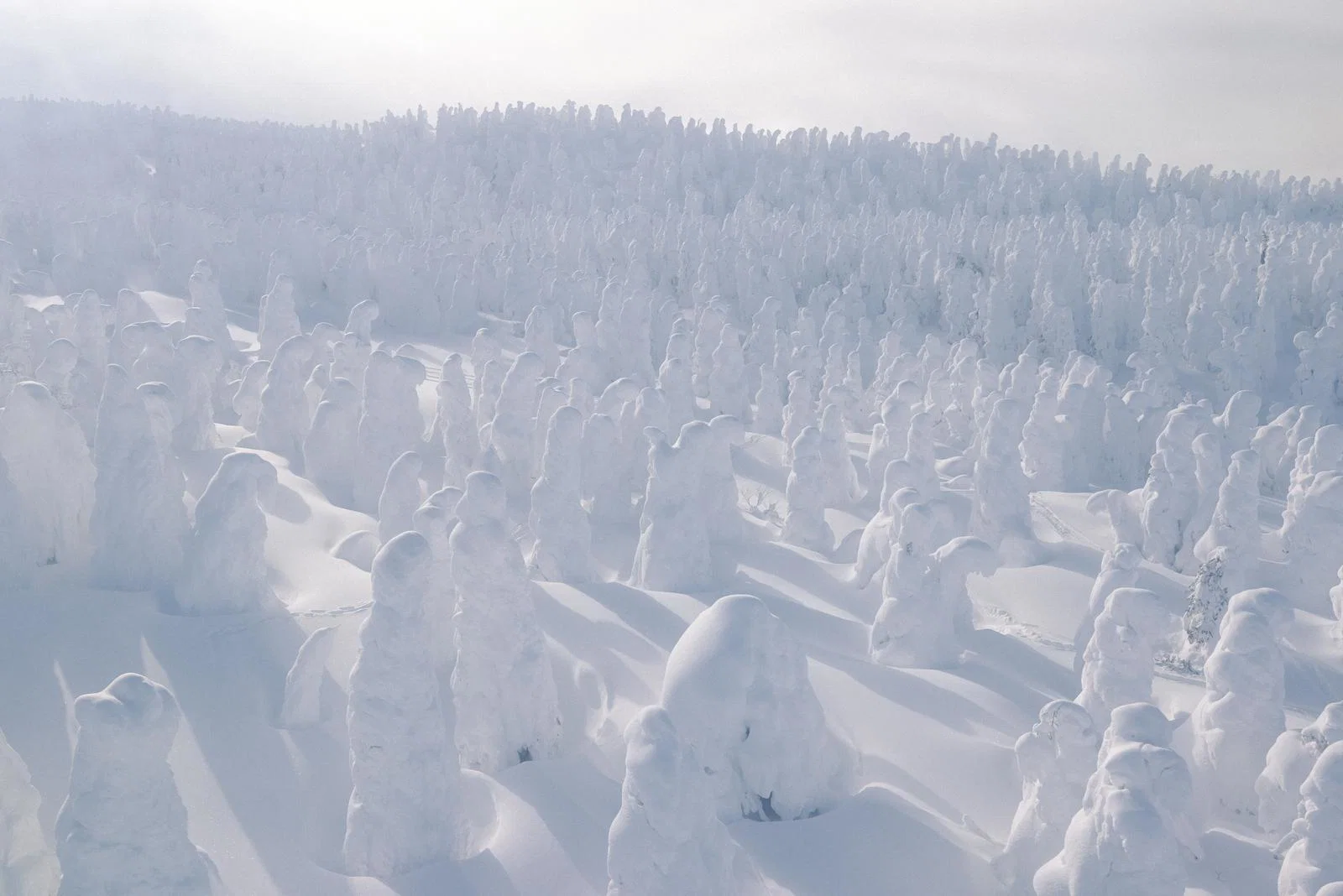
The trees get buried when supercooled water droplets and snow, driven by fierce sub-zero wind, freeze onto the conifers layer by layer. In January and February, Mount Zao sits around minus 10 to minus 15°C with average winds of 10 to 15 meters per second — a combination so specific that only a handful of places in Japan, Zao among them, create snow monsters on this scale.
You view them from the top of the ropeway, Jizo Sancho Station (地蔵山頂駅, 1,661 m), where a walking trail loops through the frozen trees. On a clear day the white monsters run to the horizon; in a storm you may not see five meters ahead. Both are winter at Zao.
When they peak
Frost starts building on the trees in November and December, grows through January, hits its fullest form in February, and begins collapsing in March. The sweet spot for a trip is late January to late February, when the snow monsters are fully formed.
It shifts with the year's temperature and snowfall, though. The ice buildup can still be light in early January, and a warm spell in March can knock the monsters down fast. There is no fixed "full bloom" date the way there is for cherry blossoms, so check the operator's growth updates close to your date on the official Zao Ropeway site.
Riding the Zao Ropeway
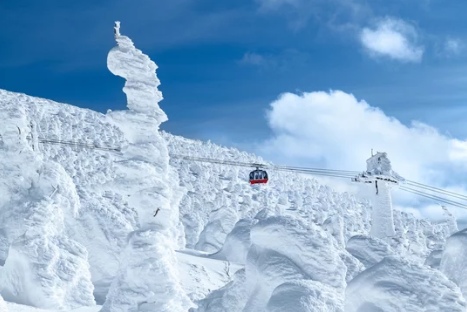
You reach the snow monsters by riding two ropeway lines from Zao Sanroku Station in Zao Onsen. The Sanroku Line takes you to Juhyo Kogen Station (1,331 m), where you change to the Sancho Line up to Jizo Sancho Station (1,661 m). The rides take about 7 and 10 minutes.
Section | Adult (round trip) | Child (round trip) |
|---|---|---|
Zao Sanroku → Jizo Sancho (all the way up) | 4,400 yen | 2,200 yen |
Zao Sanroku → Juhyo Kogen (Sanroku Line only) | 2,200 yen | 1,100 yen |
To walk the snow-monster field, buy the round trip all the way to Jizo Sancho (4,400 yen for adults). Daytime hours are 8:30–17:00 on the Sanroku Line and 8:45–16:45 on the Sancho Line, and the last car up to the summit leaves Zao Sanroku Station at 16:00. Confirm fares and times on the official Zao Ropeway site. Some seasons run a separate daytime schedule for snow-monster viewing, so check the day's hours before you set out.
Seeing them at night: on foot or by snowcat
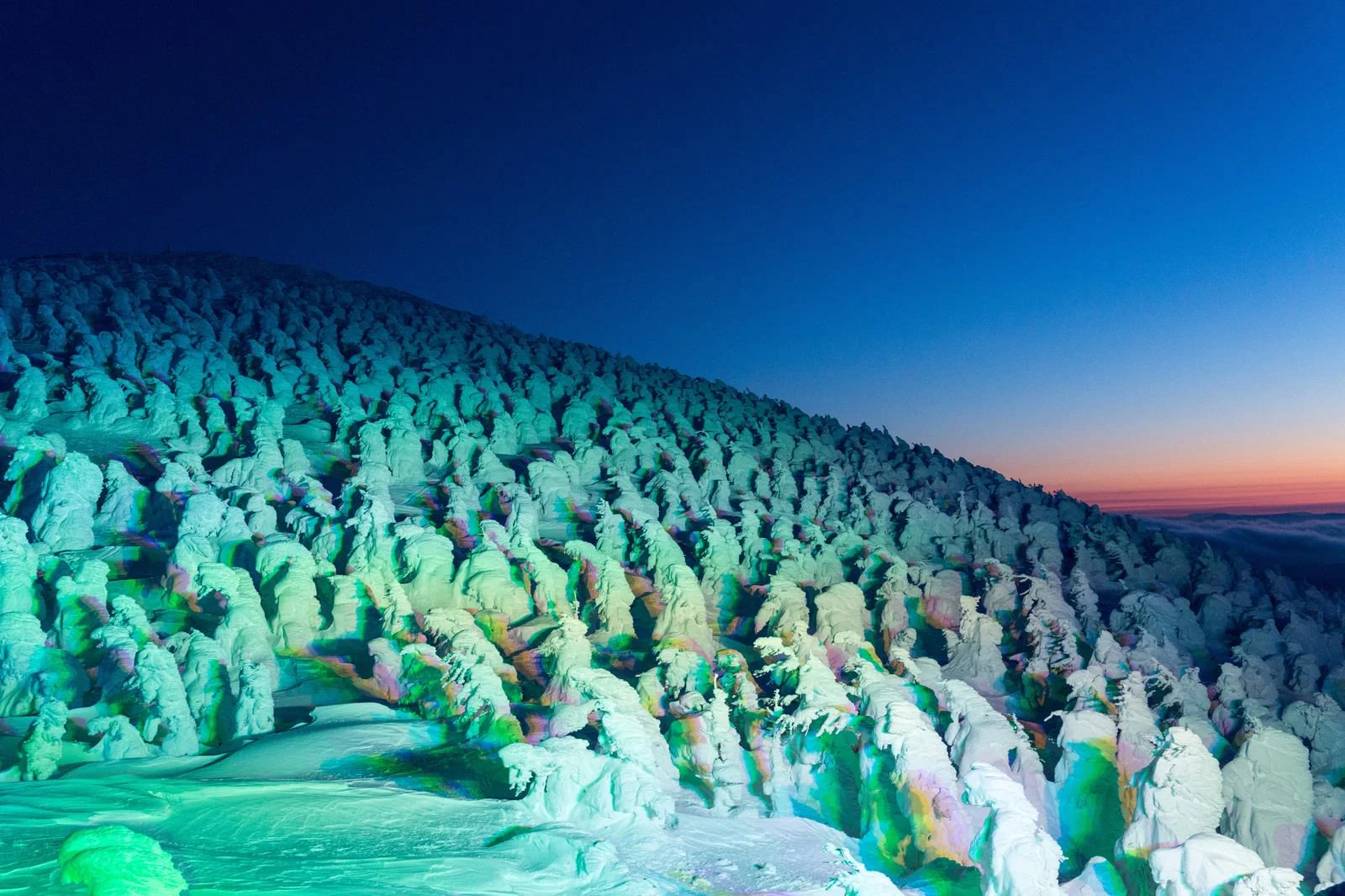
At night the trees are lit, and the snow monsters take on a completely different, eerie glow. There are two ways to see them after dark, and they are not the same booking.
The Snow Monster Light-Up runs the ropeway into the evening so you can walk out from Jizo Sancho Station on your own; last season it started December 27. The Juhyo Fantasy Corridor Tour instead puts you on a snowcat (the Night Cruiser) that drives through the frozen field, and it is a paid, reservation-only tour.
The single most important thing about a night visit is whether the ropeway is running that night. Neither the evening service nor the snowcat tour runs every night, so confirm the operating dates on the official site once your date is set.
For reference, here is what last season (2025-26) looked like. The light-up ran on selected dates between December 27, 2025 and February 22, 2026, with evening service from 17:00 to 21:00 (last car up at 19:50 from Zao Sanroku). The fare was the same 4,400 yen adult / 2,200 yen child round trip, and no reservation was needed.
The snowcat Fantasy Corridor Tour was reservation-only with limited seats per departure, and last season it cost 7,500 yen for adults and 6,000 yen for children.
The dates and operating nights for the 2026-27 season had not been announced as of September 2026. The figures above are last season's, and using them for this winter will leave you standing at a closed station. They are usually released between late October and December, and we'll update this article when they are. Check the latest on the official Zao Ropeway site.
Check Out Popular Activity Tours at Mount Zao
Getting to Zao Onsen from Yamagata and Sendai
The gateway is Zao Onsen in Yamagata City. From the east exit of JR Yamagata Station, a Yamako local bus reaches the Zao Onsen Bus Terminal in 36–40 minutes for 1,200 yen, roughly once an hour. That local bus needs no reservation and takes IC cards (Suica and the other nationwide cards) or cash.
From Sendai, a winter-only, reservation-required express bus (Sendai Station east exit to Zao Onsen, jointly run by Yamako and Miyagi Kotsu) goes direct. Last season it was 2,500 yen one way for adults and 1,250 yen for children, with assigned seats. The dates and fares change each year and the 2026-27 details are not yet out, so watch the Yamako Bus site for the announcement.
From the Zao Onsen Bus Terminal, the Zao Ropeway's Zao Sanroku Station is about a 10–15 minute walk uphill on snow, so leave yourself extra time.
What to wear, and checking operations before you go
Jizo Sancho Station sits at 1,661 m, and the summit feels far colder than the city below. With temperatures often well below minus 10°C on January and February blizzard days, full ski-grade winter gear is the baseline. Ordinary city winter clothes will not hold up to the summit wind.
Pack waterproof gloves, a knit hat that covers your ears, a neck warmer, waterproof boots with grip on snow, and goggles or sunglasses against the snow and glare. When you're picking a date, plan for daytime highs well below freezing at the top.
Weather has the final say on your day at Zao. Strong wind or bad weather closes the whole ropeway, and that can cancel the evening service. On the day, check whether it's running on the official Zao Ropeway site or the Zao Onsen operations page before you leave.
This article was translated from the original Japanese with AI assistance and reviewed by our editorial team. The Japanese version is authoritative.