On Saturday, July 25, about 5,000 fireworks go up over Showa Kinen Park (国営昭和記念公園) in Tachikawa, on Tokyo's western edge. It is the same night as the Sumida River Fireworks in central Tokyo, at almost the same hour.
Something changed in 2026. The main viewing ground — Minna no Harappa (みんなの原っぱ), the wide lawn where people used to lie back and watch — is now a paid area. And as of July 15, the ticket page for that paid area shows "sales have ended." You cannot buy your way in.
So if you go to Tachikawa on July 25, you are going to the free viewing area, whether you planned to or not. Where it is, and which gate gets you there, is the thing to get right. Pick the wrong gate and you will be turned away at the entrance, or walk until a no-entry line stops you cold.
Comparing the summer's big shows? See Tokyo Fireworks Festivals 2026: 6 Major Hanabi Shows to See This Summer (Dates, Access & Tips). For everything else happening this season, we keep a running list in Tokyo Summer 2026: Every Festival & Fireworks Show, in Date Order.
The essentials: 5,000 shells, 7:15 p.m., and a park that opens late
Event | Tachikawa Matsuri Showa Kinen Park Fireworks (立川まつり国営昭和記念公園花火大会) |
|---|---|
Date | Saturday, July 25, 2026 |
Time | 7:15 p. |
Shells | About 5,000 (planned) |
Highlights | Isshaku-gosun-dama and geikyo-dama (large shells), plus a wide starmine — a rapid-fire barrage across the sky |
Venue | Showa Kinen Park, Tachikawa, Tokyo |
Park opens (that day) | 1:30 p. |
Park admission | Free that day. |
Weather | Held in light rain. |
Organizer | Tachikawa Matsuri Showa Kinen Park Fireworks Executive Committee |
Five thousand shells is modest next to Sumida's twenty thousand. What Tachikawa fires instead are large shells — the isshaku-gosun-dama and the geikyo-dama — and they burst over open lawn, with no buildings in the way.
What changed in 2026: the main lawn now costs money
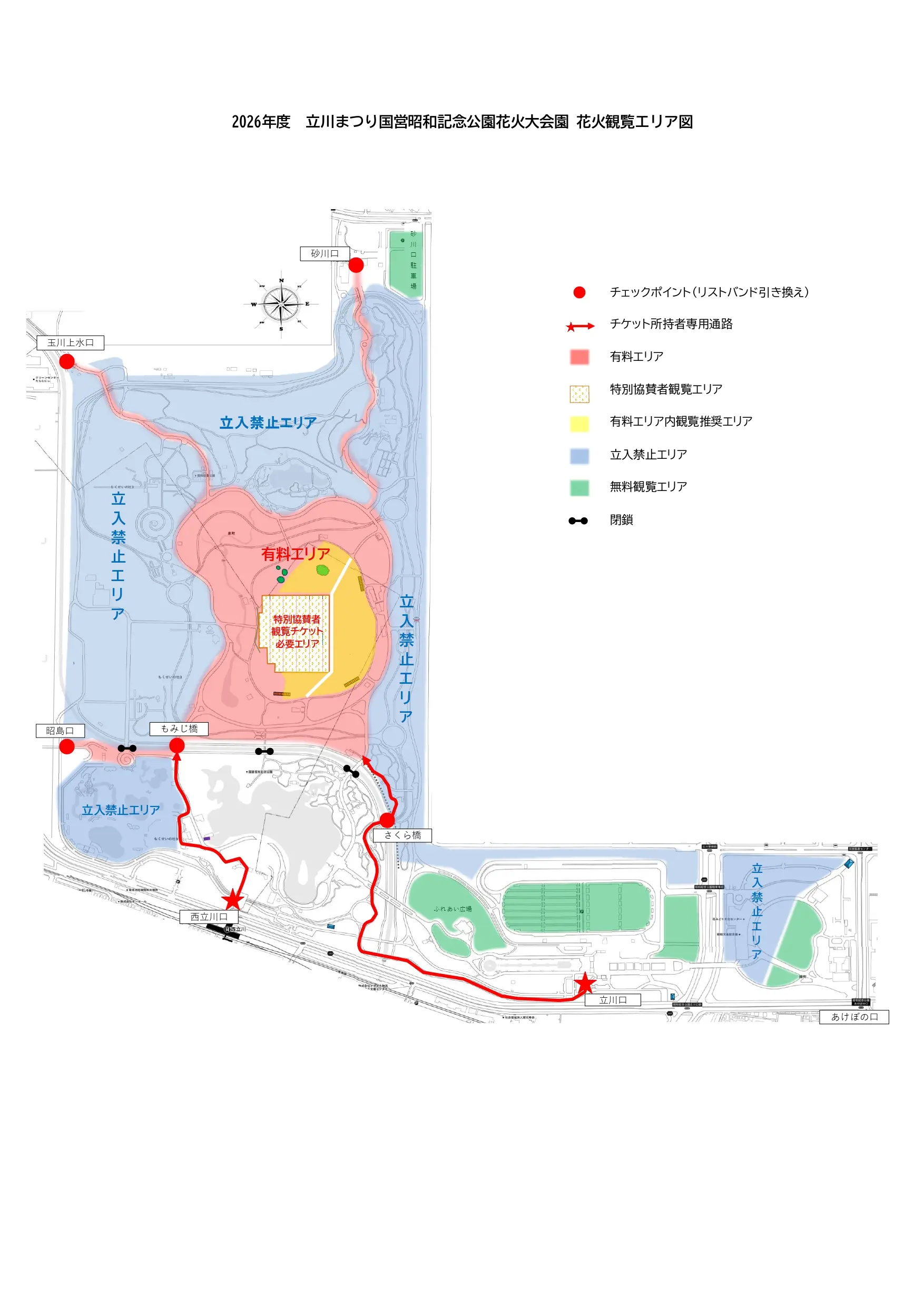
The park is divided into four zones this year: a sponsors' area, a paid viewing area, a free viewing area, and a no-entry area. The Zanbori River (残堀川), which runs through the park, is roughly the dividing line.
The park's official notice puts it plainly. North of the Zanbori — Minna no Harappa and the Keiryu Hiroba area — is paid. South of the Zanbori — from Yume Hiroba to the area around the Waterfowl Pond — is free.
Here is the part that decides your day. On the ticket site (Rakuten Ticket), as of July 15, every ticket type shows "sales have ended". The organizer has not said whether the tickets sold out or the sales window simply closed, and there is no mention anywhere official of same-day tickets. Plan as though there is no way into the paid area, because right now there isn't one. You can check the current status yourself on the Rakuten Ticket page.
For reference, this is what was sold. Entry to the paid area required a printed paper ticket — bought online, then issued at a convenience store, then carried to the gate.
Ticket | Price |
|---|---|
Single chair seat | ¥8,800 |
Pair ticket with picnic sheet (2 people) | ¥13,200 |
Group sheet (10 people, 5m × 5m) | ¥77,000 |
Paid-area entry ticket (1 person) | ¥1,500 |
Paid area details: 
【重要】会場内広域エリア有料化のお知らせ – 立川まつり 国営昭和記念公園花火大会|立川観光コンベンション協会
The free area, and the gates that let you in (July 25)
On July 25, the part of the park you can watch from without a ticket is the free viewing area south of the Zanbori River — Yume Hiroba through the Waterfowl Pond. Park admission itself is free that day, per the City of Tachikawa.
But "south of the river" does not mean "anywhere south of the river." On the park's own event map, the free area is limited to Yume Hiroba, the Fureai Hiroba area, and the area around the Waterfowl Pond (水鳥の池). A large stretch of the southern park is marked no entry. Look at the map before you leave.
Choosing the gate is the easiest thing to get wrong. Only four gates admit general visitors that day: Akebono-guchi (あけぼの口), Takamatsu-guchi (高松口), Tachikawa-guchi (立川口), and Nishi-Tachikawa-guchi (西立川口). The other three — Akishima-guchi (昭島口), Tamagawa-Josui-guchi (玉川上水口), and Sunagawa-guchi (砂川口) — are reserved for paid-area ticket holders, and general visitors cannot enter or leave through them.
Sunagawa-guchi is the trap. The park calls the Sunagawa-guchi parking lot part of the free area, yet the Sunagawa-guchi gate admits only paid ticket holders. Walk the 20 minutes from Musashi-Sunagawa Station expecting to stroll in free, and you will be turned around at the gate. To reach the free area, enter from the Tachikawa Station side (Akebono-guchi or Tachikawa-guchi), or from Nishi-Tachikawa-guchi by Nishi-Tachikawa Station. There's a fourth gate, Takamatsu-guchi, but the park's own access page gives it no station and no walking time. Stick to the other three.
One caveat once you're inside. The park does not publish walking times from any gate to the free viewing area, and this is a big park. The free ground is Yume Hiroba, the Fureai Hiroba area, and the ground by the Waterfowl Pond — all of it south of the river, all of it marked on the day-of map. Pull that map up before you walk in, and know which of the three you're heading for.
About the view, honestly. The shells go up north of the Zanbori, and Minna no Harappa — inside the paid area — is the officially recommended vantage point. From the free area you are looking north, from a distance. The organizer states outright that the free area "does not guarantee a view," and neither the park nor the organizer suggests a best spot within it. Trees and terrain block the sky in places. Find a spot with an open view to the north, and claim it early.
The park opens at 1:30 p.m. that day, four hours later than usual, and the fireworks start at 7:15 p.m. If you want a good position, plan to be inside by around 3 p.m. The park closes "once visitors have left after the fireworks," and no last-entry time is published. Nor has the organizer said when marking out a spot in the free area is permitted this year.
Park's day-of notice: https://www.showakinen-koen.jp/news/68664/
Food on July 25: no street of yatai, just stalls inside the park
Nothing on the organizer's, the park's, or the city's official pages describes a street of festival food stalls (yatai) on July 25. If that is the picture in your head, adjust it. What the park does say is that temporary stalls go up "at various locations in the park" and the permanent shops and restaurants stay open into the night. Permanent shops do sit on the free side. Where the temporary stalls land is shown on the day-of map — check it before you pick your spot.
What matters is which side of the river a shop sits on. If you are in the free area, the shops on the paid side are out of reach.
Main shops on the free side (south of the Zanbori): Lakeside Rest House (by the Waterfowl Pond, 2:00–8:30 p.m.; its rest area closes at 4:00 p.m.), Fureai Hiroba Restaurant (2:30–8:30 p.m., takeout only), Ginnan Chaya, Tachikawa-guchi Shop, Nishi-Tachikawa-guchi Shop, and the Information Center Café (all 2:00–8:30 p.m.; the café is takeout only).
Main shops on the paid side (north of the Zanbori): Harappa Central Shop (until 7:00 p.m.), Harappa South Shop, Keiryu Hiroba Restaurant, Oka Café. All inside the paid area.
Closed all day: the Barbecue Garden, Kaboku-en Shop, and Kodomo no Mori Shop.
The park notes that "the items sold and their prices differ from normal operating days." The shops exist, but so do the crowds: last year's 345,000 park visitors all wanted food in the same two hours. Buy your drinks and food at a convenience store or supermarket near the station before you go in, and you skip both the lines and the sellouts. Bring cash. The park does not say whether the stalls take cashless payment on July 25.
Shop hours and the event map: https://www.showakinen-koen.jp/news/71813/
Getting there, and getting home
Tachikawa is about 40 minutes from Tokyo Station on the JR Chuo Line rapid service, no transfers, according to the park.
Gate | Nearest station | Walk |
|---|---|---|
Akebono-guchi | JR Tachikawa Station, north exit | 10 min |
Akebono-guchi | Tachikawa-Kita Station (Tama Monorail) | 8 min |
Tachikawa-guchi | JR Tachikawa Station, north exit | 18 min |
Nishi-Tachikawa-guchi | Nishi-Tachikawa Station (JR Ome Line), park exit | 2 min |
Do not drive. The organizer says flatly that "there is no parking for the fireworks; please come by public transport," and that illegally parked cars will be reported to the police. The one lot open in the park, at Nishi-Tachikawa-guchi, is listed only as "paid, 1:30–5:00 p.m." — the park does not say whether you can leave a car there through the 7:15 p.m. show. Roads around the venue are under traffic control; the organizer publishes a traffic restriction map (PDF, Japanese) with the closures.
The scale, in the organizer's own numbers: in 2025, 345,000 people inside the park and 400,000 around it, 745,000 in all. They all go home on the same trains.
The organizer warns that "entry restrictions may be imposed at JR Tachikawa and Nishi-Tachikawa stations." Head for the station the moment the last shell fades and you join that queue. Build 30 to 60 minutes of waiting into the plan rather than racing for the platform. Both stations are named in that warning, and they are not the same animal: Tachikawa is the Chuo Line hub with trains every few minutes, while Nishi-Tachikawa is a small stop on the Ome Line, one stop away. Unless the crowd at Tachikawa looks impossible, Tachikawa is the one that gets you back.
Just know where you intend to spend that half hour. The park closes "once visitors have left," and there is no published word on how long you may linger inside. Don't count on waiting it out on the lawn; plan to kill the time in the streets around Tachikawa Station — not inside the station.
On toilets, the organizer says: "in addition to the permanent toilets there will be portable ones, but they are crowded every year, so please allow time." Go before the show starts.
One more, and it catches travelers every year. The organizer states that "mobile phone service will not connect around the time of the launch." Agree on a meeting point and a route home before you arrive. Maps and transit apps will not help you in that window.
Rules and what to bring
From the rules the organizer and the park publish, these are the ones travelers trip over.
Marking out a spot with tape or spray paint is expressly forbidden. Trespassing on private property for a better view is, obviously, not an option either.
Drones and radio-controlled aircraft are banned, regardless of weight.
Open flame — fireworks, camp stoves — may not be used. Tarps aren't allowed either; the only shelter permitted is a dome tent under 2 m (park rules).
The park is non-smoking outside the designated areas. Take your trash home or use the marked bins.
Bringing a pet requires a signed pet agreement form (park rules).
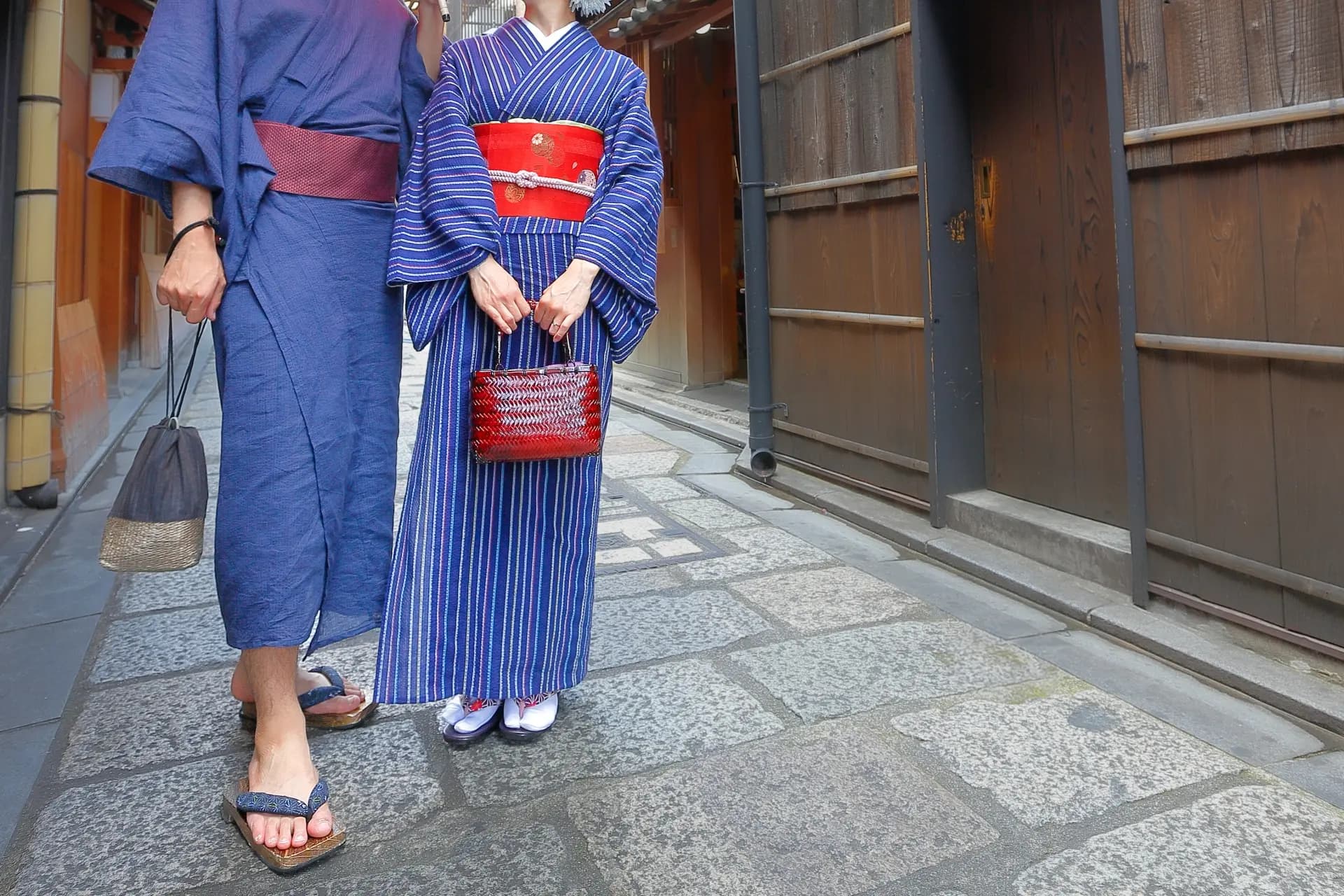
Late July nights in Tokyo stay warm and humid. Water, a fan, a towel, and a battery pack are worth the bag space, and insect repellent if you plan to sit on the grass for hours. If you're wearing yukata, geta will punish feet unused to them — pack a bandage. We cover how to wear one and where to rent in Yukata Guide 2026: How to Wear One, and Where to Rent or Buy in Asakusa, and the heat in Japan's Summer Heat Is No Joke (2026): How to Stay Safe, and Where to Buy Cooling Gear.
Viewing rules: 観覧時のお願い – 立川まつり 国営昭和記念公園花火大会|立川観光コンベンション協会
If it rains
Light rain, the show goes on. Severe weather, it is cancelled — and there is no rain date. If July 25 is a washout, that is the end of it for 2026.
The organizer has not said where or when the go/no-go call will be announced. Check the official site on the day. By phone, the contacts are the Tachikawa City tourism division (042-528-4317) and the executive committee (042-527-2700).
If you already hold a ticket: refunds are issued only if the event is cancelled, minus the event operating fee (30% of the ticket price). Nothing is refunded for any other reason, including not being able to reach the venue through the crowds.
The Digimon tie-in
This year's event has an "All Digimon" collaboration, but it is not a fireworks program. Staff T-shirts carry Agumon and friends, the paper wristband issued to paid-seat ticket holders gets an original design, and Agumon voices special announcements in the venue.
There are free uchiwa (paper fans) too, while supplies last, though the handout points are the ticket checkpoints — where paid ticket holders go — and the organizer says the exact place and time will be posted on the official site later. The perks lean heavily toward paid-area ticket holders. If you're in the free area, don't count on getting one — and check the official site before you leave.
Same night as Sumida. Which one?
Saturday, July 25 is also the Sumida River Fireworks, starting at 7:00 p.m. Tokyo's two big shows fall on the same night, one in the east, one in the west. Tachikawa runs 7:15–8:15 p.m.; Sumida runs 7:00–8:30 p.m. They overlap, and the two venues sit at opposite ends of the city, more than an hour apart by train. You cannot do both.
The numbers: Sumida, about 20,000 shells, along the river in old-town Asakusa. Tachikawa, about 5,000, big shells over an open park. And as noted, 745,000 people came to Tachikawa last year. West does not mean empty. Both will be packed.
What should actually decide it is where you are sleeping that night. Staying in Asakusa, Ueno, or Ginza? Sumida. Staying west of Shinjuku, or out toward Hachioji and Tachikawa? Tachikawa. The difference shows up in the hour after the finale — standing in a packed train, or already back at your hotel. Our Sumida guide is here: Sumida River Fireworks 2026: Sat July 25, 20,000 Shells — Free Viewing Spots and How to Beat the Crowds.
Read next
▶ Tokyo Fireworks Festivals 2026: 6 Major Hanabi Shows to See This Summer (Dates, Access & Tips)
▶ Tokyo Beer Gardens 2026: 8 Rooftops Compared by Price and Season
▶ Tokyo Summer 2026: Every Festival & Fireworks Show, in Date Order
This article was translated from the original Japanese with AI assistance and reviewed by our editorial team. The Japanese version is authoritative.