
On a quiet evening in a Tokyo residential neighborhood, you may notice it before you see it: the steam, the faint scent of warm wood, and a fabric curtain hanging in the doorway of a low wooden building. That's a sento (銭湯), Japan's neighborhood public bathhouse. For ¥550, you can walk through that curtain and step into a piece of Japanese daily life that hotels simply can't replicate. A huge tiled bath, the quiet conversation of locals, and sometimes a painted Mount Fuji stretching across the wall.
If you've been curious about trying one but a little nervous, here's everything you need to do it right.
1. So what is a sento, exactly?
A sento (銭湯, sentō) is a public bathhouse used by locals as part of their daily routine. Most sento heat ordinary tap water, though some draw from natural hot springs. Prices in Tokyo are set as a regulated maximum by the metropolitan government: ¥550 for adults (12 and up), ¥200 for children aged 6–11, and ¥100 for kids under 6.
Two terms travelers often confuse with sento:
• Onsen (温泉): Hot springs that draw mineral-rich water from underground. Often resort facilities, often pricier, sometimes far from the city.
• Super sento (スーパー銭湯): Large bathing complexes with saunas, restaurants, and lounges. Usually ¥1,000+ to enter.
The small neighborhood sento — the kind with a fabric curtain in the doorway and a regular customer base — is the most everyday, most affordable, and (we'd argue) most rewarding version of the three.
2. How many sento are left in Tokyo?
According to Tokyo Metropolitan Government data, Tokyo had 2,687 public bathhouses at its peak in 1968. By the end of 2024, that number had fallen to 430; by the end of 2025, to 417. As Japanese homes got their own bathtubs, the daily-essential function of the public bath quietly faded.
But the story isn't only one of decline. A younger generation of operators is renovating old sento into beautifully designed "neo-sento" — updated bathhouses that keep the old neighborhood feel while adding modern touches — sometimes with attached cafes, galleries, or co-working spaces. Many now offer multilingual signage and accept Suica/PASMO and credit cards.
In September 2025, the Tokyo Metropolitan Government and the Tokyo Sento Association launched the "WELCOME! SENTO" campaign, certifying 63 bathhouses as "inbound-friendly model sento." These bathhouses offer multilingual signage and visitor-friendly information, making them a useful starting point for first-timers.
3. How to use a sento, in four steps
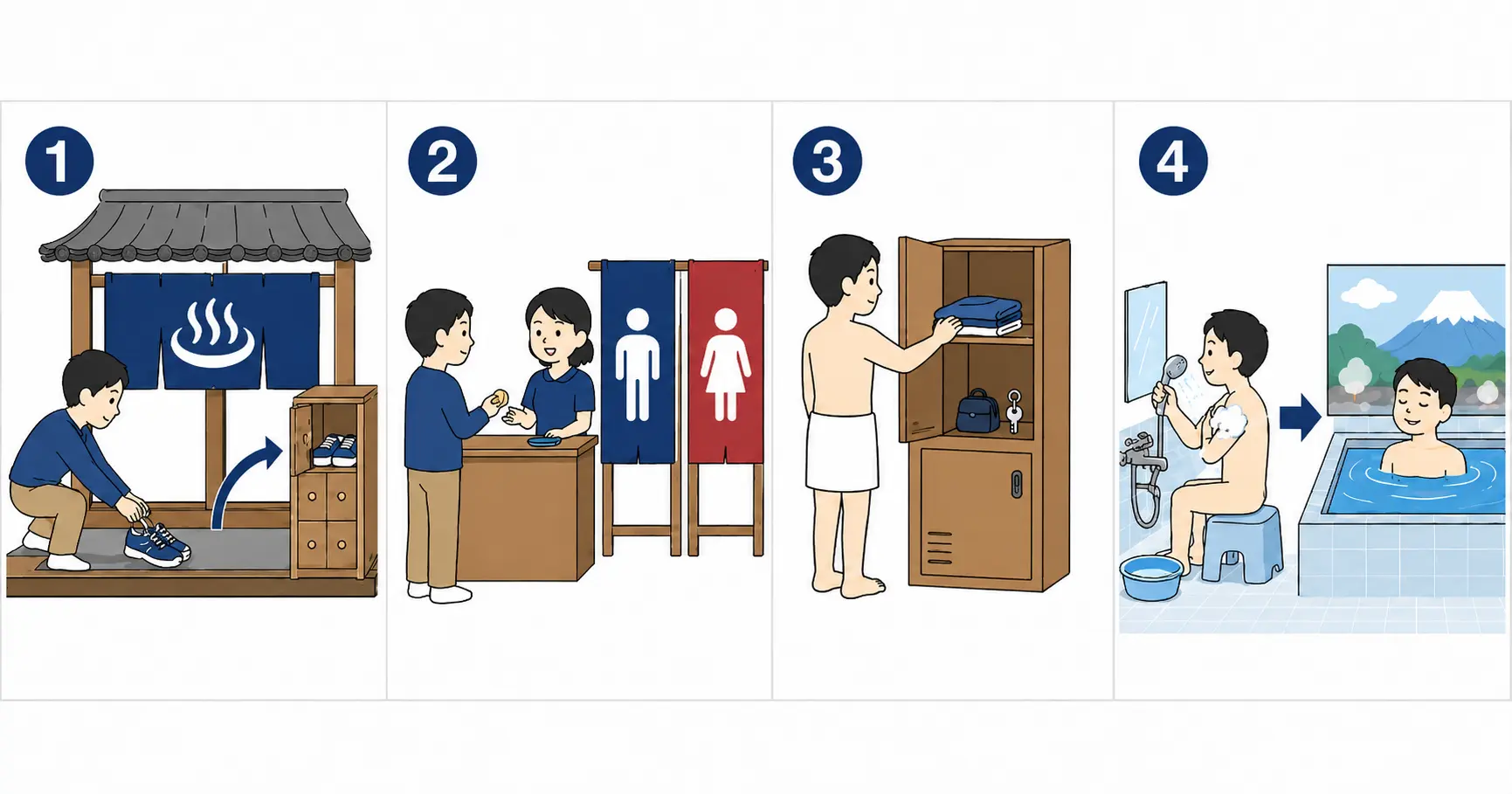
The first time is always a little nerve-racking. Here's the basic flow:
Step 1 — Cross the curtain, take off your shoes
Just inside the entrance you'll find a row of small wooden lockers for your shoes. Slip yours off, place them in, and pocket the wooden key.
Step 2 — Pay at the counter
Look for the bandai (a raised counter, usually at the front) or a reception desk. Men's and women's sides are completely separate — check the kanji 男 (men) or 女 (women) above the door, and the color of the curtain.
Step 3 — In the changing room, undress completely
Everything goes into your locker: clothes, underwear, watch, phone. Loop the locker key onto your wrist or ankle, take one small towel to carry into the bath area, and head in. Swimwear, underwear, and towels should never go into the bathtubs. Nudity is the norm — everyone else has been doing this since they were kids.
Step 4 — Wash first. Soak second
Wash stations line the walls of the bathing room: a low stool, a wooden or plastic basin, and a handheld shower. Sit down at an empty one, soap up thoroughly, and — this is the part that matters most — rinse off every trace of suds and shampoo before you step into the tub. Washing before soaking is one of the most important points of sento etiquette.
4. The 10 etiquette rules that matter most
• Wash your body and hair completely before getting into the tub.
• Do not let your towel touch the bathwater. Leave it on the edge of the tub, or fold it and place it on your head — some regulars do this.
• Long hair should be tied up or kept above the waterline.
• No swimming, diving, or splashing in the tubs.
• Keep your voice down. Save the singing for the karaoke booth.
• Don't wash clothes or underwear in the bathing area.
• No phones, cameras, smartwatches, or electronic devices in the changing room.
• No swimwear or underwear in the bath.
• Return your stool and basin to their original spot when you're done.
• Dry off lightly with your small towel before stepping back into the changing room.
The phone rule is the one most travelers slip up on. Even if you only want to check the time, do it after you've left the building. Everyone else around you is naked, and the assumption of privacy is absolute.
5. What about tattoos?
This is the question we get asked most, and the answer is more relaxed than the internet sometimes suggests.
Tokyo’s neighborhood sento tend to be more relaxed about tattoos than onsen resorts or upscale spas. The Shinjuku Bathhouse Association, for example, states in its FAQ that tattooed visitors are welcome.
That said, policies vary from place to place. If you’re unsure, a quick "Tattoo wa daijōbu desu ka?" ("Are tattoos okay?") at reception works fine. For smaller tattoos, waterproof cover patches may also help, depending on the bathhouse.
6. Where to start: three Tokyo sento worth your first visit
For your first time, pick a bathhouse with some experience welcoming visitors and a beautiful interior to look at.
▶ Kosugiyu (小杉湯) — Koenji
Five minutes from JR Koenji Station, Kosugiyu was founded in 1933 and registered as a Tangible Cultural Property in 2020. The bathing room walls feature a classic painted Mount Fuji. Its signature draw is the milk bath — a milky-white bath that feels soft on the skin — along with a rotating scented bath. Open weekdays 14:00–25:30 (last entry 25:00); weekends and holidays from 8:00 a.m. Closed Thursdays.
▶ Takarayu (タカラ湯) — Kitasenju
Originally opened in 1927 and rebuilt at its current location in 1938, this Kitasenju sento is known for its beautiful Japanese garden and the engawa (veranda) overlooking it — sometimes nicknamed the "King of Engawa" for its garden-side veranda. The herbal medicinal bath is a local favorite. A great pick for anyone who wants to soak in traditional Tokyo architecture.
▶ Kosugiyu Harajuku — Harajuku
For travelers staying in central Tokyo, Kosugiyu opened a sister branch inside the Harakado shopping complex in Harajuku in 2024. It's an easy stop between shopping and sightseeing. Open 7:00–23:00 (last entry 22:15). Closed Thursdays.
7. What to bring
You don't need much to visit a sento.
Need:
• ¥550 in cash, or Suica/PASMO/credit card at participating sento.
Nice to have:
• One small towel, used for washing, modesty, or resting on your head while you soak.
• One larger bath towel (for drying off afterward).
Buy on site:
• Shampoo and conditioner (provided free at some sento; available for purchase at the counter if not).
• Soap and body wash (provided at some sento; available for purchase if not).
• Towels (¥50–¥200 to buy; about ¥100 to rent).
If you’re walking past a sento on a whim, just buy a ¥150–¥250 "towel set" at the counter — it will include everything you need. Some sento provide shampoo and body soap at the wash stations for free; if not, you can usually buy them at reception.
And when you walk out, find the lobby vending machine. Buy a small bottle of coffee milk (コーヒー牛乳) or fruit milk (フルーツ牛乳). Stand by the machine, plant one hand on your hip, and drink it cold. This is, by long Tokyo tradition, how a bath ends.
8. Stepping out of the bath: a new kind of experience
You can have a big bath at almost any Tokyo hotel. But a sento isn't really about the bath. It's about sitting next to a neighborhood regular, soaking in the same water, looking up at the same painted Mount Fuji, and realizing for a moment that you're inside a piece of daily life no guidebook ever quite puts you in.
If the moment feels right, try saying "ii oyu desu ne" — "the water feels nice" — to a nearby local. The smile you get back may be one of the things you remember longest about Japan.
▶ Tokyo Sento Association — Official Sento Map (EN)
▶ WELCOME! SENTO Campaign
▶ Kosugiyu (Koenji) — Official Site
This article was translated from the original Japanese with AI assistance and reviewed by our editorial team. The Japanese version is authoritative.
