
In July, Kyoto belongs to Gion Matsuri.
The festival of Yasaka Shrine (Yasaka-jinja / 八坂神社) runs the whole month, from July 1 to 31, and the sound of Gion-bayashi music starts drifting through the streets.
The headline events are its two float processions—Yamaboko Junko (山鉾巡行)—on July 17 (the former festival, Saki Matsuri / 前祭) and July 24 (the latter festival, Ato Matsuri / 後祭).
Gion Matsuri packs in so many events that first-timers usually get stuck on one question: when and where do I actually go? This guide lays out the 2026 dates and highlights, and along the way I'll tell you which procession suits which kind of traveler, and how to dodge the worst of the crowds.
What Gion Matsuri Is: A Month at Yasaka Shrine
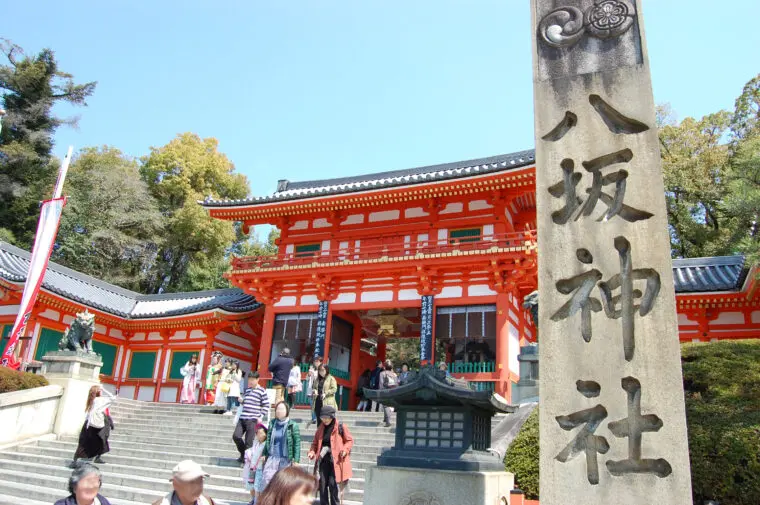
Gion Matsuri began over a thousand years ago as a rite to ward off the epidemics that spread in Kyoto's humid summers.
It opens with Kippu-iri (吉符入) on July 1 and closes with the Ekijinja Nagoshi-sai on July 31, with ceremonies and events filling the weeks in between.
The float procession used to happen all at once, but in 2014 the Ato Matsuri was revived, restoring the original two-procession format. Those two parades are the heart of the festival.
2026 Key Dates
Both processions land on a Friday in 2026 — handy if you're building a weekend trip around them.
Saki Matsuri Yoiyama (eve nights)
July 14 (Tue)–16 (Thu), from early evening
Saki Matsuri float procession
Friday, July 17, departs 9:00 a.m. from Shijo-Karasuma (四条烏丸)
Shinko-sai (mikoshi portable-shrine procession)
Friday, July 17, evening into night
Ato Matsuri Yoiyama
July 21 (Tue)–23 (Thu), from early evening
Ato Matsuri float procession
Friday, July 24, departs 9:30 a.m. from Karasuma-Oike (烏丸御池)
Hanagasa procession & Kanko-sai
Friday, July 24
Saki Matsuri vs. Ato Matsuri: Which One to See
If it's your first time, take the Saki Matsuri—full stop. The most floats come out, the Yoiyama nights have food stalls and pedestrian-only streets, and you get the full, electric version of Gion Matsuri. The Ato Matsuri is the opposite: no stalls, just lanterns and music on quiet streets. If big crowds genuinely wear you out, the Ato Matsuri is surprisingly calm, and I'd point you straight to its Yoiyama.
The Saki Matsuri procession leaves Shijo-Karasuma at 9:00 a.m. on the 17th, led by the Naginata Hoko (長刀鉾), the one float that goes first every year without drawing lots. The moment to watch is the tsuji-mawashi (辻廻し), where a massive float is pivoted 90 degrees: crews lay split bamboo under the heavy wheels, douse it with water, and heave the float around by hand while the crowd breaks into applause.
The tsuji-mawashi is easiest to see at the Shijo-Kawaramachi corner, which is exactly why it's the most packed. For a little more room, walk up toward Shinmachi-Oike, where the crowds thin out. That same evening, the Shinko-sai sends three of Yasaka Shrine's mikoshi (神輿) through the streets to the Otabisho (御旅所) resting place.
The Ato Matsuri procession leaves Karasuma-Oike at 9:30 a.m. on the 24th and runs the reverse route (Oike → Kawaramachi → Shijo). It's led—again without lots—by the Hashi-Benkei Yama (橋弁慶山), and brought up at the rear by the Ofune Hoko (大船鉾), a great boat-shaped float that returned in 2014 after about 150 years and has become the symbol of the Ato Matsuri's revival. The same day brings the elegant Hanagasa flower-umbrella procession and the Kanko-sai, when the mikoshi return to Yasaka Shrine.
The Floats: Nail-Free "Moving Museums"
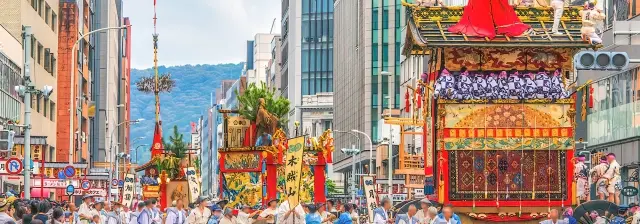
There are 34 floats in all (23 in the Saki Matsuri, 11 in the Ato Matsuri). Draped in imported textiles and fine craftwork, they're often called "moving museums." Remarkably, they're built without a single nail—timber is lashed together with rope in a traditional technique called nawagarami.
A hoko (鉾) is the big type: roughly 12 tons and about 25 meters tall, riding on wheels with musicians aboard. A yama (山) is smaller, around 1.2–1.6 tons and about 6 meters. These float events were designated an Important Intangible Folk Cultural Property of Japan in 1979 and inscribed on UNESCO's list of Intangible Cultural Heritage in 2009.
Watching the Parade: Paid Seats vs. the Free Roadside
You can watch the procession for free from the roadsides along Shijo, Kawaramachi, and Oike streets. Honestly, if you can handle the heat, the tsuji-mawashi corners give you a better show for free than most seats do. But the crowds are heavy and standing for hours in the July sun is genuinely tough, so if you want a guaranteed spot, book a paid grandstand seat on Oike Street.
For 2026, the paid seating is organized and run by the Kyoto City Tourism Association (ticketing handled by Pia). The tiers differ a little by procession (all tax included):
General seats (both processions): 8,000 yen front row, 6,000 yen behind
"Manabi" seats (July 17 only; live expert commentary you stream on your own phone—bring earphones): from 11,500 yen
"Special Manabi" seats (both processions; commentary in Japanese and English): from 14,500 yen
Premium front-row seats (July 17 only): from 125,000 yen
For most people the front row of the general seats is the safest pick. If you want the running commentary—and English is a plus—the Special Manabi seats are the ones to look at.
Reserve your Gion Matsuri paid grandstand seats
Yoiyama Pleasures: Chimaki & the Folding-Screen Display
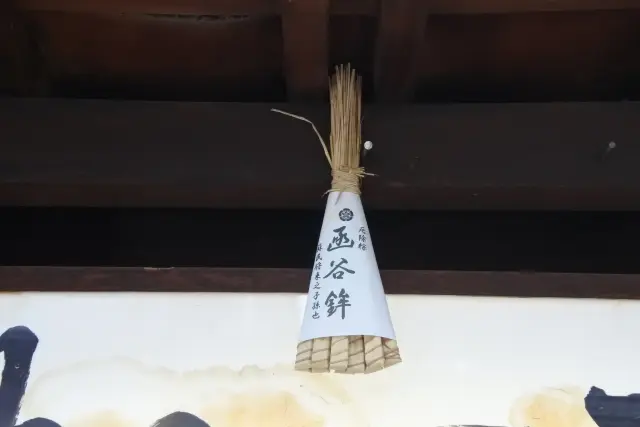
At each float's neighborhood office during Yoiyama, you can receive a chimaki (粽). It isn't the edible kind—it's an inexpensive protective charm woven from bamboo grass, hung at your front door to wish for a safe year. Prices vary by float neighborhood.
Look out, too, for the Byobu Matsuri (屏風祭), when old machiya townhouses and long-established shops open their fronts to display heirloom folding screens and furnishings. It's one of the quieter pleasures of Yoiyama, and easy to miss if you're only there for the stalls.
Getting There
The festival centers on Yasaka Shrine (625 Gionmachi Kitagawa, Higashiyama-ku, Kyoto) and the Shijo-Karasuma area.
To Yasaka Shrine: from JR Kyoto Station, take city bus 100 or 206 and get off at Gion — the shrine is right at the stop. Or walk it: about 5 minutes from Keihan Gion-Shijo Station, 8 minutes from Hankyu Kyoto-Kawaramachi Station.
To the Shijo-Karasuma area: Hankyu Kyoto-Kawaramachi and Karasuma stations, plus the Karasuma-line subway stops Shijo and Karasuma-Oike, are all close.
On procession days, traffic is restricted across a wide area and city buses run badly behind schedule—the subway and private railways are your reliable bet. Visiting Yasaka Shrine and watching the procession from the roadside are both free.
What Travelers Should Know
July in Kyoto is intensely humid, and the procession means hours under the open sun. Bring a hat or parasol and a cooling item, and drink water often. For more, see our Japan Summer Heat Survival Guide (2026).
Yoiyama and procession days are some of the most crowded in all of Kyoto. If you have small kids or a stroller, skip the peak evening hours.
Hotel rooms across Kyoto fill up early during the festival. Once your dates are set, lock in your accommodation as soon as you can.
If you only have a day or two, pair a Yoiyama evening (July 14–16) with the procession on the morning of the 17th. With a longer stay, add the quieter Ato Matsuri procession on the 24th and you'll catch both faces of Gion Matsuri.
This article was translated from the original Japanese with AI assistance and reviewed by our editorial team. The Japanese version is authoritative.

