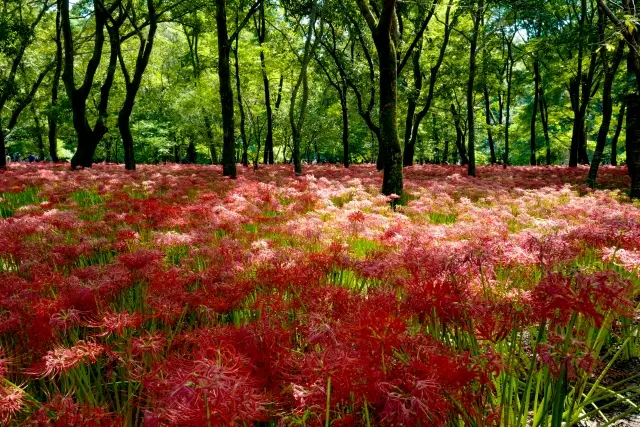
Every autumn, a river bend in Hidaka, Saitama turns solid red. Kinchakuda (巾着田) holds one of Japan's largest colonies of red spider lilies — manjushage (曼珠沙華), also called higanbana (彼岸花) — with around five million stems blooming under the trees. For a short stretch from mid-September into early October, the ground all but disappears beneath them.
It's an easy day trip from central Tokyo, about 60 to 90 minutes by train. Ride the Seibu Ikebukuro Line to Koma Station (高麗駅), and the colony is about a 15-minute walk from the platform.
The flowers peak for only about a week, so it's easy to arrive too early or too late. Check the official bloom report before you lock in a date — that one habit is what separates a wall of red from a field of green stems.
If you're collecting other seasonal flower fields you can reach by train, our guide to Sunflower Fields Near Tokyo 2026: 5 Spots by Train, With Peak Timing and Access covers five of them.
What Kinchakuda Is (Five Million Red Blooms)
Kinchakuda sits inside a wide bend of the Koma River, on a flat piece of land roughly 500 meters across and about 22 hectares in area. Seen from above, the loop of the river resembles a drawstring pouch — a kinchaku — which is how the place got its name.
In one corner, under a canopy of trees, around five million red spider lilies bloom together. In the dappled shade, the leafless stems carry nothing but red flowers, and where they cluster the ground reads as a single sheet of scarlet.
Red spider lilies open on cue with the autumn equinox — higan (彼岸) in Japanese, which is why they're also called higanbana.
The 2026 Bloom and Festival Dates
Red spider lilies open at nearly the same time every year, and the usual viewing window runs from mid-September into early October. The peak lands around the autumn equinox, roughly September 23.
The colony has an early-blooming section that colors first, and the red then spreads across the rest of the grounds. Because the timing differs from spot to spot even within the same week, checking the bloom report for which section is at its best will save you a wasted trip.
As of this writing, the official 2026 dates for the Kinchakuda Manjushage Festival have not yet been announced. For reference, the 2025 festival ran September 19 to October 8, and the 2024 festival ran September 18 to October 9 — so it typically starts in mid-September and continues into early October.
The confirmed dates, admission, and transport details are usually published around August on the official Kinchakuda site and the Hidaka City tourism pages. Check the official pages again as your trip gets closer.
Hidaka City — Kinchakuda Manjushage Festival: 有料入場期間は9月30日(水曜日)までとなりました。10月1日(木曜日)から曼珠沙華群生地の無料開放を行います。(注釈)駐車場利用料は別途必要です。10月3日(土曜日)・4日(日曜日)のシャトルバスの運行は中止になりました。なお、ひだか栗フェスティバルは予定どおり10月4日(日曜日)に開催します。まつり開催期間は変更ありません(10月6日(火曜日)まで)。
巾着田曼珠沙華まつり【9月21日から10月6日まで開催】|日高市ホームページ
How to Check the Bloom (Report, Live Video, Phone)
The red spider lilies hold their peak for only a short time. So you don't make the trip only to find buds or spent stems, the official site gives you three ways to check how far along the bloom is.
- Bloom report (official site): updated regularly with photos, showing which sections are open and by how much.
- Live video: the official site streams a real-time view of the colony.
- Recorded phone line: from September into mid-October, an automated message reports bloom conditions (Kinchakuda management office, 042-982-0268).
Bloom report: 開花速報 - 埼玉県日高市・曼珠沙華の里「巾着田」公式ホームページ
Official Kinchakuda site: 秋に咲く曼珠沙華(彼岸花)の群生が日本一の埼玉県日高市「巾着田」の紹介。四季の写真、交通案内、観光バス予約受付、ハイキングコースなど埼玉県日高市・曼珠沙華の里「巾着田」公式ホームページ
Admission and Opening Hours
During the bloom, entry to the colony is charged. You pay on the day, at the gate, with no reservation needed. The figures below are from 2025 — check the official site for the 2026 amounts and hours once they're posted.
Admission | ¥500 per person (one day) |
|---|---|
Free entry | Junior high age and under; holders of a physical, intellectual, or mental disability certificate |
Group discount | 20% off for groups of 20 or more |
Opening hours | 9:00 a. |
When it's charged | Only during the red spider lily bloom |
During the festival — September 19 to October 8 in 2025, with the 2026 dates not yet announced — local food and craft stalls line the grounds. Outside the bloom period entry is free, and the park also has fields of rape blossoms (菜の花) and cosmos at other times of year.
Getting There from Koma Station and Special Trains
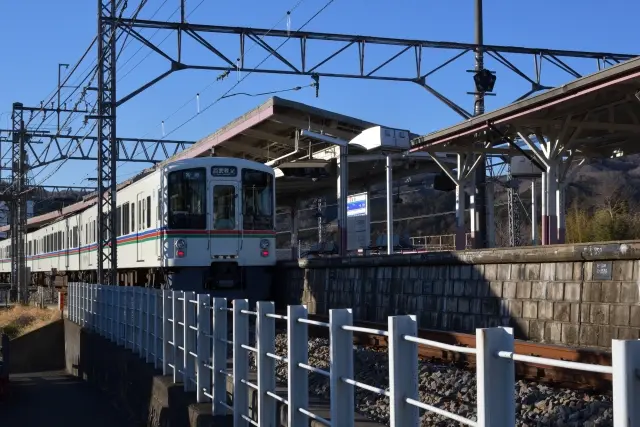
Public transport is the way to go. The nearest station is Koma (高麗) on the Seibu Ikebukuro Line, about a 15-minute walk from the grounds.
Nearest station | Koma Station, Seibu Ikebukuro Line |
|---|---|
From the station | About a 15-minute walk |
Address | 125-2 Komahongo, Hidaka, Saitama |
From central Tokyo | About 1 to 1.5 hours from Ikebukuro on the Seibu Ikebukuro Line |
During the festival, Seibu adds service for the crowds. In 2025, Seibu ran extra local trains between Hanno and Koma, and some limited express trains (Laview and others) made special stops at Koma — but only on Saturdays, Sundays, and holidays.
The limited express stops at Koma only on weekends and holidays, not on weekdays. If you're traveling on a weekday, plan to change to a local train at Hanno.
Seibu's 2026 special trains and limited express stops are usually announced in mid-August, so if you're counting on the limited express, wait for that announcement to confirm.
Seibu Railway service info: 西武鉄道のWebサイト。時刻表、路線図、運行情報、乗換案内、運賃表など西武線のご利用案内から、特急ラビュー・特急レッドアロー号・S-TRAIN・拝島ライナーのご案内、レジャー情報、沿線での暮らしやおでかけ情報、企業情報などを提供しています。
西武鉄道Webサイト
Coming by Car and Parking
You can drive, but the area gets busy during the festival. The parking details below are from 2025 (rates and operation change year to year, so confirm the latest with the official site).
Car | ¥500 per day |
|---|---|
Motorcycle | ¥100 per day |
Large bus | ¥3,000 per day (reservation required) |
Hours | 7:00 a. |
In 2025, a free shuttle ran on select days for drivers, connecting an overflow lot at Koma Shrine with the festival grounds — it does not depart from Koma Station. The operating days change each year, so check the official schedule before relying on it.
Photography and Viewing Rules (No Tripods During the Bloom)
Kinchakuda draws a lot of photographers, and there are a few rules to respect during the crowded season.
- Tripods, monopods, and light stands may not be used at any time during the bloom (there is no place to store them, either).
- Please don't fly drones or other small unmanned aircraft.
- Inside the colony, stay on the marked paths and take care not to damage the flowers.
Handheld shooting is fine. Early morning brings softer light and thinner crowds.
Before You Go: A Quick Checklist
Four things worth locking in before your first trip to Kinchakuda:
- Use the bloom report and live video to confirm the peak, then pick your date.
- Entry is charged (¥500 per person in 2025, paid at the gate). Bring small change.
- Take the Seibu Ikebukuro Line to Koma Station, then walk about 15 minutes. Limited express stops only on weekends and holidays.
- Tripods and monopods are off-limits during the bloom — shoot handheld.
Planning the rest of your autumn? Our guide to Tokyo Autumn Leaves 2026: Peak in the Last Week of November, Some Gardens Close at 4:30 p.m. looks a little further ahead.
This article was translated from the original Japanese with AI assistance and reviewed by our editorial team. The Japanese version is authoritative.