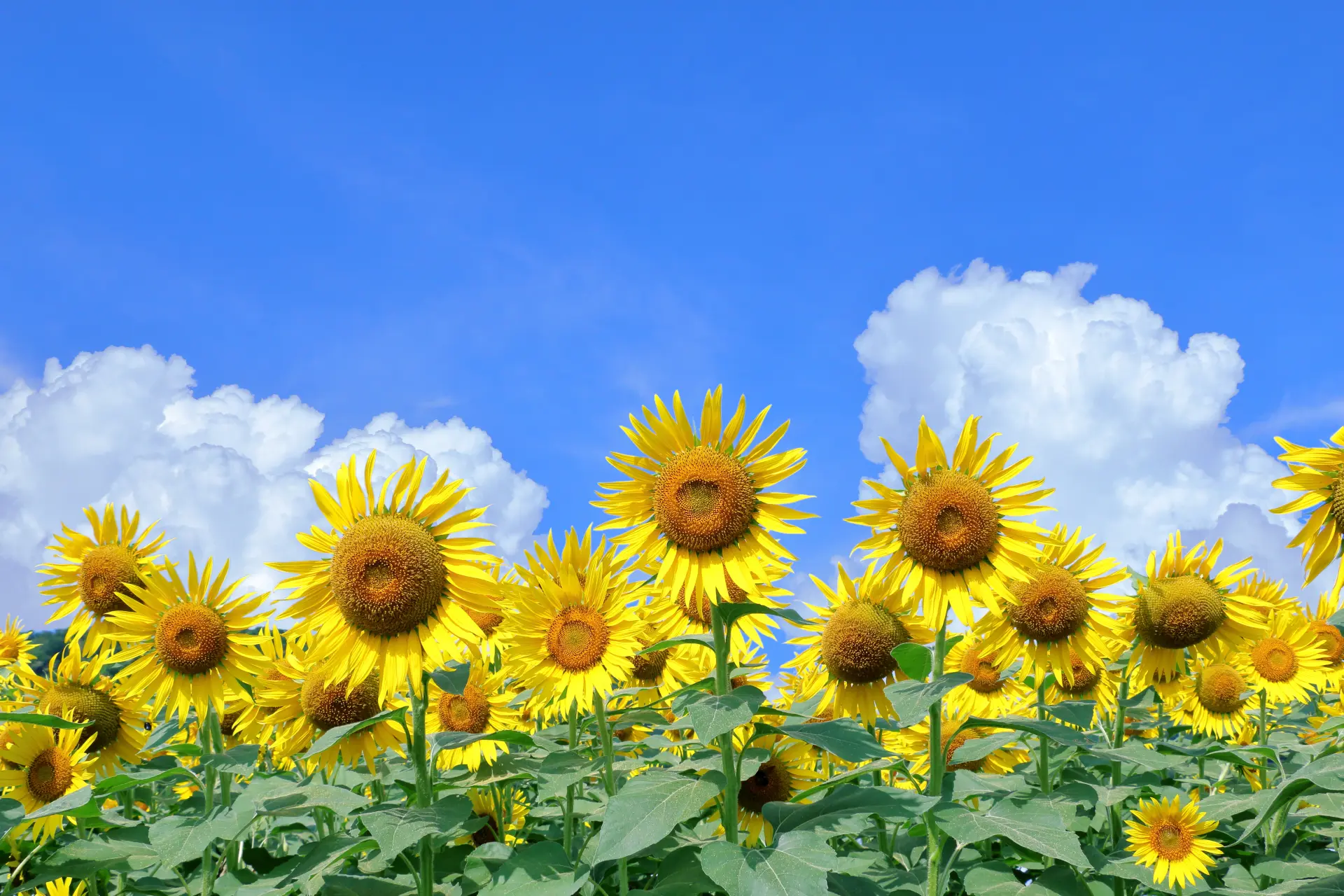
Every summer, the countryside around Tokyo fills up with sunflowers tall enough to look you in the eye, and the good news is that most of the best fields are a manageable train (and often bus) trip from the city.
This guide covers five sunflower spots you can visit on a day trip, listed from closest to Tokyo to farthest (which is also roughly easiest to hardest to reach). All the 2026 dates, prices, and access details below are from each spot's official website.
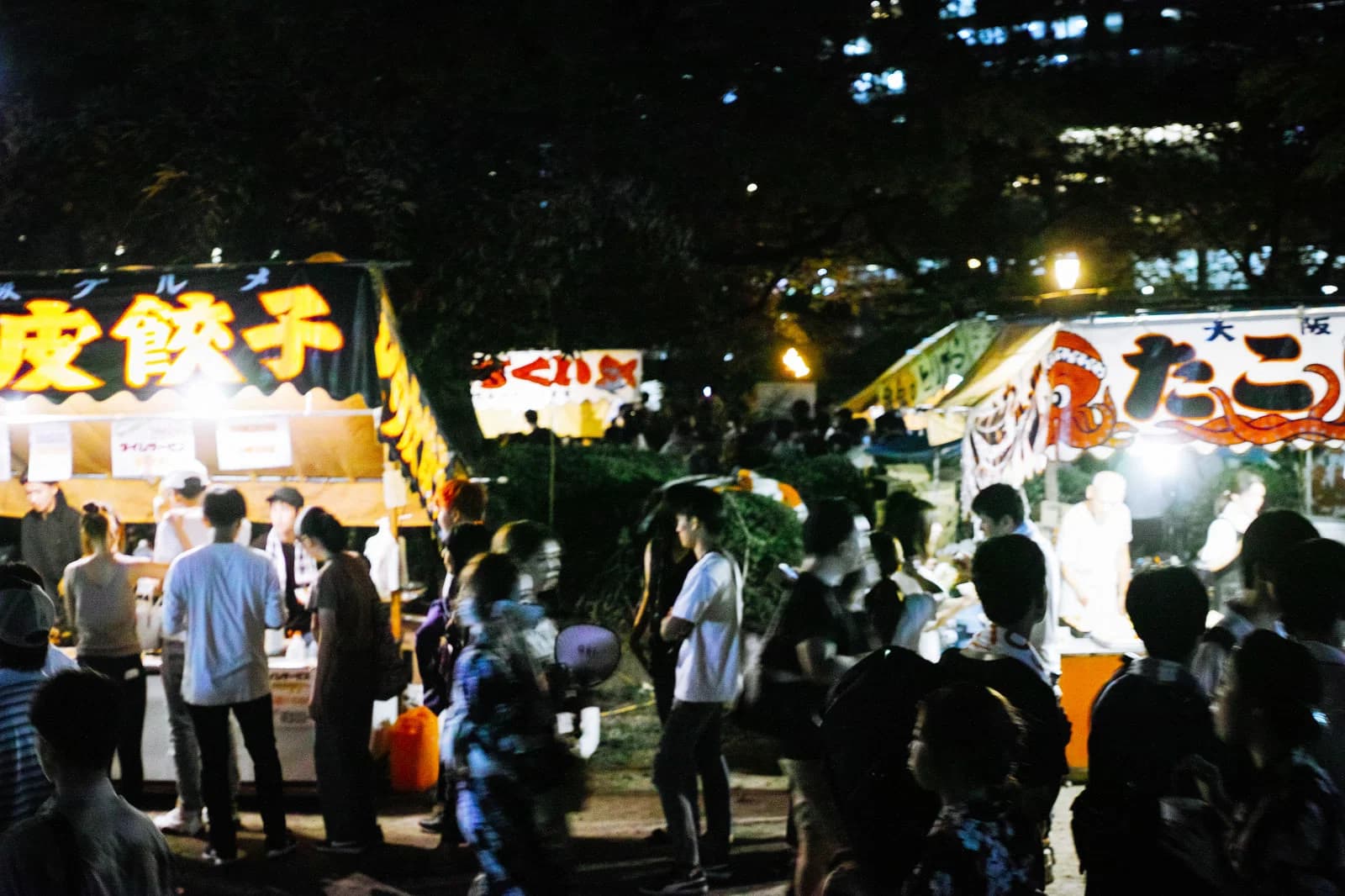
Bloom timing shifts with the weather, so check each spot's official site or social media for the latest flowering status before you go. If you're building a summer day around festivals or fireworks, take a look at Tokyo Summer Fireworks 2026 and A Guide to Japanese Summer Festivals 2026 too.
Compare the Spots at a Glance
Not sure where to go? The table below lets you weigh bloom timing against how easy each spot is to reach. Kiyose is the closest of the big fields; Showa Kinen Park is the simplest to get to. Travel times are rough estimates from Shinjuku Station and will vary with transfers and the day's train and bus service.
Spot | 2026 bloom / dates | Scale | Admission | From central Tokyo (from Shinjuku, approx. |
|---|---|---|---|---|
Kiyose Sunflower Festival / 清瀬ひまわりフェスティバル (Kiyose, Tokyo) | July 18–26 | ~100,000 flowers, one of the largest in Tokyo | Free | ~35 min by train + bus |
Showa Kinen Park / 昭和記念公園 (Tachikawa, Tokyo) | Mid-July to September (typical) | Blooms by variety in stages | Adults ¥450 | ~40 min (2-min walk from Nishi-Tachikawa Sta. |
Zama Sunflower Festival / 座間市ひまわりまつり (Zama, Kanagawa) | Around mid-August (2026 dates TBA) | ~550,000 flowers | Free | ~50 min by train + bus |
Akebonoyama Agricultural Park / あけぼの山農業公園 (Kashiwa, Chiba) | Mid- to late July (typical) | ~80,000 flowers | Free | ~1 hr by train + bus |
Akeno Sunflower Festival / 北杜市明野サンフラワーフェス (Hokuto, Yamanashi) | July 18 – Aug 16 | ~400,000 flowers | Free (parking donation) | ~2.5 hrs (limited express + bus) |
These five spots are scattered in different directions — northwest Tokyo, Chiba, Kanagawa, and Yamanashi — so plan on one spot per day. The exception is Kiyose and Showa Kinen Park: both sit in northwest Tokyo, so with a transfer you can pair them as two half-day visits.
Kiyose Sunflower Festival / 清瀬ひまわりフェスティバル (Kiyose, Tokyo)
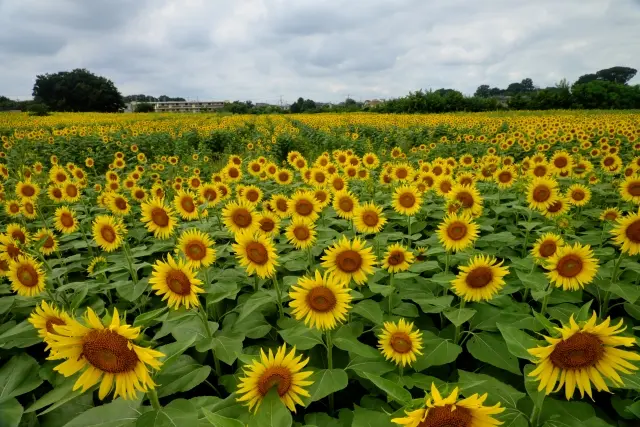
For the best balance of size and proximity to the city, head to the Kiyose Sunflower Festival. About 100,000 sunflowers bloom across roughly 24,000 square meters, billed as one of the largest sunflower fields in Tokyo. Marked paths run through the field, so you can walk surrounded by flowers that tower over your head.
Dates | July 18 (Sat) – July 26 (Sun), 2026 |
|---|---|
Hours | Weekdays 9:00–13:00 / weekends & holidays 9:00–18:00 (last entry 30 min before closing) |
Admission | Free |
Scale | ~100,000 flowers across ~24,000 m² |
Access | From the north exit of Kiyose Station (Seibu Ikebukuro Line), take a local bus; or catch the free shuttle bus from the temporary stop at the north exit, then walk about 3 minutes. |
The festival runs just nine days, and as one of the largest fields in Tokyo, it gets especially busy on weekends. If you drive, the temporary parking lot is paid and fully reservation-only (book by the day before), so public transit is the easier choice.
Official site: 清瀬市公式ホームページ
清瀬ひまわりフェスティバル|清瀬市公式ホームページ
Showa Kinen Park / 昭和記念公園 (Tachikawa, Tokyo)
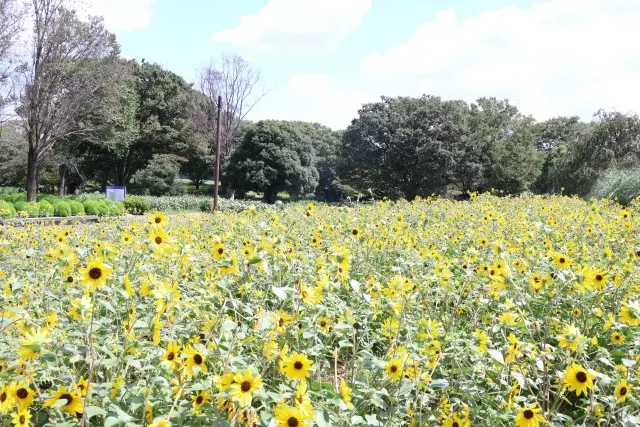
If sheer ease of access is what matters, Showa Kinen Park in Tachikawa is in a league of its own. It's about a 2-minute walk from Nishi-Tachikawa Station (JR Ome Line) to the park gate — simple enough even on your first trip to Tokyo. From mid-July into September, several types of sunflower come into bloom in turn, from tall single-stem varieties to smaller branching ones.
That said, this isn't one vast field so much as sunflowers blooming by variety in different corners of a very large park. Think of it as flowers to enjoy while you stroll, rather than a single field to make a beeline for.
Hours | April–September, 9:30–17:00 (until 18:00 on weekends and holidays) |
|---|---|
Admission | Adults (high school and older) ¥450 / Seniors (65+) ¥210 / free for junior high age and younger |
Bloom | Mid-July to September (timing shifts by variety) |
Access | About a 2-minute walk from the park exit of Nishi-Tachikawa Station (JR Ome Line) to the Nishi-Tachikawa gate — the shortest route. |
The varieties, flower counts, and current bloom status are posted on the park's official "Hana-dayori" flower bulletin. It's worth a look before you set out.

Zama Sunflower Festival / 座間市ひまわりまつり (Zama, Kanagawa)
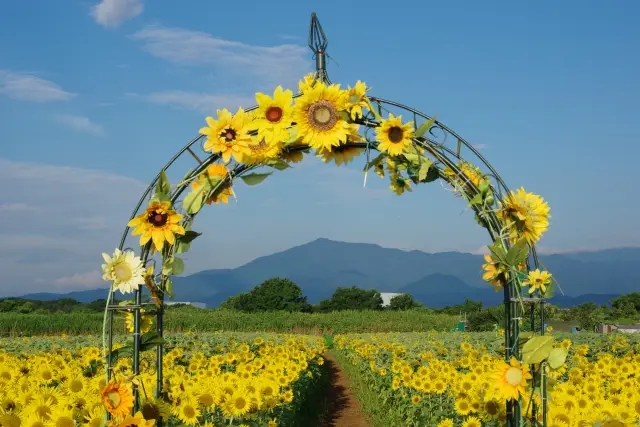
For flat-out overwhelming scale, there's the Zama Sunflower Festival in Kanagawa. Around 550,000 sunflowers bloom in the fields near Zakae Bridge (座架依橋), turning everything gold. Admission is free. It's held as a "sunflower festival" around the Obon period each year, with a direct shuttle bus from the nearest station while it's on. With this many flowers drawing crowds, weekend mornings fill up fast.
Bloom | Early to mid-August (typical) |
|---|---|
2026 dates | Not yet announced (usually around Obon; in 2025 it ran August 9–11) |
Scale | ~550,000 flowers |
Admission | Free |
Access | Direct shuttle bus to the site from Sobudai-mae Station (Odakyu Line), running only during the festival. |
The 2026 dates had not been announced as of July 2026. Once they're set, they'll appear on the Zama City and Zama City Tourism Association websites, so check before you lock in your travel plans.
Official site: 神奈川県座間市の公式ホームページです。市政情報や市民の方、事業者の方向け情報、観光・文化財・イベント情報など、さまざまな情報を提供しています。
座間市ホームページ
Akebonoyama Agricultural Park / あけぼの山農業公園 (Kashiwa, Chiba)
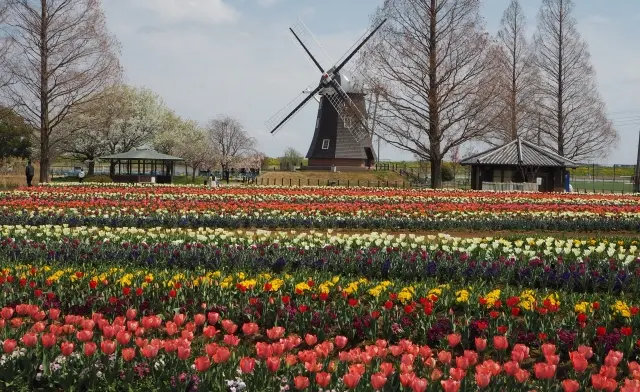
If you want to photograph sunflowers against a Dutch-style windmill, this is the one — Akebonoyama Agricultural Park in Kashiwa. Around 80,000 sunflowers (the count varies year to year) bloom in the field in front of the windmill. They stand about 150 cm tall, so you're surrounded by big blooms right at eye level. Both admission and parking are free, making it an easy stop even with kids.
Hours | 9:00–17:00 |
|---|---|
Admission | Free (parking is free too) |
Closed | Mondays (or the next day if Monday is a holiday) and year-end/New Year |
Bloom | Mid- to late July (typical) |
Access | From the north exit of Abiko Station (JR Joban Line), take the Hanto Bus bound for "Akebonoyama Nogyo Koen" (~17 min) to the last stop; the park is about a 1-minute walk away. |
This isn't a "festival" with fixed dates — it's a sunflower field in a park that's open year-round, so the peak depends on that year's bloom. Check the Kashiwa City or park website for flowering status before you visit.
Official site: Akebonoyama Agricultural Park
Akeno Sunflower Festival / 北杜市明野サンフラワーフェス (Hokuto, Yamanashi)
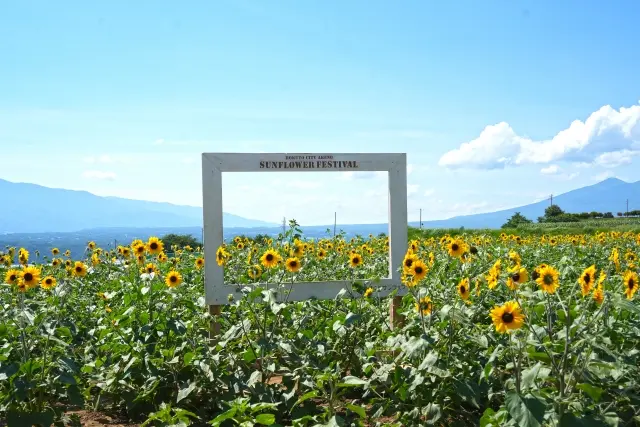
It's farther than the other four, but the scenery pays you back. If you're up for the trip, Akeno in Hokuto, Yamanashi is worth it. Across several sites in Akeno — a town that bills itself as having Japan's longest hours of sunshine — some 400,000 sunflowers bloom in succession. On a clear day you can take them in with the Southern Alps or Yatsugatake mountains behind, which makes for postcard-worthy photos.
Dates | July 18 (Sat) – August 16 (Sun), 2026 |
|---|---|
Bloom | Throughout the festival (each site peaks in turn) |
Scale | ~400,000 flowers |
Admission | Free (parking donation requested; ¥1,000 per car at the main lot, etc. |
Access | From Nirasaki Station (JR Chuo Line), take the Kayagatake–Mizugaki Denen bus about 25–30 minutes to "Heidi's Village Clara-kan mae," then walk about 5 minutes. |
You can do it as a day trip from Tokyo, but keep in mind that it means connecting a limited express train with a bus. Bloom status and bus service are updated on the official site and social media, so confirm before you head out.
Official site: 2026年7/18〜8/16開催!山梨県北杜市で40万本のひまわりが咲き誇る「北杜市明野サンフラワーフェス」。360度の大パノラマ絶景や開花状況をチェック!
北杜市明野サンフラワーフェス2026
Before You Go
Sunflower fields offer almost no shade, and you'll be walking under the full midsummer sun, so don't skip the hat, sunscreen, and water.
For photos, early morning is best — the light is soft and the crowds are thin. Kiyose (with its short run) and Zama (with all those flowers) get especially busy on weekend afternoons, so an early start makes for a smoother visit. Since sunflowers face the sun, keeping the light behind you helps you catch the flowers head-on.
Bloom timing can shift by a week or two from year to year. The dates in this guide are the official 2026 figures, but whether the field is at full bloom on a given day comes down to the flowering that season. Check each spot's official site for the latest status right before you go.
Related Reading
Tokyo Summer Fireworks 2026: 6 Major Shows for Visitors
This article was translated from the original Japanese with AI assistance and reviewed by our editorial team. The Japanese version is authoritative.