
Owara Kaze no Bon (おわら風の盆) runs September 1 to 3 in Yatsuo, a hillside district of Toyama City on the Sea of Japan side of central Honshu. Dancers with straw hats pulled low over their faces move through the streets after dark, to shamisen and kokyu (胡弓), a bowed string instrument.
Eat before you come. There's no convenience store in the district, and nothing about food stalls is published for September 1, 2 or 3 — they aren't something you can plan around.
If you want to sit down for it, the main seated option is the indoor Owara Kaze no Bon Kyoenkai (おわら風の盆競演会), the ticketed competition stage. Tickets are ¥4,000, and they go through the travel-booking site tabiwa.
September 3 is the odd night out: it starts at 19:00 instead of 17:00, which makes it two hours shorter than the other two. If you can only make one night, make it the 1st or the 2nd.
2026 dates, hours, and the ¥4,000 seat
Item | Details |
|---|---|
Dates | Tuesday September 1, Wednesday September 2, Thursday September 3, 2026 (all weekdays) |
Hours | Sept 1-2: 17:00-23:00 / Sept 3: 19:00-23:00 (neighborhoods may finish early) |
Location | The Yatsuo area of Toyama City, Toyama Prefecture, including the Fukushima district |
Paid seating | Owara Kaze no Bon Kyoenkai, ¥4,000 (unreserved, 350 seats per session) |
Rain | Dancing pauses; nothing official has been published about postponement |
The committee's own summary of the three nights: the content is the same each night, and the third is simply shorter.
The pre-festival evenings (前夜祭), normally held in the Yatsuo streets from around August 20 to 30, won't take place in 2026. The Etchu-Yatsuo Tourism Association says flatly that they're off.
Two small ticketed events land on August 29 and 30 instead. The Tourism Association hosts Banka no Yube — Mosugu Kaze no Bon (晩夏の夕べ もうすぐ風の盆) at the Owara Museum. The committee runs Joso no Owara (序奏のおわら) in a former ryotei (旧料亭杉風莊) — a high-end traditional restaurant — with 20 places a day at ¥22,000.
To check availability for the first, call the Tourism Association (076-454-5138); for the second, the organizing committee (076-454-5152).
Official site: Owara Kaze no Bon organizing committee
The indoor Kyoenkai stage — and the street time it costs you
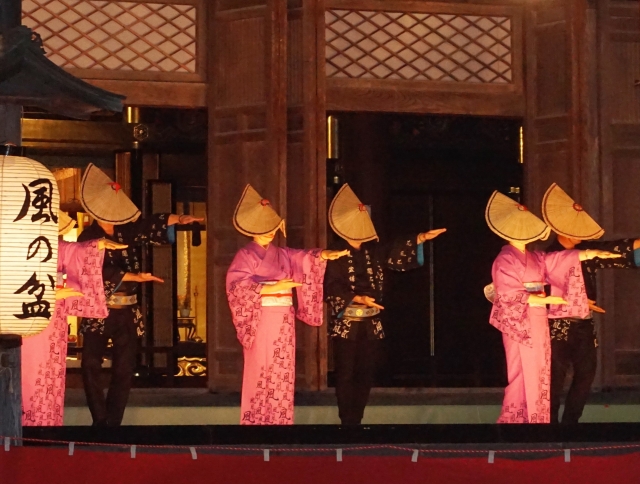
The Owara Kaze no Bon Kyoenkai is a ticketed performance at the Yatsuo Hikiyama Exhibition Hall. It runs twice a night on all three nights: session 1 from 18:00 to 19:00, session 2 from 19:20 to 20:20. Tickets are ¥4,000 including tax, unreserved, 350 seats per session.
One session stands apart from the rest: in the second session on September 3, and only then, the audience is taught the steps before heading out to the street ring dance.
Now the trade-off. On September 1 and 2, session 1 costs you the street dancing between 18:00 and 19:00 — the festival's published hours start at 17:00, so there's an hour of street dancing on the schedule before you go in. Session 2 keeps you inside from 19:20 to 20:20.
On September 3 the streets don't start until 19:00, so session 1 conflicts with nothing.
Each session is an hour: two neighborhood branches, 30 minutes apiece, drawn from the Etchu-Yatsuo Owara Preservation Society (富山県民謡越中八尾おわら保存会) and the Toyama Prefectural Yatsuo High School folk arts club.
The committee publishes who appears when. September 1: Nishimachi and Kagamimachi, then Fukushima and Kami-shinmachi. September 2: Suwamachi and Tenmamachi, then Imamachi and Higashimachi. September 3: the Yatsuo High School club with Nishi-shinmachi, then Higashi-shinmachi and Shimo-shinmachi.
If there's a neighborhood you want to see indoors, pick your night and session from that list.
Individual tickets (1-10 people) have been on sale through tabiwa since June 2, 2026. The link is on the committee's Kyoenkai page, below. Groups of 11 or more and travel agencies book by phone at 076-454-5152.
The committee's homepage says "Kyoenkai tickets on sale," but that notice is marked "as of July." The official pages don't say how many seats are left, whether same-day tickets exist, or when the doors open. Seating is unreserved, so where you sit comes down to when you arrive.
The Tourism Association is also running a 2026 Owara Kaze no Bon Special Live at the Owara Museum on the same three nights. Tickets went on sale July 6; for pricing and times, call the association (076-454-5138).
The Kyoenkai is indoors, so it goes ahead in the rain. The street dancing and ring dancing outside do not.
Official site: Kyoenkai tickets and schedule
Which neighborhood to stand in — schedules due mid-August
The committee is blunt about this: there is no main venue.
Eleven branches perform in their own streets — Nishi-shinmachi, Higashi-shinmachi, Kami-shinmachi, Suwamachi, Kagamimachi, Higashimachi, Nishimachi, Imamachi, Shimo-shinmachi, Tenmamachi and Fukushima (a district of Yatsuo — nothing to do with the prefecture).
No two feel the same. Suwamachi is the gentle slope up toward Higashi-shinmachi, lined with paper lanterns. Water channels run down both sides of the street, so there's a trickle of water under the music.
Kagamimachi is a former geisha quarter, and the committee itself singles out its women's dance.
Kami-shinmachi has the widest street of the old neighborhoods, which makes the dancing comparatively easy to see. Fukushima has more people involved in Owara than anywhere else in town.
Visitors are welcome to join in during the ring dancing. Fukushima and Kami-shinmachi usually hold a large ring dance, and the other neighborhoods set aside time for it too.
The neighborhood-by-neighborhood schedule still hadn't been published as of August 4, 2026. The committee says schedules are usually settled by mid-August and will go up on the official site and at the information desks on the day.
Some branches put on a stage performance as well as dancing in the street. You'll read online that the night goes on into the small hours; the only hours the committee publishes end at 23:00.
Rain, crowds, and early finishes
Rain stops the street dancing: the instruments and the costumes both have to be kept dry.
The committee is careful with the wording: it's a pause, not a cancellation, and each neighborhood decides for itself whether to start again once the weather clears. No official source says anything about moving a night to another day. Toyama City lists the hours with "(paused in rain)" attached.
Weather isn't the only reason it stops. The Toyama City Tourism Association warns that neighborhoods sometimes finish earlier than scheduled, and that dancing can be suspended when crowding makes it unsafe.
Show up at 22:30 and the neighborhood you picked may already have packed up.
Getting there, and the road closures (September 1-3)
From Toyama Station, the JR Takayama Line reaches Etchu-Yatsuo Station in 25 to 30 minutes. On festival nights you need a numbered boarding ticket (整理券) to get on, and as of August 4, 2026, JR hasn't said how those will be handed out, or whether it will add extra trains. In 2025 the announcement came on August 27.
The dancing runs until 23:00, so sort out the return leg before you lock in the rest of your plans. The Etchu-Yatsuo trains are JR West; anything beyond Toyama Station is Ainokaze Toyama Railway.
The Chitetsu Yatsuo-line bus leaves from stop 6 at Toyama Station's south exit and takes 50 to 60 minutes to the last stop. A taxi from Toyama Kitokito Airport takes 25 to 30 minutes.
Be careful with the bus. In past years part of the route has been suspended during the festival, with detours and short-turn services. No 2026 notice had appeared as of August 4, so call Toyama Chitetsu (076-454-2626) before you count on it.
Two parking lots are open in 2026: Yatsuo Sports Arena and Konagatani. Parking runs ¥3,000 per vehicle — officially a cooperation fee — and the lots take cars from 09:00 to 23:00. The Yatsuo Clinic lot, used in past years, is not available in 2026.
The shuttle bus runs only between Yatsuo Sports Arena and Yatsuo Bridge; there's no service from Konagatani. The committee doesn't publish the shuttle's hours, or say whether the ¥3,000 covers the fare, so call them (076-454-5152) if you need to know how you're getting home after the last dance.
Roads close 16:00 to 24:00 on September 1 and 2, and 18:00 to 24:00 on September 3, according to the Etchu-Yatsuo and Toyama City tourism associations. Toyama City says the festival area is closed to vehicles and can only be crossed on foot. The committee publishes the 2026 road closure map (PDF) covering September 1 to 3.
Most of what's still unconfirmed — the neighborhood schedules, the train arrangements, the bus route — has to be checked by phone in Japanese. If that's a problem, ask your hotel front desk to call for you.
What to bring, and how to behave
Bring food with you if you can. The committee spells it out: the handful of restaurants in town are small family places that fill up fast.
Even vending machines are few and far between, and the committee asks visitors not to eat while walking.
Food trucks and stalls sometimes set up in whatever space they can find, but the committee publishes neither dates nor locations for September 1, 2 or 3 — don't count on finding food.
The Etchu-Yatsuo Tourism Association says information desks and temporary toilets are set up at the main points — in front of JR Etchu-Yatsuo Station, at the bus drop-off areas, and so on.
The streets are narrow, so the committee asks visitors not to wheel large luggage through them. There's almost nowhere to sit, and a light folding stool helps.
Bring a rain jacket rather than an umbrella. Umbrellas block the view of everyone behind you, and you'll want your hands free while you wait for a shower to pass.
Don't fire a flash at the dancers up close. It blinds them for a second and breaks up the street dancing. The committee also asks that tripods not block sightlines or walkways.
Before you go, and what's next in September
Watch the committee's site from mid-August for the neighborhood schedules — that's the last piece you need before you book anything.
Owara ends, but September doesn't. Just over two weeks later, Osaka has the Kishiwada Danjiri Festival 2026 on September 19 and 20.
This article was translated from the original Japanese with AI assistance and reviewed by our editorial team. The Japanese version is authoritative.