
The Sawara Grand Festival (Sawara Taisai) in Katori City, Chiba, runs from Friday, October 9 to Sunday, October 11 in 2026. It is one of Japan's UNESCO-listed "Yama, Hoko, Yatai float festivals," and over three days, 14 towering wooden floats are pulled through the old streets of Sawara, a riverside district known as "Little Edo."
The best part for travelers: Sawara sits right outside JR Sawara Station, about an hour by train from Narita Airport. If you land at Narita or have a spare day before flying home, this is one of the easiest traditional festivals to reach.
This guide covers the 2026 dates and hours, what to look for, how the three days differ, the traffic restrictions, and how to get there from Sawara Station, Narita Airport, and central Tokyo. If you want other autumn festivals too, see our guide to autumn festivals in Japan.
In 2026 the festival runs October 9–11, 10:00–22:00 each day. Saturday, October 10 is the day all 14 floats line up. The area around Sawara Station and the Ono River is closed to cars during those same hours.
Dates and the basics (2026)
Item | Details |
|---|---|
Festival | Sawara Grand Festival, Autumn (Suwa Shrine festival) |
2026 dates | Friday, October 9 – Sunday, October 11 |
Hours | 10:00–22:00 each day |
Where | Shinjuku district, Sawara, Katori City (west of the Ono River) |
Floats | 14 |
Nearest station | JR Sawara Station (the festival area starts right outside) |
Rain | Held in the rain (the float figures are covered with plastic sheeting) |
Admission | Free to watch |
One thing worth knowing: Sawara holds its Grand Festival twice a year. The summer festival (July) belongs to Yasaka Shrine in the Honjuku district, east of the Ono River. The autumn festival (October) belongs to Suwa Shrine in the Shinjuku district (a neighborhood in Sawara, not Tokyo's Shinjuku), on the west side, with 14 floats. If you are coming in autumn, look for "Suwa Shrine, Shinjuku district, 14 floats."
What you'll see: the floats and the "nonoji-mawashi"
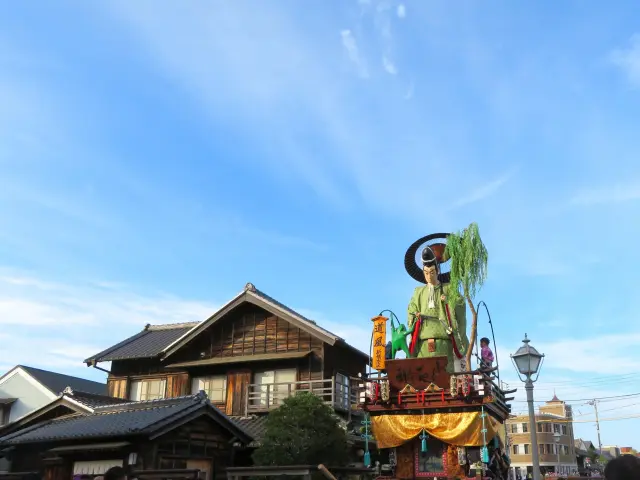
The autumn floats are built from solid zelkova wood, carved with heavy Kanto-style woodwork, and topped with giant figures made by master doll-makers of the Edo and Meiji eras. A float can reach about seven meters tall, and watching one squeeze past the eaves of the old townhouses is a sight in itself.
The signature moment is the "nonoji-mawashi," a feat of float-handling. The pullers spin a float weighing three to four tons and standing up to seven meters, tracing the shape of the hiragana character "の" on the ground. It is part turn, part show of strength, and the crowd roars as the float swings around.
Throughout the day you'll hear "Sawara-bayashi," counted among Japan's three great festival music traditions. Flutes and drums carry across the whole town, so you often hear a float coming before you see it.
Which day to go: Friday, Saturday, or Sunday
All three days have floats out from 10:00 to 22:00, so you'll see them whenever you go. Beyond that, each day has its own character.
Saturday, October 10 is the middle day, when all 14 floats gather for the "soroi-biki" lineup. According to Katori City, that full lineup starts around 13:30 (the floats are out from 10:00, as on the other days). It's the fullest, most spectacular day, and also the most crowded.
Katori City doesn't publish a set procession schedule or a fixed route for Friday and Sunday, so those days are harder to plan around. The upside is likely thinner crowds and more room to wander the old streets at your own pace. Go Saturday for the full 14-float lineup and the biggest spectacle, or pick Friday or Sunday if you'd rather have a calmer day. Either way, the festival's official digital map (see below) is the surest way to follow a particular float.
Road closures and getting around (October 9–11)
On all three days (October 9–11), the festival area is closed to traffic from 10:00 to 22:00. The area in front of Sawara Station, across Chukei Bridge, along the Ono River, and around Suwa Shrine is closed to vehicles, with a "please avoid driving" zone around its edge. Some local and loop buses are suspended or rerouted.
Katori City posts a 2026 road-closure map on its official site, so if you plan to drive anywhere near the center, check the closed streets in advance.
On the ground, the festival's official digital map (opened from a QR code) shows the live position of each float along with gathering spots and rest areas. It's run by the Sawara Grand Festival executive committee and is handy when you're trying to track down a particular float.
Getting there: Sawara Station, Narita Airport, and Tokyo
By train, get off at JR Sawara Station on the Narita Line and the festival area is right outside. The photogenic heart of the festival, around the Ono River and Chukei Bridge, is about a 15-minute walk from the station.
From Narita Airport, take the train from Narita Airport Terminal 1 or 2 Station, change at Narita Station, and continue on the Narita Line to Sawara. It takes about an hour and costs roughly ¥720 one way (¥715 with an IC card). There is generally no direct train from the airport, so plan on the change at Narita Station.
From central Tokyo, there are highway buses from the Tokyo Station area to Sawara Station, or you can take JR trains via Chiba and Narita onto the Narita Line. Any special or extra train service varies by year, so check the timetable before you set out.
By car, it's about 10 minutes from the Sawara-Katori IC on the Higashi-Kanto Expressway. On festival days a free temporary lot for 1,000 cars opens on the Tone River flood plain, with a shuttle bus that drops you near the festival area (¥500 per person, elementary school age and up). Since the center is closed to traffic, drivers should use this lot.
Sawara itself has few places to stay. If you want to stay the night before or after, one option is to base yourself around Narita Station, about 30 minutes away by train, and commute in.
Check hotel availability and rates in the Narita area
Rain, food stalls, and a Little Edo stroll (October 9–11)
The autumn festival is held in the rain, and the float figures are covered with plastic sheeting when it's wet. Katori City doesn't state its policy for severe weather, so if the forecast looks rough, check the day's announcements before you go.
It's worth staying into the evening on any of the three days. After dark, each float lights up with paper lanterns and takes on a completely different mood. It gets cool by the river in October, so bring a light layer if you plan to stay for the lantern-lit floats.
For the 2026 festival (October 9–11), the official Katori City pages don't mention food vendors, so check local announcements closer to the date rather than assuming stalls will be there.
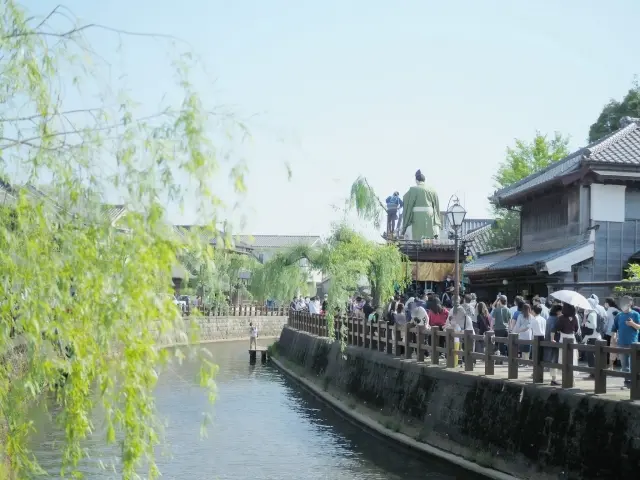
Sawara is a nationally designated preservation district of historic buildings, a genuine "Little Edo" townscape. Between floats, it's a fine place to simply wander the lanes along the Ono River. For another Kanto festival built around wooden floats, see our Kawagoe Matsuri guide.
This article was translated from the original Japanese with AI assistance and reviewed by our editorial team. The Japanese version is authoritative.
