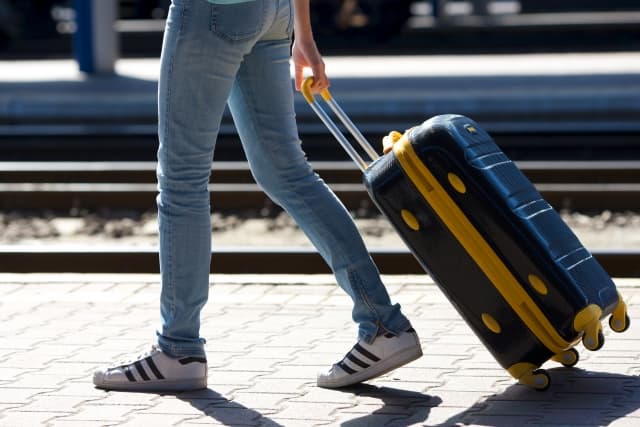
There's a familiar gap in almost every Japan itinerary: your hotel checks you out at 10 a.m., but your bullet train or flight doesn't leave until evening.
That leaves you with a whole day of sightseeing and a suitcase in tow — on crowded trains, up and down station stairs, and into cafes where there's nowhere to put it.
The good news is that Tokyo is built for traveling light, and there are four easy ways to get your luggage out of the way for a few hours, a full day, or overnight.
One quick note before we start. If you're changing cities — say, Tokyo to Kyoto — the smartest move is often not to store your bag at all, but to forward it ahead to your next hotel.
That's a separate service called takkyubin, and we cover it in our luggage-forwarding guide. This article is about storing your luggage locally so you can explore hands-free and pick it up later that day or the following day.
Option 1: Coin lockers (the cheapest, most common)
Coin lockers (コインロッカー, koin rokka) are everywhere in Tokyo — inside and around train stations, in shopping centers, and near busy sightseeing areas.
They generally come in three sizes, and prices vary by location and machine.
As a rough guide: small ¥300–¥500 (a daypack or small backpack), medium ¥500–¥800 (a small carry-on or larger bag), and large ¥700–¥1,000 (a suitcase). At major hubs like Tokyo Station, the large lockers for big suitcases can run ¥900–¥1,000.
Most modern lockers let you pay with coins or with a transit IC card — just tap your Suica or PASMO, and the card itself becomes your 'key,' which you tap again to open the door later.
Older coin-only lockers still exist, so it's worth keeping a few ¥100 coins on you. If you need coins, buy something small at a konbini (a Japanese convenience store) and use the change, or look for an IC-card locker — konbini ATMs dispense cash, but they won't break a note into coins.
Two things trip up first-timers.
First, 'one day' isn't a rolling 24 hours from when you drop the bag — the daily fee resets at a set time, often midnight or 2 a.m. depending on the machine.
So a bag left from 5 p.m. until 10 a.m. the next morning can be billed as two days, even though it sat there for under 24 hours. The exact cut-off varies by locker, so check the panel.
Second, there's a time limit: most station lockers hold your bag for about three days, after which it may be removed and held by station staff.
Airport lockers allow longer — at Haneda, all three terminals let you keep a locker for up to seven days from the start date, with each 24-hour period counted as one day. If you need more than a couple of days, read the notice on the locker door before storing your bag.
Finding an empty locker
The real catch with lockers is simple: at popular stations the big ones fill up fast, and mid-morning, weekends, and holiday periods are the hardest times to find one.
A few habits help.
Try basement levels such as B1 and the quieter exits rather than the main concourse — the lockers right beside the Shinkansen ticket gates are always the first to go.
Free finder sites and apps such as Coin Locker Navi show where locker banks are located in each station and what sizes are available.
And remember: if you paid with an IC card, you have to come back with that same card to open the door, so don't switch phones or cards in between.
Tokyo Station has more than 100 locker locations, with over 900 lockers around the Gransta area on basement level 1 alone. A large new locker center also opened on the Yaesu side in March 2026; some lockers there start at ¥100, and it can handle oversized gear such as skis and snowboards — handy when the smaller banks are full.
Option 2: Bag-drop apps (when lockers are full or your bag is too big)
When every locker is taken, or your suitcase is simply too big to fit in one, a bag-drop service is the easy fallback.
The best-known option is ecbo cloak, an app that lets you reserve space at a partner location — a cafe, hotel, shop, or sometimes even a konbini — and leave your bags there for the day.
You book and pay in the app (it's available in English), drop off your bag, and pick it up before the shop's closing time. Standard pricing is ¥500 per day for a bag (under 45 cm on its longest side) and ¥800 per day for a suitcase (45 cm or more), with a weight limit of about 20 kg. Some locations charge different rates, so check the price on the booking screen, and note that individual shops set their own opening hours.
A couple of international apps, such as Bounce and Radical Storage, run similar networks of drop-off points if you prefer a more familiar international platform.
Option 3: Your hotel (often free)
Don't overlook the simplest option of all: most hotels will hold your luggage for free, both before check-in and after check-out (though valuables and perishables may not be accepted).
Arriving at 9 a.m. with a bag you can't drop until the 3 p.m. check-in? Leave it at the front desk and go explore.
Many larger stations also have staffed baggage rooms (手荷物預かり所, tenimotsu azukarijo) if you'd rather hand your bag to staff than leave it in a metal locker. Rates depend on size — at Tokyo Station, expect roughly ¥500–¥2,000 per item.
Option 4: Forward it instead
Finally, if you're moving on to another city or heading to the airport, consider skipping storage altogether and sending your suitcase ahead.
Takkyubin courier services can send a suitcase from your hotel to your next hotel, or to the airport.
The price depends on size, distance, and any airport handling fee, but as a rough guide, sending a suitcase between hotels in central Tokyo, or from central Tokyo to Haneda, usually costs around ¥2,000–¥3,500 (longer hauls like Tokyo–Kyoto, or oversized bags, cost more).
Our luggage-forwarding guide walks through exactly how.
You can also send your bags from the airport to your hotel as soon as you land; see our Narita and Haneda airport access guide.
And if you're taking the Shinkansen with oversized luggage, check the oversized-luggage reservation rules in our guide to riding the Shinkansen.
So which one should you choose?
For a few hours with a small bag, a coin locker is cheapest and quickest. If the lockers are all full or your case is large, try ecbo cloak.
Before check-in or after check-out, simply use your hotel. And if your bag's whole journey is to the next city, forward it with takkyubin and travel hands-free.
You don't have to pick just one — most visitors naturally end up using two or three of these during a single trip. The point is that you never need to drag a suitcase around a temple, museum, or department store again.
Note: prices, time limits, opening hours, payment methods and reservation availability vary by locker, shop and season, and can change. Station lockers may carry peak-season surcharges, and the daily cut-off time differs by machine. Before you store a bag, check the notice on the locker, the touch panel or booking screen, and the operator's site for the latest details.
This article was translated from the original Japanese with AI assistance and reviewed by our editorial team. The Japanese version is authoritative.

