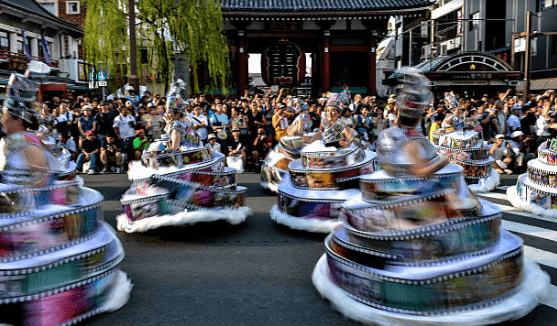
Every late August, the old-town streets of Asakusa (浅草) fill with the thunder of Brazilian drums and rows of feathered dancers. The Asakusa Samba Carnival is one of the largest samba events in Japan, drawing around 500,000 people to the avenues by Kaminarimon (雷門), the great gate of Sensō-ji temple.
In 2026, the 41st Asakusa Samba Carnival Parade Contest takes place on the afternoon of Saturday, August 29. This guide covers the start time, the parade route, where you can watch for free, and the seating situation — all based on the official announcements.
It's a crowded weekend for the city: several other summer festivals and fireworks fall around the same dates. For a day-by-day rundown, see Tokyo Summer Events Calendar 2026.
Event Overview for 2026
Event | 41st Asakusa Samba Carnival Parade Contest |
|---|---|
Date | Saturday, August 29, 2026 |
Start | 1:00 p. |
Venue | Umamichi-dori to Kaminarimon-dori, Asakusa |
Nearest stations | Asakusa Station / Tawaramachi Station |
Viewing | Free standing room along the route (apart from paid supporter seats) |
Organizer | Asakusa Samba Carnival Executive Committee |
Applications for the paid supporter seats (kojin kyōsan-seki) closed on August 10. On the day itself, watching from the route is free, standing room only.
The carnival began in 1981, which makes 2026 the 41st edition. Taito City says roughly 500,000 people come each year, and the organizers report that the most recent 40th carnival drew about 470,000.
The parade starts at 1:00 p.m., but no official end time is published, so leave some room in the rest of your day.
Parade Route and Free Viewing
The parade runs along Umamichi-dori (馬道通り) and Kaminarimon-dori (雷門通り), passing right by Kaminarimon and Sensō-ji. Floats and dance troupes make their way down the avenue one after another.
Barriers line the course, and spectators stand just inside them. Because there are no seats, you can't hold a spot with a chair or a picnic sheet.
The nearest stations are Asakusa and Tawaramachi, both a short train ride from central Tokyo. Expect the area around the route to get very crowded on the day.
That same Saturday, Koenji holds its own Awa Odori dance festival on the other side of town. The times and location are different, but if you'd like to compare two contrasting Tokyo street performances, take a look at Koenji Awa Odori 2026.
Paid Seats and Watching on the Day
For 2026, the organizers offered paid "supporter seats" (kojin kyōsan-seki, a form of individual sponsorship) at 8,000 yen per unit. Each unit came with one reserved seat for the parade contest, an exclusive event towel, and an official program.
Applications were first-come, first-served with a limited number of places, and they closed on August 10, 2026, so there's no longer any way to book a paid seat in advance.
If you want a good view on the day, your best move is to arrive along the route early.
The Teams and What to Watch For
The heart of the carnival is the parade contest, where the teams compete against one another. In 2026, the top-tier S1 League has six teams and the S2 League has eight, plus one team in the Theme Samba League. A separate Communication League brings in local elementary schools and other community groups.
The S1 League features names such as Império do Samba (インペリオ ド サンバ), Nakamise Barbaros (仲見世バルバロス), and União dos Amadores (学生サンバ連合). Judges score them on how they interpret the theme, along with energy, costumes, music, and dance.
Up close, the massed ranks of feathered dancers and the ground-shaking percussion hit with real force. It's one of the few places you can feel the heat of a Brazilian carnival in the middle of Tokyo.
Weather, Traffic, and Practical Notes
At the 40th carnival, the parade ran even in rain and was called off only in severe weather, with that decision made by 11:00 a.m. on the day. It can also be stopped at the committee's discretion if the crowds become unsafe. That was the previous edition's policy, so the final call for 2026 will be posted on the official site closer to the date.
If the forecast looks uncertain, check the official site for the latest decision before you set out.
There will be traffic restrictions on the event day, Saturday, August 29, but the 2026 details (which streets close and when) haven't been announced yet. For the latest, check the notices from Taito City and the Asakusa Police. Some bus routes may be diverted on the day as well.
There are also rules on filming and what you can bring. Drones and selfie sticks are banned, and you can't bring monopods, tripods, or chairs either. It's peak summer and the sun is strong, so drink plenty of water and pace yourself in the heat.
This article was translated from the original Japanese with AI assistance and reviewed by our editorial team. The Japanese version is authoritative.