Every autumn, Miharashi Hill (みはらしの丘) at Hitachi Seaside Park (国営ひたち海浜公園) in Hitachinaka, Ibaraki, turns a deep, glowing red. The hillside is covered in thousands of round kochia bushes (コキア), and the sight is one of the most recognizable images of autumn in Japan.
The catch is timing. Kochia changes color fast, and the true red only lasts about a week to ten days. Come even a week too early or too late, and you'll find a green or golden hill instead. This guide covers when to go for the red, when the evening illumination runs and what it costs, plus admission, access, and how to dodge the crowds.
If you're planning a wider autumn trip, see our guide to Japan's best autumn foliage spots as well.
When the Kochia Turns Red
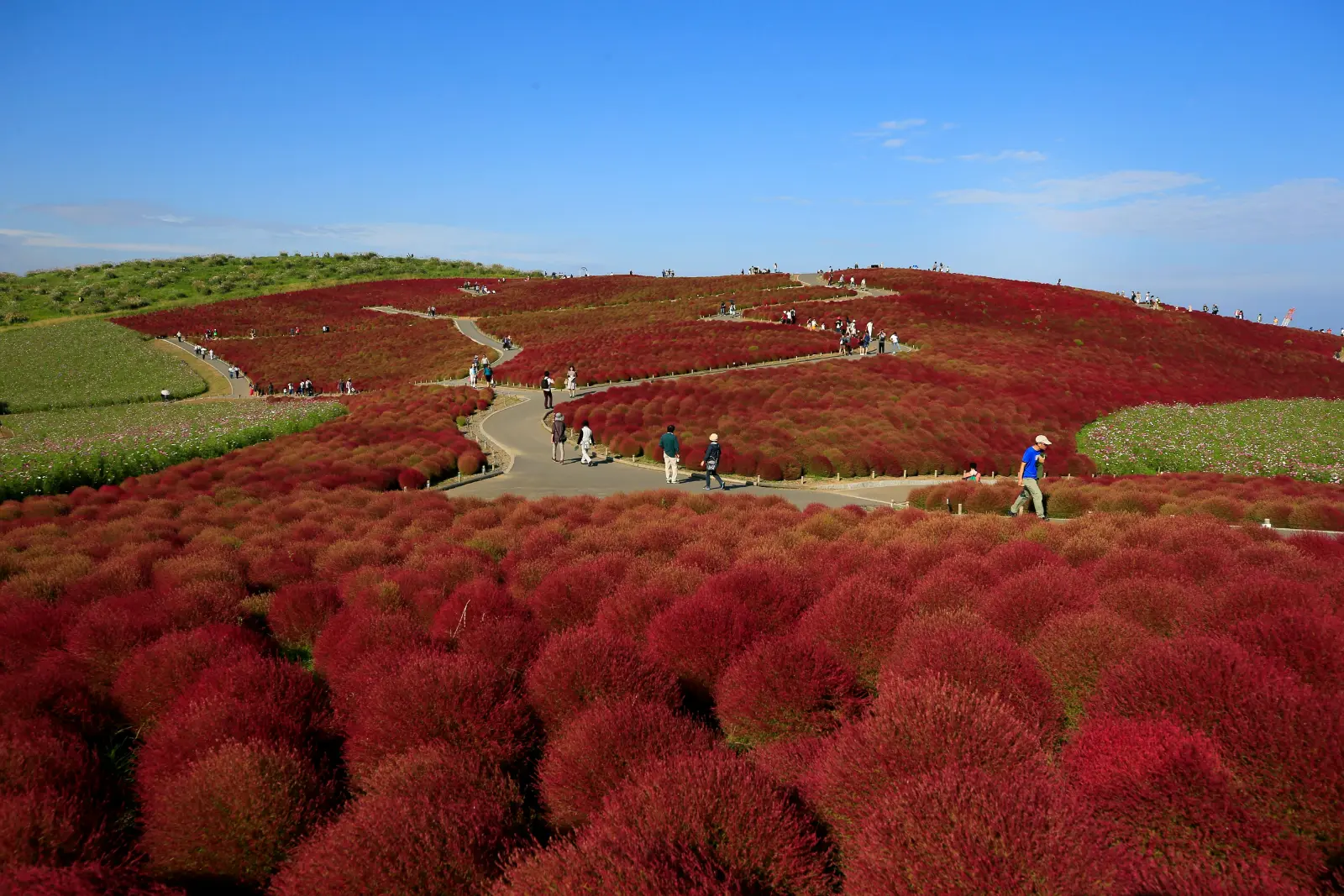
The kochia on Miharashi Hill shifts color through the season. According to the park, the bushes are green from mid-August through late September, turn a green-and-red mix in early October, and hit their deep red peak in mid-October.
For 2026, the park's forecast published on September 17 puts the start of the color change around October 10 and the peak around October 15. That red peak holds for roughly a week to ten days. In late October the red fades toward brown, and the hill turns a soft gold into early November.
For 2026 the park forecasts peak red around October 15. Before you lock in a date, check the color on the park's official bloom-status page.
Peak timing shifts a little from year to year. The park's bloom-status page regularly posts dated photos showing the kochia's current color. Check it before you leave so you know whether the hill has actually turned red.
For 2026 the park added a new planting at Miharashi no Sato (みはらしの里), the meadow at the foot of the hill, bringing the total to about 40,000 bushes. The park's seasonal guide still puts Miharashi Hill itself at around 33,000.
Hours and Admission in 2026
The park is open 9:30 a.m. to 5:00 p.m. from September 18 through October 31, and 9:30 a.m. to 4:30 p.m. from November 1 to 3.
On the ten illumination nights, September 18 to 27, the park does not close at 5:00 p.m. as usual; it stays open through to 9:30 p.m., with last entry at 8:30 p.m.
The park normally closes on Tuesdays. During the Kochia Carnival, though, it opens every day except September 29.
Admission is free on three days this autumn: September 21 (visitors 65 and over only), and September 26 and 27 (everyone). You still need the illumination viewing ticket on those nights, and parking is still charged.
Admission is normally ¥450 for adults (high school age and up), ¥210 for seniors (65+), and free for junior high students and younger. In autumn a seasonal surcharge applies, taking adults to ¥800 and seniors to ¥560.
Category | Regular | Autumn (kochia season) |
|---|---|---|
Adult (high school and up) | ¥450 | ¥800 |
Senior (65 and up) | ¥210 | ¥560 |
Junior high and younger | Free | Free |
In 2026 the seasonal rate applies from October 9 through November 3, adding ¥350 to admission. Mid-October, when the kochia is reddest, falls inside that window.
The Kochia Carnival and the Evening Illumination
The park runs an event called the Kochia Carnival ("Kite Mite Sawatte Kochia Carnival"—roughly, "come, look, and touch"). In 2026 it runs from September 18 through November 3. That is a significant change from 2025, when it ran only for the month of October (October 1 to 31).
The evening kochia illumination runs from September 18 to 27 in 2026. The lights are on from 5:30 p.m. to 9:15 p.m., and last entry is 8:30 p.m. It is called off in severe weather.
Here is the part worth getting straight: during the illumination the kochia is still green. The park forecasts peak red around October 15, well after the lights end, so the two never overlap. If you came hoping to photograph a blazing red hill under floodlights, that combination does not exist.
The evening illumination runs September 18–27, and the viewing ticket is ¥1,000 on top of admission. The kochia is green then; the red hill comes in mid-October.
The illumination needs its own viewing ticket on top of park admission: ¥1,000 for adults (high school age and up), ¥500 for elementary and junior high students, free for preschoolers. Annual passholders still need one, and there are no refunds if bad weather cancels the event.
If you arrive after 5:00 p.m., you can buy a combined admission-and-viewing ticket at the West Gate or the Tsubasa Gate (翼のゲート). If you come during the day, buy the viewing ticket at the temporary booth beside Kinen no Mori Resthouse (記念の森レストハウス), open 4:00 p.m. to 6:00 p.m.
One more thing if you plan to stay from afternoon into the evening: the Miharashi area is closed from 4:30 to 5:00 p.m. while staff set up, so you will have to come down off the hill for that half hour.
Cosmos in Bloom Alongside the Kochia
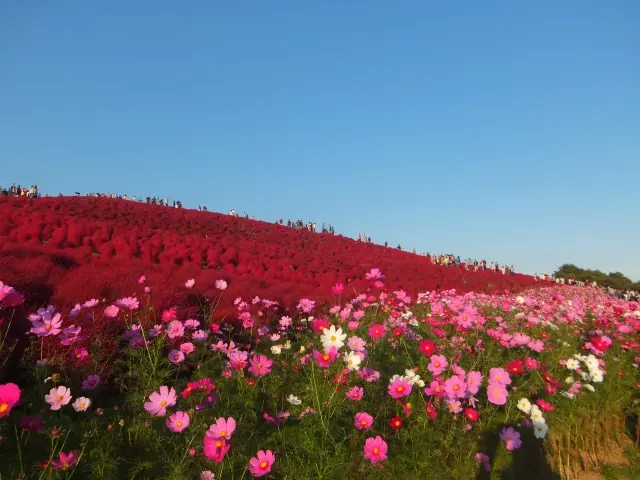
In autumn, cosmos flowers (コスモス) bloom alongside the kochia on Miharashi Hill. The cosmos are at their best from early to late October, around the same time the kochia turns red. At the foot of the hill you'll also find a patch of white buckwheat flowers.
Red kochia above, pink and red cosmos spreading below—it's a combination you only get in these few autumn weeks. Linger over the flower beds at the base before you head up the hill.
Getting There and Parking
By train, it's about 85 minutes from Tokyo Station to Katsuta Station (勝田駅) on the JR Joban Line limited express. From the station's east exit, catch an Ibaraki Kotsu bus at Bus Stop 2; it reaches the park's West Gate in about 15 minutes.
By car, take the Hitachinaka Toll Road off the Kita-Kanto Expressway and exit at Hitachi Seaside Park IC, which is right at the gate.
There are three parking lots—West, South, and Seaside—plus an overflow lot that opens in peak season. The West lot, next to the West Gate, is the closest to the kochia on Miharashi Hill. Parking is ¥600 per day for a standard car.
If you are driving on an illumination night, watch the closing times: the South and Seaside lots shut at 5:00 p.m. After that, use the West lot (last entry 8:20 p.m.) or the overflow lot, open 4:00 to 8:00 p.m.
Route | How | Rough time |
|---|---|---|
Train + bus | Tokyo Station → Katsuta Station (ltd. | ~1 hr 40 min |
Car | Off the Hitachinaka Toll Road at Hitachi Seaside Park IC | — |
One thing to plan around: from October 9 to 25, the Seaside lot gives priority to tour buses. Ordinary cars are not banned, but expect it to be full, so count on the West, South or overflow lot instead.
The Seaside Train (a one-day pass is ¥600) loops the park and gets you close to Miharashi Hill. The grounds are large, so it's handy if you'd rather not wear yourself out walking.
Search Hitachi Seaside Park Tours
Check hotel availability and rates in Ibaraki
How to Avoid the Crowds
On weekends in mid-October, when the kochia is at its reddest, the roads around the park jam up and the lots can fill. The park publishes a color and crowding forecast worth checking before you pick a date. If you want to see the hill without the crowds, aim for a weekday or the first hour after opening.
In some years an extra direct bus runs from Katsuta Station to the West Gate during peak season. Check with Ibaraki Kotsu for the 2026 operating days and fare before you go.
That short red window only comes once a year. Keep an eye on the bloom status, pick your day, and aim for the peak—ideally on a weekday morning.
This article was translated from the original Japanese with AI assistance and reviewed by our editorial team. The Japanese version is authoritative.