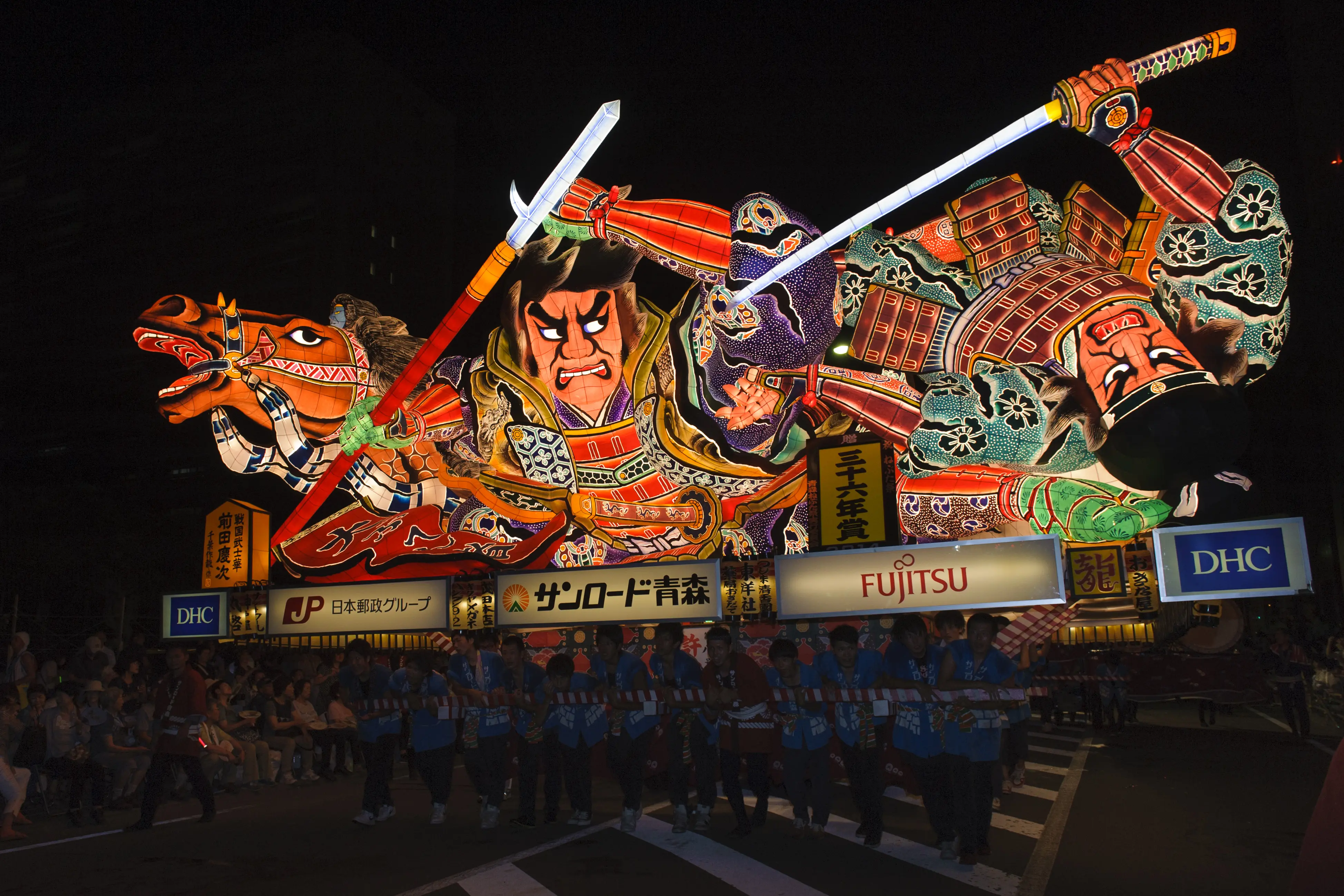
Every August, giant illuminated floats push through the streets of downtown Aomori while drummers, flute players, and thousands of costumed dancers move alongside them. This is the Aomori Nebuta Festival (青森ねぶた祭), one of the biggest summer festivals in northern Japan. In 2026 it runs for six days, August 2 (Sun) through August 7 (Fri). But "six days" is misleading if you just show up on any of them: the start time and what you'll actually see change from day to day, so it's worth deciding your date before you go. The final day, the 7th, is a completely different experience from the rest.
This guide walks through the day-by-day schedule, how to join in as a dancer (haneto), the paid seats and the rules for watching free, plus how to get there and what to expect on the roads. Everything here comes from official sources. If you're still choosing between summer festivals, start with our Japan Summer Festival Guide 2026: Yukata, Etiquette, and Where to Go for the big picture, then come back here to lock in your Aomori plans.
The Basics (2026)
Name | Aomori Nebuta Festival (青森ねぶた祭) |
|---|---|
Dates | August 2 (Sun) – August 7 (Fri), 2026 |
Eve event | August 1 (Sat) / Aoi Umi Park "Nebuta Rasseland" |
Where | The parade course in central Aomori (about a 10-minute walk from JR Aomori Station) |
Organizer | Aomori Nebuta Festival Executive Committee |
Watching | Free along the roadside; paid grandstand seats also available |
Rain | Held rain or shine (organizers say the parade has never been canceled) |
The night before the festival, on August 1, there's an eve event at Aoi Umi Park (青い海公園) "Nebuta Rasseland." All of the large floats that will run over the following days are lined up here fully lit, and you can see them up close and standing still. Once the festival starts, you're watching moving floats from a distance, so the eve is the best chance to study the artwork and construction in detail. Start times shift from year to year, so check the official site before you head over.
What Happens Each Day—Read This First
The single thing visitors get wrong about Nebuta is assuming every day is the same. It isn't. Here's how 2026 breaks down.
Aug 2 (Sun) & 3 (Mon) | From 19:00 / children's floats (about 10) and large floats (about 15) |
|---|---|
Aug 4 (Tue) – 6 (Thu) | From 18:45 / large floats (about 20) |
Aug 7 (Fri), daytime | From 13:00 / daytime run of the large floats (about 20) |
Aug 7 (Fri), evening | 19:15–around 21:00 / four large floats on the water + the 72nd Aomori Fireworks (Aomori Port) |
On the 2nd and 3rd, children's floats run alongside the large ones, which makes those two evenings a comfortable pick for families. From the 4th through the 6th, around 20 large floats fill the streets and the scale steps up. If you want to dance as a haneto yourself, these evening runs from August 2–6 are your window (more on that below).
The final day, the 7th, is unlike the other five. It starts with a daytime run from around 13:00, when the floats move in full daylight and you can study the painted panels and the shapes clearly—something you can't do at night. Then in the evening, four of the large floats are loaded onto barges and paraded across Aomori Port while the 72nd Aomori Fireworks light up the sky above them. You only get the floats and fireworks moving together on the evening of the 7th.
Dancing as a Haneto
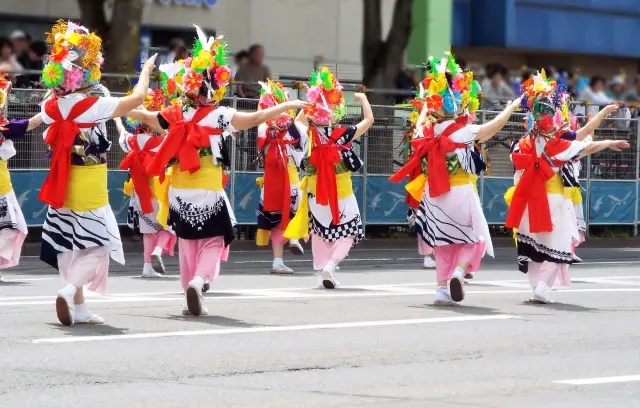
What sets Nebuta apart from most Japanese festivals is that you don't only watch—you can join the procession yourself as a haneto (跳人), a dancer. There's no advance registration and no sign-up desk on the day, and only one condition: you have to wear the proper haneto costume (the flower hat and the traditional outfit). As long as you're dressed in it, you can join freely, right there on the spot.
To take part, head to the gathering point before your float group sets off. If you try to jump in after the procession has started, you may be turned away when it's crowded. There are a few rules—no going backward against the flow, no whistles or firecrackers—so follow the guides' instructions. The evening street runs where you can dance are August 2–6. Whether you can join the daytime run or the evening water procession on the 7th isn't stated on the official site, so if you specifically want to dance that day, check with the organizer first.
You can rent a costume from several shops around the city. Expect roughly ¥4,000 for a set, with items like tabi socks, sandals, and the flower hat sometimes charged separately depending on the shop. Costumes run short during the festival, so reserving ahead is the safe move.
If you'd rather just soak up the atmosphere in a yukata without dancing, that's a fine way to spend the evening too. For how to wear and where to rent one, see our Summer Yukata Guide 2026: How to Wear One, and Tips for Renting or Buying in Asakusa.
Paid Seats, and Watching for Free
If you'd rather sit and watch at your own pace, there are paid grandstand seats along the parade course. Here are the 2026 prices.
Individual seat (Aug 2–6 & Aug 7 daytime) | ¥4,000 per person (tax incl. |
|---|---|
Aug 7 "Daytime Nebuta & Fireworks" set | ¥9,500 per person (tax incl. |
Wheelchair seat | ¥3,200 for the guest / ¥4,000 for a companion |
Paid seats are sold through ticket agencies—Ticket Pia, Lawson Ticket, Pomit! Ticket—as well as by phone and at the ticket counter. General sales opened in late June (first round from June 27, second round from July 18), and the popular dates sell out first. Same-day tickets are sold only if seats remain, from around 17:00 on the day at the "Matsuri Information Shop," but they're not guaranteed. If you have a specific day you want to sit for, buy ahead.
One point to watch is the 7th, where the tickets split three ways:
Daytime floats only → the ¥4,000 individual seat. On the 7th it covers only the daytime run—not the evening water procession or fireworks.
Daytime floats and the fireworks → the ¥9,500 "Daytime Nebuta & Fireworks" set from the festival committee, which bundles both (check its ticket page for the exact fireworks seat it includes).
Fireworks only → buy the fireworks organizer's own seats directly (details below).
Getting this right matters because the daytime parade and the evening fireworks are run by two different organizers, so the wrong ticket leaves you without a seat for the part you came for.
You don't need a paid seat to enjoy Nebuta—it's free to watch from the roadside anywhere outside the grandstand areas. Just note that saving spots days in advance, or taping off a patch of road, is prohibited. To get a good spot, aim to arrive about one to two hours before the run starts that day.
The August 7 Water Procession and Fireworks Are a Separate Ticket
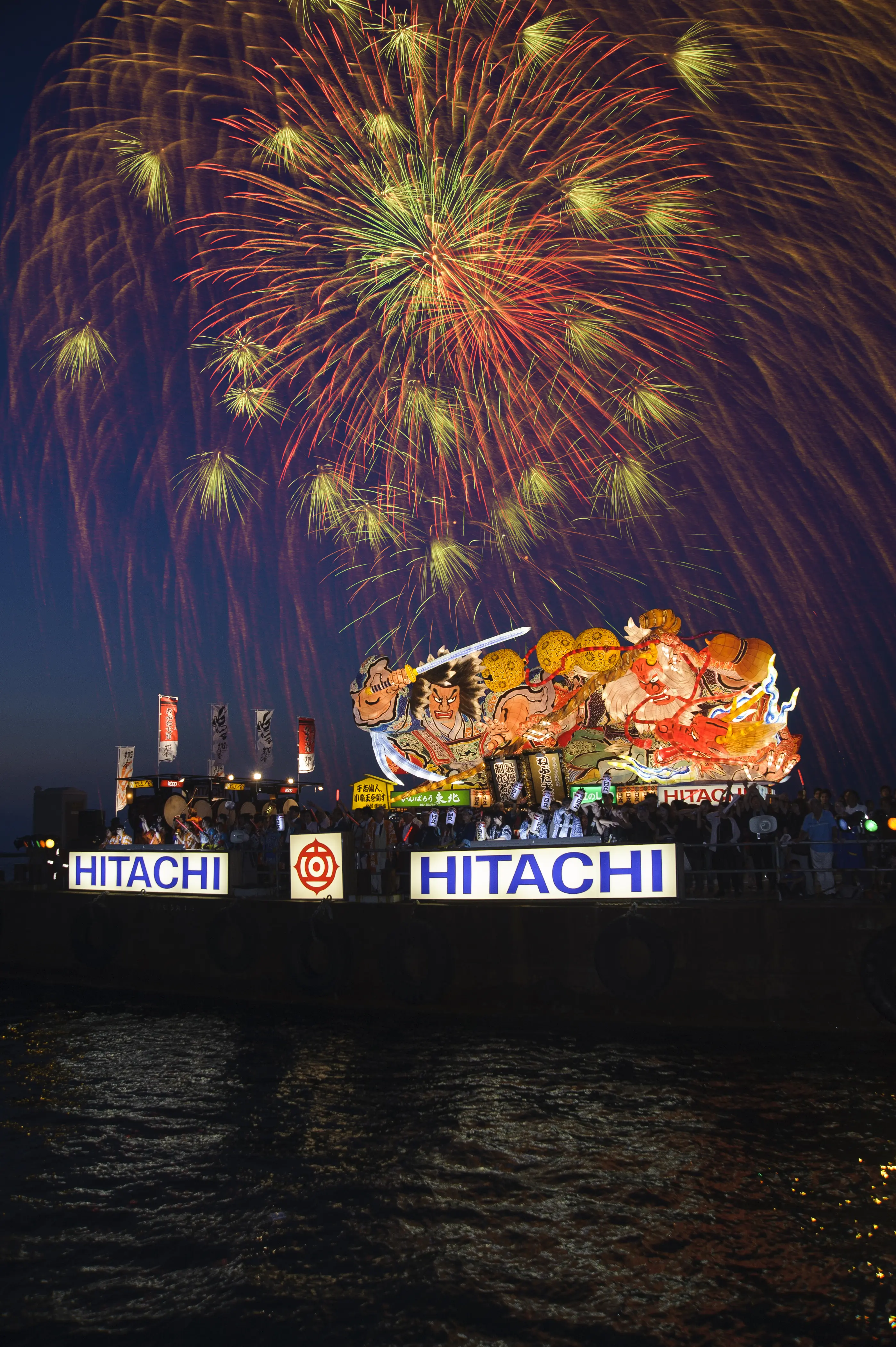
The evening water procession and the 72nd Aomori Fireworks on the 7th are run by a different organizer, on a separate ticket from the daytime parade. Both take place over the water at Aomori Port. The fireworks launch point and the water procession sit a little apart, and free viewing spots aren't guaranteed the way the roadside parade is, so check the official viewing map for where to stand—and whether you'll want a paid seat—before the 7th.
The fireworks paid seats are ¥5,500 for S seats and ¥4,500 for A seats, with viewing areas at Aoi Umi Park, the west side of Aoi Umi Park, and Shin-Chuo Pier (the price is the same at all three). General sales opened on July 7 (Tue). The fireworks handle bad weather differently from the parade: rain or lightning can lead to cancellation, and if it's canceled, the Aomori Fireworks announce it on their official site and phone line, so confirm on the day. Note too that during the fireworks and water procession on the evening of the 7th, there may be separate road closures or entry restrictions around Aomori Port on top of the daytime ones.
Getting There and the Roads on the Day
During the festival, the streets around the parade course are closed to vehicles. As a rough guide, closures run from about 18:00 to about 21:40 on August 2–6, and from about 12:50 to about 15:30 on the 7th, depending on the road. Inside the course, cars can't get in or out, and roads reopen one by one as the run finishes. The exact scope and timing can shift with conditions and police direction on the day, so skip the car and come by public transport.
The parade course sits in the central city, about a 10-minute walk from JR Aomori Station. From Tokyo, the usual route is the Tohoku Shinkansen to Shin-Aomori (roughly three hours), then a local train over to Aomori Station. Rooms in the city fill up fast during the festival and sell out well ahead, so if you're staying overnight, book as early as you can.
It Runs Even in the Rain
Nebuta is held rain or shine. The floats run under large plastic covers when it rains, so the parade isn't canceled, and the organizers note that the run itself has never been called off. Bring a rain jacket rather than an umbrella so your hands stay free for watching. The one exception, as noted above, is the fireworks on the evening of the 7th, which can be canceled in rain or lightning.
If you're mapping out your summer and want to pair this with fireworks nearer Tokyo, take a look at our Tokyo Fireworks Festivals 2026: Dates, Access, and How to Enjoy the 6 Big Displays Worth Traveling For as well. Aomori Nebuta is one of the few festivals in Japan where you don't just watch—you can join in. Pick your day, keep the plan loose, and let the night come to you.
Official site: Aomori Nebuta Official
This article was translated from the original Japanese with AI assistance and reviewed by our editorial team. The Japanese version is authoritative.