
Now that June is here, Japan is shifting from the rainy season into full summer. As the heat and humidity climb, mosquitoes start becoming more active, though the timing varies by region. If you're planning to be outside in the evening—watching fireflies, wandering a summer festival, strolling along a river or through a park, or settling in at a beer garden—mosquito repellent isn't a nice-to-have. It's something you'll want in your bag.
The good news: insect repellent in Japan is fairly affordable and easy to find just about anywhere. You'll find it at drugstores, convenience stores, and 100-yen shops, so there's no need to pack it from home—just buy what you need after you land and keep your suitcase light.
This guide breaks down the two things travelers ask most: where to buy it, and how to choose (the difference between DEET and icaridin), all current for 2026.
Note: All prices are approximate and tax-included. They vary by store, size, and season. Information is current as of 2026. Always check the product label before use.
Where to buy: best spots for travelers
You'll find repellent at drugstores nationwide, and that's where the selection is widest. The big chains include Matsumoto Kiyoshi ("Matsukiyo"), Welcia, Sugi Pharmacy, Tsuruha, Sundrug, and Cocokara Fine. Branches in major tourist areas often have multilingual staff and tax-free counters, which makes a first purchase painless.
Don Quijote ("Donki") stays open late—often 24 hours—so you can grab repellent and souvenirs in one trip.
100-yen shops (Daiso, Seria, Can Do) carry handy travel-size mists and wipe-type repellents. Concentration and how long they last vary from product to product, but they're handy for a short stretch of city walking or as a backup.
Convenience stores (7-Eleven, FamilyMart, Lawson) sometimes stock pocket-size repellent in summer. The selection is limited, but they're open 24/7—worth remembering when you suddenly need some.
If you want a large bottle at the lowest price, supermarkets and home centers are an option too. One heads-up: during stretches of extreme heat, popular products can sell out fast, so grab one when you see it.
The real choice: two active ingredients
Japanese repellents fall into two main types based on their active ingredient. Understanding this difference is the key to picking the right one.
DEET — for maximum protection
The most widely used repellent ingredient worldwide. In Japan, you'll find products with up to 30% DEET, sold as Class-2 OTC medicines. It lasts a long time—roughly five to eight hours for the higher concentrations—and helps keep a wide range of biting insects and ticks away. That makes it the pick for mountains, riversides, grassy areas, and firefly viewing, where you really don't want to get bitten.
A few manufacturer guidelines are worth knowing, though. DEET should not be used on babies under six months, and there are limits on how often it can be used on children under twelve. The 30% formulas in particular—such as Skin Vape Mist Premium and Saratect Rich Rich 30—are labeled as not for use under age 12, so always check the recommended age before using one on a child. Traveling with little ones? The icaridin options below are the easier choice.
Icaridin — for families and sensitive skin
A newer ingredient, available in Japan at up to 15%. According to manufacturers, it has no age restrictions and no daily-use limits, so it's a convenient option for everyone from small children to adults. It's nearly odorless, and many products emphasize how gentle it feels—an easy pick if you're traveling with young kids or simply prefer something mild on the skin. At 15%, it lasts about six to eight hours.
The rule of thumb is simple: for serious protection in the mountains or by the water, reach for a higher-concentration DEET; for families or anyone who wants something gentle, go with icaridin. Either way, check the label before you apply.
Choosing by format
Even with the same ingredient, the format changes how easy it is to use. Pick based on your travel situation.
Pump mists are easy to apply evenly and are easier to travel with than aerosol cans.
Aerosol cans cover a wide area fast.
In general, insect-repellent sprays are treated like cosmetic or medicinal products for air travel, so they can usually be carried on or packed in checked baggage—as long as each container holds 0.5 L (0.5 kg) or less and your total stays under 2 L (2 kg). On international flights they also count as liquids, subject to the usual 100 mL container limit and clear-bag rule, and the exact rules vary by airline and destination—so if in doubt, just buy after you land. (Pest-control sprays meant to kill insects are generally not allowed in carry-on or checked baggage.)
Wipe-type repellents are great for the face and for kids, and since they aren't liquids, they're convenient to carry. Gels and roll-ons let you apply precisely with little mess.
Wristbands, stickers, and patches are cute and popular, but their effect is limited to the area right around them and won't protect your whole body. Don't rely on these alone—pair them with a spray or mist to be safe.
Brands worth knowing
The drugstore shelf can be overwhelming, so here are the names travelers reach for first.
Skin Vape (スキンベープ, by Fumakilla)
A staple repellent brand. Skin Vape Mist Premium contains 30% DEET (sold as a medicine) and is built for situations where you want long, reliable protection.
虫よけ成分〈イカリジン〉を高濃度に配合 より幅広い年齢層に向けたスマートな装い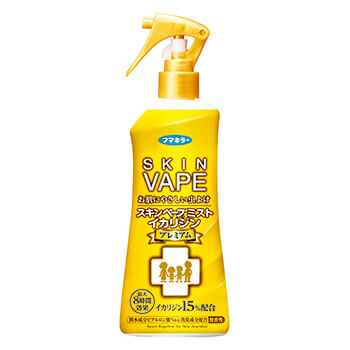
スキンベープミスト イカリジンプレミアム[イカリジン配合]200mL
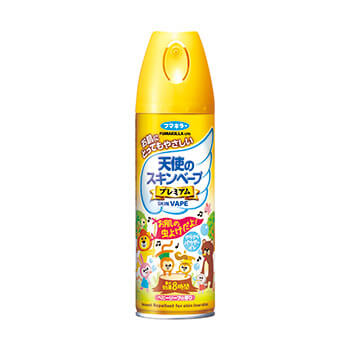
For babies and children, the Tenshi Skin Vape ("Angel Skin Vape") line uses 15% icaridin and is an easy pick.
Saratect (サラテクト, by Earth)
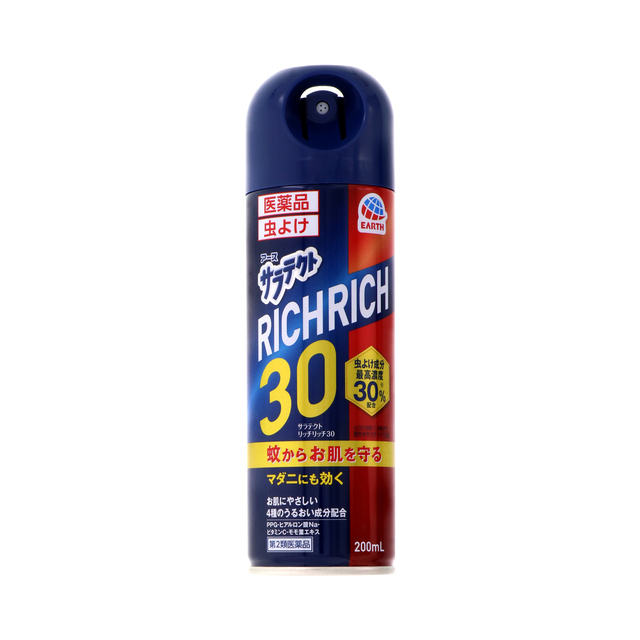
Another standby you'll spot at drugstores nationwide. Saratect Rich Rich 30 contains 30% DEET (a Class-2 OTC medicine) and lasts about five to eight hours. It comes in many formats—mist, lotion, gel, and wipes—and some versions list bedbugs among the pests they repel, alongside mosquitoes. Keep in mind that these protect your skin; they do not eliminate bedbugs from a room. If you're worried about bites during your stay, it's an easy brand to reach for, and there's an English product site, too.
KINCHO is another of Japan's major repellent makers. If you're unsure at the shelf, compare three things—the ingredient (DEET or icaridin), the concentration, and the format—and you'll find the right one quickly.
What it costs
A standard-size spray or mist (around 200 mL) runs roughly ¥500–1,000 at a drugstore. Pocket-size mini mists are about ¥300–600, and 100-yen shop minis start at ¥110. Repellent in Japan is generally affordable, so buying it locally is easy on the wallet.
How to shop tax-free
Most drugstores offer tax-free shopping. Repellent, sunscreen, and cosmetics count as "consumables," which qualify when you spend at least ¥5,000 before tax (and under ¥500,000) at one store on the same day. You'll need to show your passport.
Through the end of October 2026, consumables must be sealed in the specified packaging and taken out of Japan unopened and unused, with the tax waived right at the register. Note that the system changes on November 1, 2026, to a "refund" model: you'll pay the full tax-included price and, once customs confirms at departure that you're taking the items out of the country, get the consumption tax refunded through the store or its designated agent. The new system also lets you combine general goods and consumables toward the threshold and drops the sealed-packaging requirement.
Repellent alone won't usually hit the threshold, so bundle it with sunscreen or snacks. For the full details, see our separate guide, "Japan's Tax-Free Shopping Is Changing: What the New Refund System Means for Your Next Trip."
Tips for using it well
Using sunscreen too? Apply the sunscreen first, let it dry, then layer the repellent on top. Reapply after sweating or after a few hours have passed.
If you're heading out to see fireflies, repellent matters even more. Fireflies appear near rivers and water at dusk—right where, and when, mosquitoes tend to be out. Apply before you go (and while you're watching, go easy on white lights out of consideration for the fireflies). If your skin is sensitive, start with icaridin or a lower concentration.
Want a lighter bag? Buy it after you arrive
Sprays face carry-on liquid limits and take up surprising space in a suitcase—and with aerosol cans it's worth checking your airline's rules and the international liquids limit before you pack one. Buying repellent after you land, just what you need, keeps your luggage lighter. To stay comfortable through a Japanese summer, pick up whatever repellent suits your trip soon after you arrive.
Popular right now


This article was translated from the original Japanese with AI assistance and reviewed by our editorial team. The Japanese version is authoritative.