
Nikko, in Tochigi Prefecture, is the autumn day trip from Tokyo that pays off most. The land climbs from about 500 meters in the town to 1,500 meters up in Oku-Nikko (奥日光), so the color never arrives all at once. It starts high and works its way down over roughly two months. Knowing where the leaves are on a given week is what lets a single visit land on the peak.
Planning around the city instead? We've mapped the central Tokyo spots in Tokyo Fall Foliage 2026: Peak Week and 4:30pm Park Closings.
Peak by elevation: mountains first, town last (late September–November, typical year)
Nikko's foliage begins in high Oku-Nikko and moves downhill toward the town. Here's the usual schedule. Timing shifts a week or two with the year's weather, so check the Nikko tourism association's live foliage-status page right before you go.
Spot (approx. | Typical peak |
|---|---|
Senjogahara & Odashirogahara marsh grasses (approx. | late Sept – early Oct |
Ryuzu Falls, Lake Chuzenji, Lake Yunoko | mid-October |
Senjogahara larch (karamatsu) | late October |
Irohazaka & Kegon Falls | late Oct – early Nov |
Toshogu Shrine & Nikko town | mid-October – mid-November |
From the marsh grasses up high to the maples in town, the season runs about two months. As a rough guide: mid-October for Lake Chuzenji and Ryuzu Falls, then late October into early November for the Irohazaka and Kegon Falls.
Updated October 14, 2026: Weathernews' 2026 forecast (as of October 14) expects peak color to arrive on October 17 at Ryuzu Falls, October 23 on the Irohazaka, October 27 at Lake Chuzenji and Kegon Falls, and November 12 around Toshogu Shrine.
The Japan Weather Association (October 1 release) has the Irohazaka peaking from October 21. Forecasts get revised, so check again right before you go.
The Irohazaka: two separate one-way roads
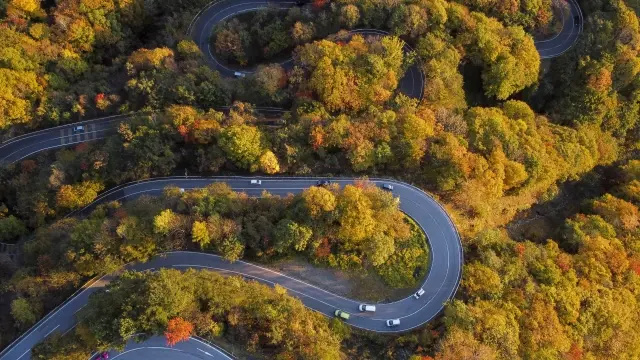
The mountain road up to Oku-Nikko is the Irohazaka (いろは坂). It splits into two one-way roads — the Second Irohazaka climbing up, the First Irohazaka coming down — with 48 hairpin curves in all, one for each character of the old Japanese "iroha" syllabary.
Partway up the Second Irohazaka is Akechidaira (明智平), a lookout over Kegon Falls, Lake Chuzenji, and Mount Nantai (男体山).
One catch for 2026: the Akechidaira Ropeway closed for renovation on January 15, 2026, and stays closed through the autumn season (it is due to reopen in September 2027). You can't ride up to the upper observation deck this year, so plan around that.
Beating the traffic: before 7am on weekends, after 3pm on weekdays
The single biggest obstacle in autumn is traffic. Per the Nikko City Tourism Association, jams hit mainly on weekends and holidays from mid-October into early November, and at the height of the season even weekdays back up.
Congestion peaks between 9am and 3pm. On weekends it can run until 5pm, and entering the Irohazaka around 2–3pm can turn a stretch that's usually quick into a three-hour crawl.
On the Irohazaka, traffic peaks from 9am to 3pm. Head up before 7am on a weekend, or after 3pm on a weekday, and the same road moves.
Can't shift your timing? There are still ways through. If you're set on driving during the busy stretch, there are detours — approaching from the Gunma side (Numata IC on the Kan-Etsu Expressway, then the Nikko-Romantic Road), or looping in via Kirifuri Highland, Kawamata, or the Sanno forest road.
Want to skip the driving altogether? A Tobu bus from Tobu-Nikko Station is one option, but the bus takes the same Irohazaka, so it sits in the same jams. The before-7am, after-3pm-on-weekdays rule holds for the bus, too.
Kegon Falls and Toshogu Shrine: fees and hours
The essentials for the two landmarks most people pair with the Oku-Nikko leaves.
Spot | Fees & hours |
|---|---|
Kegon Falls (華厳ノ滝) elevator | Mar 1 – Nov 30, 8:00–17:00. |
Nikko Toshogu (日光東照宮) | Admission ¥1,600 adult & high-school / ¥550 elementary–junior high. |
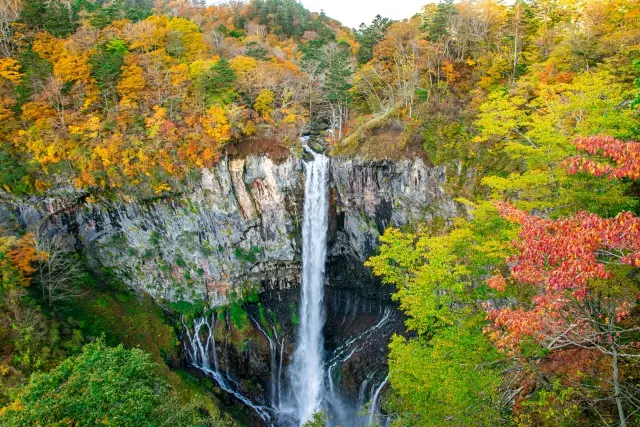
At Kegon Falls, the elevator drops you to a viewing platform near the base, where the water and the surrounding color line up head-on.
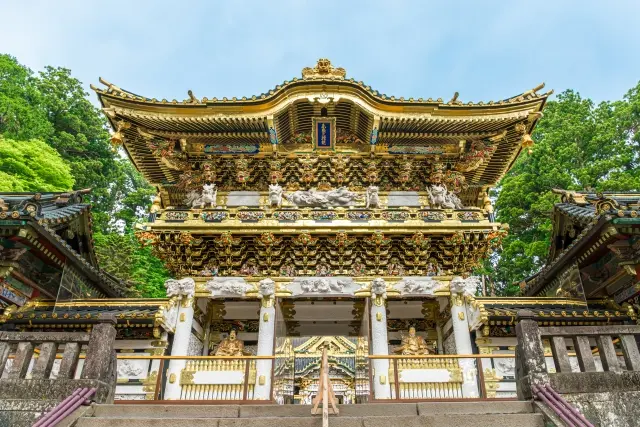
Toshogu sits down in town, where the leaves hold into mid-November — a good stop once the higher elevations have gone bare.
Lake Chuzenji (中禅寺湖) also runs a sightseeing boat through November 30; a full loop is about an hour, and you take in the shoreline color from the water. Check the operator's site for fares and the timetable.
Getting there from Tokyo, and the foreign-passport pass
The easy way in is a Tobu limited express from Asakusa. On a SPACIA X or similar, Asakusa to Tobu-Nikko is about 1 hour 50 minutes.
For visitors, Tobu's NIKKO PASS is the value play. To reach Oku-Nikko, take the wider-coverage ALL AREA pass. Note, though, that the pass covers ordinary-train round trips only — riding a limited express like the SPACIA X still means buying a separate express ticket.
Pass | What's included |
|---|---|
NIKKO PASS ALL AREA | ¥8,000 adult / ¥4,000 child, 4 days. |
NIKKO PASS WORLD HERITAGE AREA | ¥3,000 adult / ¥1,500 child, 2 days. |
If you're going up to Oku-Nikko (Lake Chuzenji, Senjogahara, Yumoto Onsen), the town-only WORLD HERITAGE AREA pass won't get you there by bus. Choose ALL AREA for Lake Chuzenji and Kegon Falls.
From Tobu-Nikko Station, it's a bus ride out to Lake Chuzenji — around 40–50 minutes when the road is clear, and much longer at peak times.
What to wear: colder up in Oku-Nikko
Between the town and Oku-Nikko, the elevation gap is close to 1,000 meters. Lake Chuzenji and Senjogahara run noticeably colder than the town, and the morning and evening chill arrives earlier.
For a late-October trip up high, pack a layer more than you'd wear in town; a light down jacket or windbreaker earns its place. By November the leaves in Oku-Nikko are mostly down, and the center of the season shifts to the town.
Where you sleep decides how much of the morning you get: the station area, Oku-Nikko and Kinugawa each put you at a different starting line. See Where to Stay in Nikko 2026.
Read next
- Central Tokyo's foliage timing and how to work it: Tokyo Fall Foliage 2026: Peak Week and 4:30pm Park Closings
- Mountain color on another easy day trip: Mount Takao Autumn Leaves 2026: Peak Timing, Cable Car Waits, and Night-View Days
- How to reach Mount Takao: Mount Takao Day Trip 2026: The ¥1,090 Ticket from Shinjuku
This article was translated from the original Japanese with AI assistance and reviewed by our editorial team. The Japanese version is authoritative.


