
For five days each July, the temple grounds of Kawasaki Daishi fill with wind chimes gathered from all over Japan.
When a breeze moves through, hundreds of them ring at once, and the sound alone somehow makes the summer heat feel lighter.
This is the Kawasaki Daishi Wind Chime Market (Furin Ichi), one of the Kanto region's beloved summer traditions. In 2026 it runs from Friday, July 17 to Tuesday, July 21.
The setting is a famous "evil-warding" temple, and you can stand in one spot and hear how a glass chime from Tokyo, an iron one from Toyama, and a ceramic one from Tokushima each sound completely different. It's also an easy half-day trip from Haneda Airport on the Keikyu Line, which makes it a good add-on to a Tokyo itinerary.
What Is the Kawasaki Daishi Wind Chime Market?
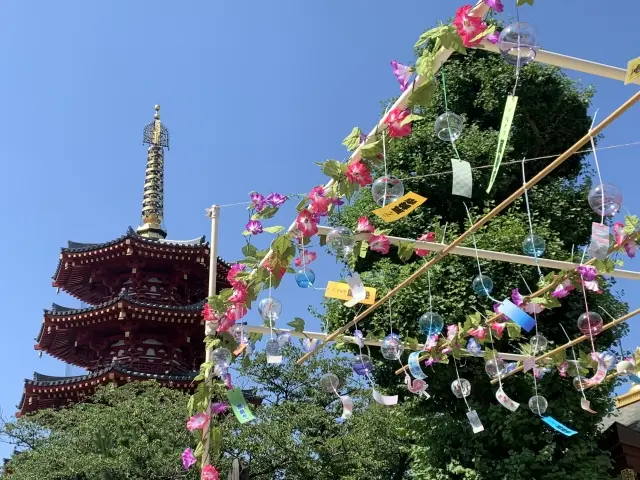
The Furin Ichi is a display-and-sale market of wind chimes (furin) held in the precincts of Kawasaki Daishi, formally Heikenji Temple (平間寺). 2026 marks the 31st edition. In the Seikadō Stone Garden Plaza on the grounds, more than 800 kinds of wind chimes are brought together from every part of the country.
The word "furin" covers an enormous range. There's the hand-blown glass of Edo furin (江戸風鈴) from Tokyo, the cool-toned glass of Tsugaru Vidro (津軽びいどろ) from Aomori, the long, clear ring of Takaoka teppu (高岡鉄風) from Toyama, plus Kiyomizu-yaki (清水焼) from Kyoto, Kazuwa-yaki (上神焼) from Tottori, Otani-yaki (大谷焼) from Tokushima, and Hakata furin (博多風鈴) from Fukuoka. A chime's material—metal, glass, or ceramic—changes both its pitch and how long the sound hangs in the air. Walking the rows and telling those differences apart by ear is the real pleasure of the market.
Wind chimes began as a practical tool for coping with the heat. A ringing chime meant a breeze was passing, and over time the sound itself, not just the breeze, became a way of cooling off in summer. It's a kind of cool no air conditioner delivers, and the temple grounds are a good place to feel it.
2026 Dates and Details
Name | The 31st Kawasaki Daishi Wind Chime Market (Furin Ichi) |
Dates | Friday, July 17 – Tuesday, July 21, 2026 (5 days) |
Hours | 10:00 a. |
Venue | Seikadō Stone Garden Plaza, precincts of Kawasaki Daishi (Heikenji Temple) |
Cost | Free to browse (you only pay if you buy a chime) |
July 20 is Marine Day (Umi no Hi, 海の日), a national holiday and the final day of the three-day weekend. Only on that day does the market stay open until 7:00 p.m., so it's a nice chance to see the chimes later in the day as the light softens. Crowd levels and any year-specific notices can change, so it's worth checking the official site before you go.
The Limited Daruma Wind Chime Charm
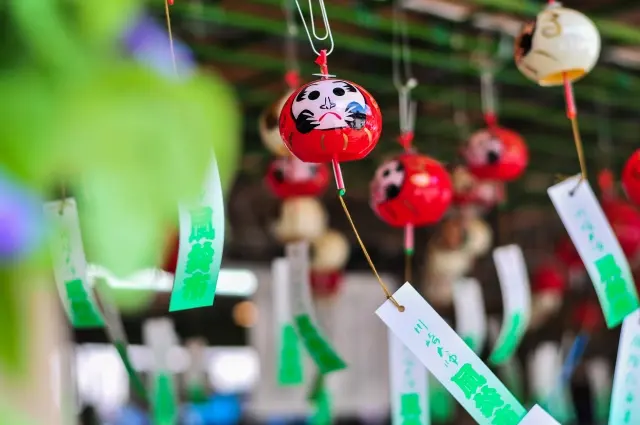
The one item unique to Kawasaki Daishi is the "Yakuyoke Daruma Furin" charm (厄除だるま風鈴守). Modeled on a Daruma doll, it's a temple-original wind chime charm available in two colors, red and white. Each one is 800 yen.
It's offered only during the market's run, so if you want one, it's best to go earlier in the day before the crowds build. You can receive it at several spots on the grounds, including the Main Hall (Daihondo) reception and the amulet office (Ofudasho). As a charm from a temple long tied to warding off misfortune, it makes a good keepsake or a small gift for someone back home. It's compact and easy to carry, and tucks neatly into a suitcase.
Getting There
Nearest station | Kawasaki-Daishi Station (Keikyu Daishi Line), about an 8-minute walk |
|---|---|
Address | 4-48 Daishimachi, Kawasaki-ku, Kawasaki City, Kanagawa |
From Haneda Airport | About 25 min on the Keikyu Line, with one transfer at Keikyu Kawasaki |
From central Tokyo | About 20–30 min from Shinagawa on the Keikyu Line; from Tokyo Station, take JR to Kawasaki, then transfer |
Kawasaki-Daishi is a stop on the short Keikyu Daishi Line. Because it's a quick, one-transfer ride from Haneda Airport, it works well as a half-day stop on your arrival or departure day. From the station, follow the approach street (sandō, 参道) on foot and it leads you right to the temple's main gate.
The Nakamise Shopping Street
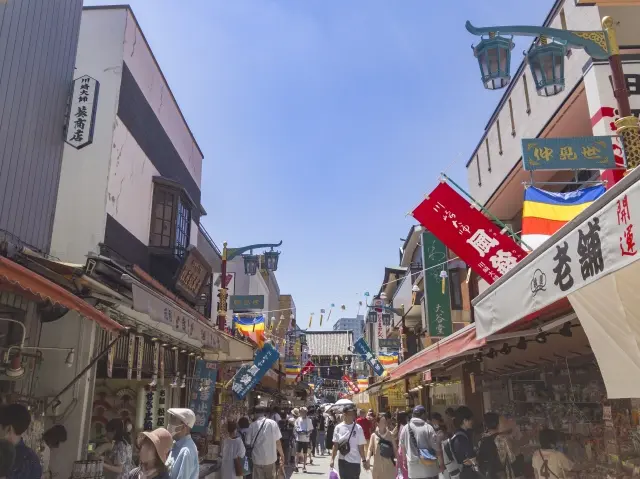
The obvious pairing with the market is the Nakamise (仲見世) shopping street that leads up from the main gate, where Kawasaki Daishi's local specialties are lined up.
One is kuzumochi (久寿餅), a chewy sweet made by lactic-acid fermenting wheat starch, served with kinako soybean flour and black-sugar syrup. Another is tontoko candy (とんとこ飴, also called sarashi-ame) and cough-drop candy (せき止め飴). At the candy shops along Nakamise, you can watch vendors cut the candy on a board with a rhythmic "ton-toko, ton-toko" beat. That sound is a draw in its own right, and in that sense the street shares something with the chime market. The cool ring of the furin and the light tap of the candy knife are both sounds people remember this place by.
About Kawasaki Daishi
Kawasaki Daishi is formally Kongosan Kinjoin Heikenji (金剛山金乗院平間寺), one of the head temples (daihonzan) of the Chisan branch of Shingon Buddhism. Founded in 1128, during the Heian period, it enshrines Kōbō Daishi (Kūkai, 弘法大師・空海), the great Buddhist master. Widely known as a "yakuyoke" (evil-warding) temple, it draws one of the largest New Year's first-visit (hatsumode) crowds in all of Japan.
The summer wind chime market is one of the seasonal events held here. Pay your respects first, then browse the chimes—you leave with the sound in your ears and a few calmer minutes.
Practical Tips for Travelers
July in Kawasaki is hot and humid. Bring a hat, water, and a towel to stay comfortable.
The grounds are outdoors, so mornings are the most comfortable time to go, before the midday heat peaks.
The Daruma wind chime charm is only offered during the market, so aim for an earlier hour if you want one.
If you're stopping by on your arrival or departure day, there are coin lockers at Keikyu Kawasaki Station where you can drop your suitcase first.
Shops along Nakamise may take cash only, so it helps to carry small bills and coins.
It's a walk from Kawasaki-Daishi Station to the grounds, so wear comfortable shoes.
This article was translated from the original Japanese with AI assistance and reviewed by our editorial team. The Japanese version is authoritative.


