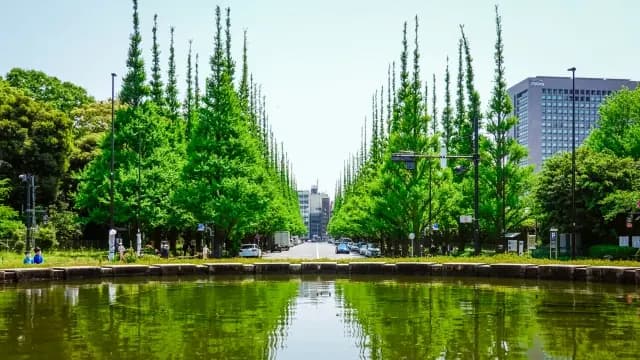
The ginkgo avenue at Meiji Jingu Gaien (神宮外苑いちょう並木, Icho Namiki) is the most famous stretch of golden autumn trees in Tokyo. Roughly 300 meters of road, lined with 146 ginkgo trees, turns into a tunnel of yellow when the leaves change.
One thing to get straight first: if you are going for the old "Jingu Gaien Ginkgo Festival," you will be disappointed. This guide sorts out what is certain about a 2026 visit and what is not. For other autumn-color spots around the city, see our roundup of Tokyo Autumn Leaves 2026.
The avenue is a public road, so simply walking through it costs nothing and needs no booking. The trees themselves are the whole point; food markets and evening lighting come and go from one year to the next.
Peak color: mid-to-late November
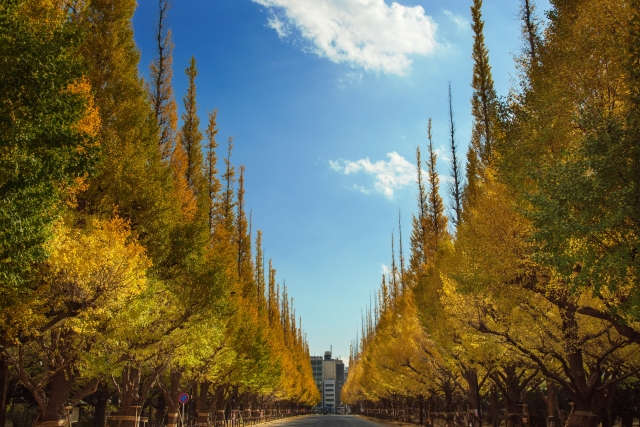
In a normal year the ginkgos start turning around mid-November and hit their golden peak in late November. Through early December the leaves drop and the road turns into a carpet of yellow.
There is no official peak-color forecast for 2026 yet. The Japan Weather Association starts publishing its autumn-foliage estimates around September, so if you want to pin down the exact days, check the latest forecast then.
How fast the color arrives depends on the year's temperatures. If you want to be sure of seeing the golden tunnel at its best, aim for a weekday in late November and leave yourself a few days of flexibility.
A 146-tree avenue from 1923
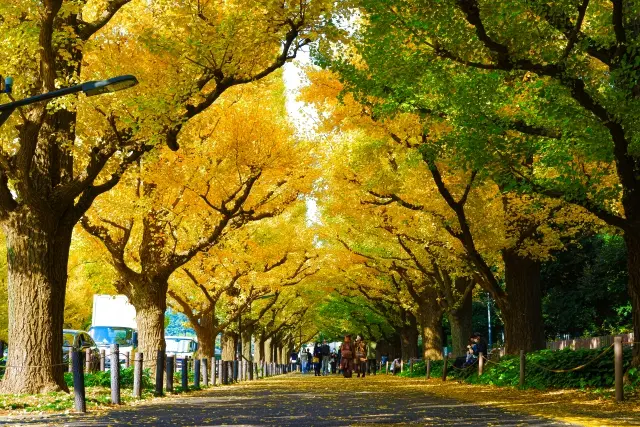
The avenue was completed in 1923 (Taisho 12). The seeds were collected in 1908 from native trees in Shinjuku Gyoen (新宿御苑), and the landscape architect Yoshinobu Orishimo (折下吉延) designed the planting. More than a century on, the tallest trees now reach about 28 meters.
The clever part is the use of perspective. Seen from the Aoyama-dori end, the trees are trimmed slightly shorter toward the far side so that the Meiji Memorial Picture Gallery (聖徳記念絵画館) at the end of the road appears neatly framed in the distance.
Worth knowing: that gallery is closed for restoration work from April 2025 until the end of May 2027 (planned). The 2026 viewing season falls inside that period, so the building at the head of the avenue may be behind scaffolding or protective sheeting.
The golden leaves themselves are unchanged. But the classic shot with the gallery as a clean backdrop will be hard to get during this stretch, so plan your photos with that in mind.
The "Ginkgo Festival": gone since 2019
The autumn "Jingu Gaien Ginkgo Festival" (神宮外苑いちょう祭り) has not run under that name since 2019 (November 15 to December 1). It was called off in 2020 because of COVID-19 and hasn't come back since. The event page that Tokyo's tourism site once carried no longer appears.
In recent years a separate food-and-crafts event has been held on and off, but in a different plaza rather than on the avenue itself, and under a different name. Whether the kind of food stalls the old festival ran (last held November 15 to December 1, 2019) come back in 2026 is up in the air, and there's no official confirmation either way.
In short, do not assume that walking the avenue at peak color means there will be food vendors set up. If food is your goal, check for an organizer's announcement before you lock in your dates.
Evening lighting: decided year by year by Tokyo
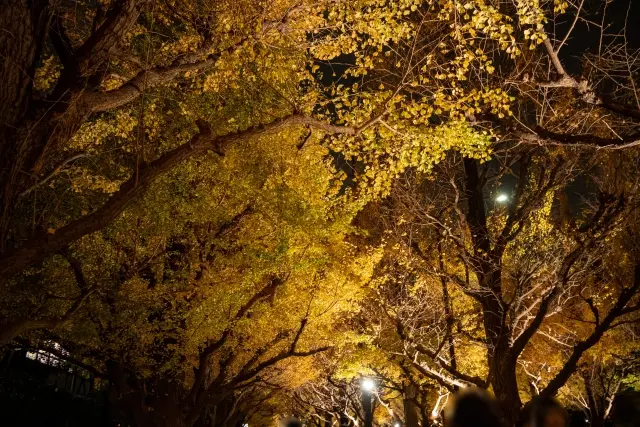
The evening lighting also happens in some years and not others. It is run not by Meiji Jingu Gaien but by the Tokyo Metropolitan Government's Bureau of Construction, which manages the street trees.
In 2025 the Aoyama-dori side of the avenue had an illumination from November 22 to November 30, roughly 4:30 to 7:30 p.m. This is not a fixed annual event, though; whether it runs, and on which dates, is decided by the city from one year to the next. As of now, there's no word on any lighting for 2026.
If seeing the avenue lit up at night is your aim, wait for the Bureau of Construction's announcement in November before you go. Show up on the wrong dates and you are just walking a dark road.
Getting there and timing your visit
The entrance to the famous "golden tunnel" is on the Aoyama-dori side. The closest station to it is Gaienmae (外苑前) on the Tokyo Metro Ginza Line. If you walk in from the Picture Gallery end instead, JR Shinanomachi (信濃町, Chuo-Sobu Line) and Kokuritsu-Kyogijo (国立競技場, Toei Oedo Line) are nearer.
Because the avenue is a public road, walking through costs nothing and needs no booking. Early in the morning it is quiet, and you can have the golden tunnel of leaves almost to yourself. Midday on a peak-season weekend, however, gets very crowded, so a weekday or an early morning is your best bet for an unhurried walk.
Seasonal open-air cafes with terrace seating sometimes appear along the avenue, but they vary from year to year. Treat them as a bonus rather than a plan, and drop in only if one happens to be open.
This article was translated from the original Japanese with AI assistance and reviewed by our editorial team. The Japanese version is authoritative.