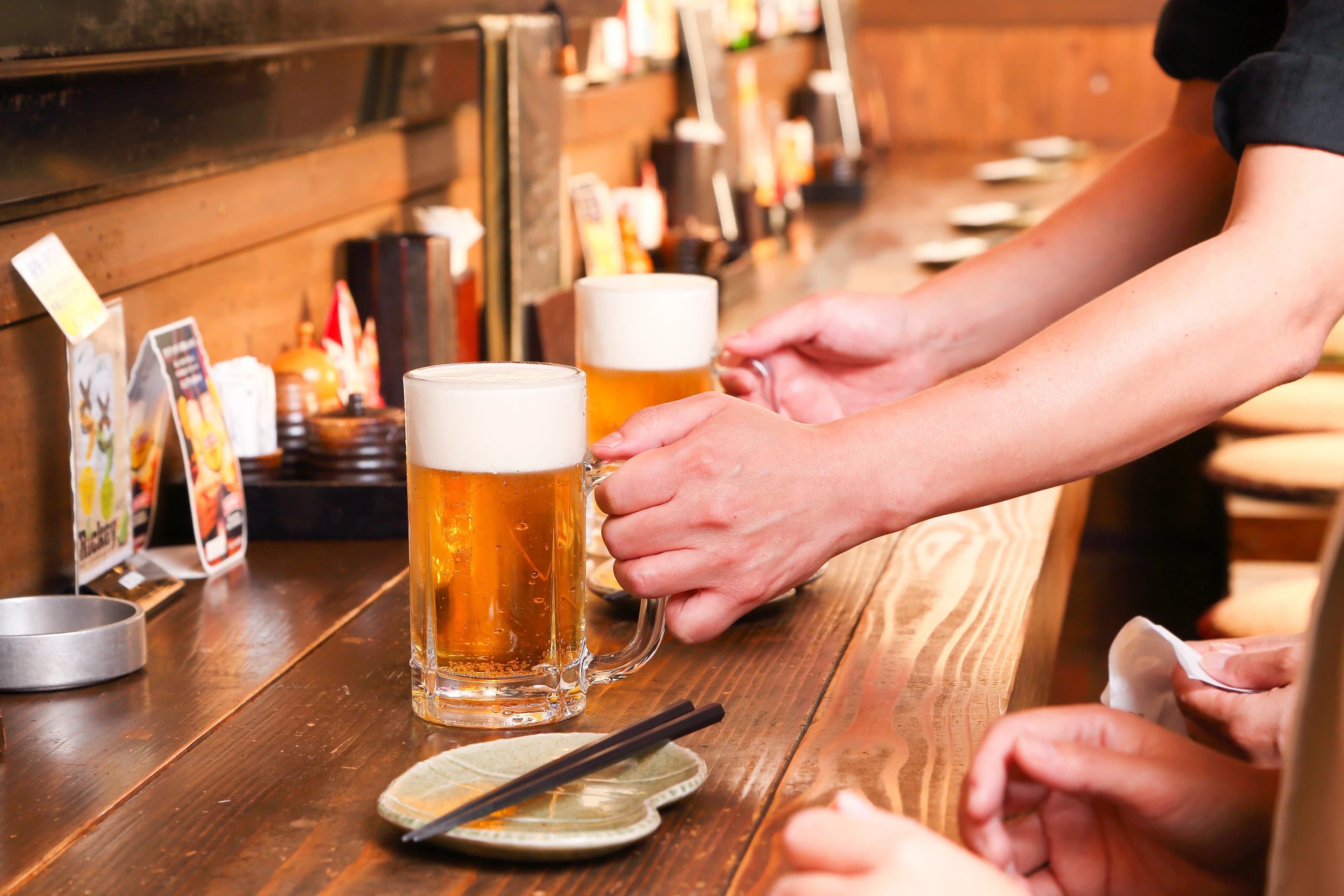
At the height of summer, the word "unagi" (うなぎ, eel) shows up everywhere in Japan.
Supermarkets set up special counters by the entrance, and long-established restaurants have lines out front.
This is Doyo no Ushi no Hi (土用の丑の日), the "midsummer day of the ox," and in 2026 it falls on Sunday, July 26.
It's the day eel sales spike and far more people than usual sit down to a plate of grilled eel. If you run into the buzz while you're traveling, knowing the story behind it makes the whole scene more fun.
Here's why eel, where to eat it, and roughly what it costs, all from a traveler's point of view.
When is Doyo no Ushi no Hi in 2026?
In 2026, the midsummer day of the ox lands on Sunday, July 26. Some years it comes around twice in one summer, a second date called ni no ushi (二の丑), but 2026 has just the one.
If you want eel, the week or so around that date is prime time. Just know that on the day itself everywhere gets packed, and both restaurants and supermarkets sell out. Reserve a few days ahead, or shift your visit to just before or just after the 26th.
So what is "Doyo no Ushi no Hi"?
The name sounds cryptic, but it breaks down easily. Doyo (土用) is a seasonal marker in the old calendar: the roughly 18 days just before each of the four season changes (the first days of spring, summer, autumn, and winter). So doyo happens four times a year, not only in summer.
Ushi no hi, the "day of the ox," comes from the Chinese zodiac (rat, ox, tiger, and so on) being assigned to days in a repeating 12-day cycle. Because the cycle is 12 days long, an 18-day doyo period contains one ox day, and in some years two. The famous eel day is where the summer doyo and an ox day overlap.
Why eel?
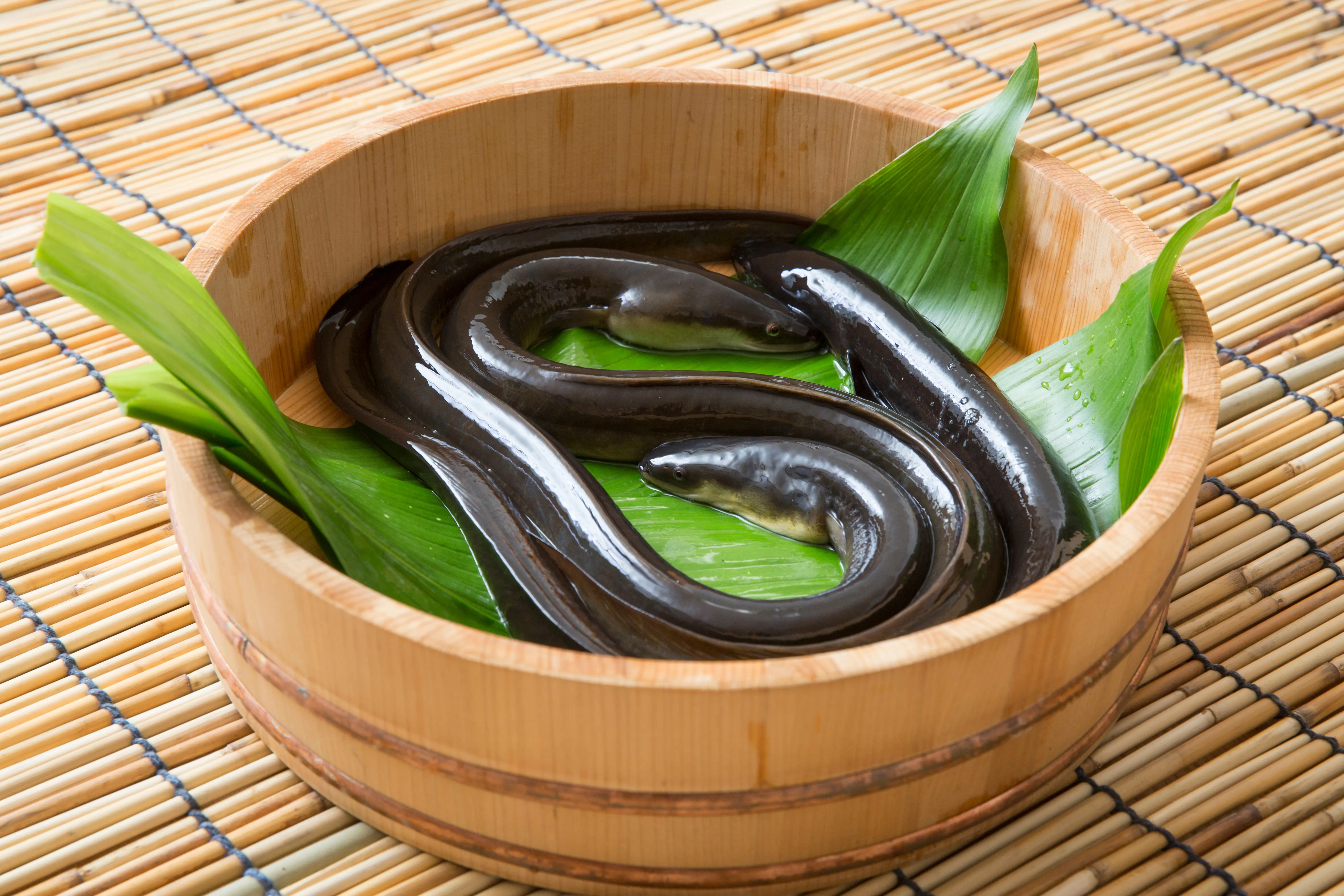
The truth is, no one knows the custom's origin for certain. The best-known story credits Edo-period scholar Hiraga Gennai (平賀源内), who supposedly told a struggling eel shop to post a sign reading "Today is the day of the ox" — and business boomed. There's no solid record of this, though, so it's told as folklore rather than fact.
Behind the custom is an older belief that eating foods starting with the sound "u" on the ox day helps you shrug off the summer heat. Eel fits perfectly — unagi begins with "u" — and the same list includes umeboshi (pickled plum), uri (gourd), and udon. Eel is also rich in vitamins and minerals, so it took hold as a bit of summer nourishment for a season when appetites fade. Nutrition alone won't cure summer fatigue, but the day lives on as a small ritual of eating something restorative to get through the heat.
The eel vocabulary worth knowing
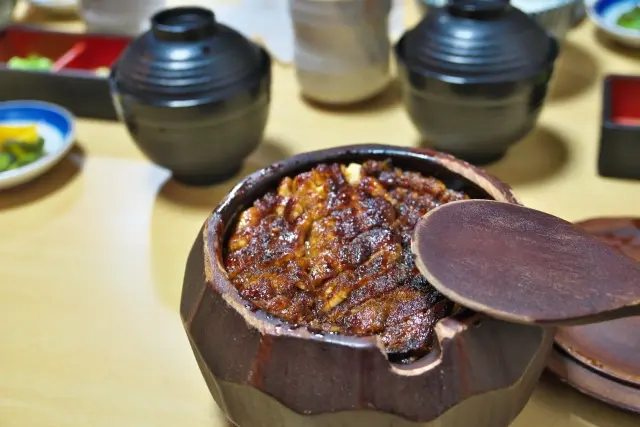
*Hitsumabushi
A few words will keep you from getting lost when you order.
Term | What it is |
|---|---|
Unaju (うな重) | Grilled eel over rice in a lacquered box; the classic at specialty shops |
Unadon (うな丼) | The same idea in a rice bowl, a more casual serving |
Kabayaki (蒲焼き) | Split eel skewered and grilled with a sweet-savory glaze |
Shirayaki (白焼き) | Grilled plain, no sauce; eaten with wasabi or salt |
Kimosui (肝吸い) | A clear soup with eel liver, often served alongside unaju |
Hitsumabushi (ひつまぶし) | Chopped grilled eel over rice, a Nagoya specialty (see below) |
Nagoya's hitsumabushi has its own ritual.
Divide the rice into quarters with the paddle, then eat it four ways: the first quarter plain, the second with condiments like scallion and wasabi, the third with dashi broth poured over it like ochazuke, and the last however you liked it best. One bowl, several ways to enjoy it — it's a meal you'll remember.
East and West grill eel differently
The same fish is prepared differently in eastern and western Japan, and knowing the split makes the tasting more fun.
Kanto (Tokyo / east) | Kansai (west) | |
|---|---|---|
How it's split | Along the back | Along the belly |
Before grilling | Steamed, then grilled | Grilled straight, no steaming |
Skewers | Bamboo | Metal |
Result | Soft and fluffy | Crisp-skinned, firmer flesh |
The eastern back-split is usually explained by a samurai aversion in Edo to slicing the belly, which called to mind seppuku. The rough boundary between the two styles runs around Lake Hamana (浜名湖) in Shizuoka. Eel you eat in Tokyo is, as a rule, the steamed-then-grilled, melt-in-your-mouth kind.
What does it cost?
Let's be honest: eel is not cheap. The Japanese eel has suffered years of poor juvenile catches and is listed as endangered on the Red Lists of both Japan's Ministry of the Environment and the IUCN. Prices have climbed in recent years, so leave a little room in your budget.
Where you buy or eat | Rough price |
|---|---|
Kabayaki at supermarkets / konbini | Around ¥1,400 per 100g (summer 2025); roughly ¥1,500–3,000 a pack |
Chain restaurants / set meals | Generally ¥1,500 to the low ¥3,000s |
Unaju at long-established specialists | From the ¥3,000s; top houses run past ¥10,000 |
Many shops grade their unaju like "sho / chiku / bai" (pine / bamboo / plum) by portion and origin, so start with the most affordable grade if you're unsure.
Where to eat eel in Tokyo
Tokyo has plenty of houses going back to the Edo era. Here are a few long-established spots that are approachable for travelers.
Komagata Maekawa (駒形前川)ーAsakusa
An old house with views of the Sumida River and Skytree; unaju runs ¥6,300–9,300, with a top grade at ¥12,000.
Nodaiwa (野田岩)ーAzabu / Akabanebashi
A venerable name said to date to the late Edo period; also praised for its shirayaki.
Obana (尾花)ーMinami-senju
Widely regarded as one of Tokyo's very best.
Expect all of them to be slammed around the ox day.
Some take reservations and some are walk-in only, so check how each one works before you go; the old houses mostly book by phone and often only in Japanese, so have your hotel call ahead if you can.
Opening hours are often split between lunch and dinner, closing days can be irregular, and quite a few take cash only — confirm the hours and payment before you set out.
If you're in Nagoya or Kansai
Even if your trip takes you beyond Tokyo, there are eel houses worth seeking out.
Atsuta Horaiken (あつた蓬莱軒)ーAtsuta, Nagoya
The house said to have originated hitsumabushi — a term it holds as a registered trademark. The one to try first.
Kyogoku Kaneyo (京極かねよ)ーShinkyogoku, Kyoto
Famous for kinshi-don (きんし丼), an eel bowl crowned with a big, thick dashi omelet.
As Nagoya's hitsumabushi and Kyoto's kinshi-don show, eel takes on a local character wherever you go. Western Japan favors the un-steamed, crisper grill, so it's a chance to taste how it differs from the Tokyo version.
You don't need a specialist to eat eel
If your budget or schedule is tight, don't give up. As the ox day nears, supermarkets, department-store food halls, and convenience stores fill up with kabayaki and eel bento, and pre-orders open too.
Reheat one in your hotel room and you'll get that flavor for far less than a restaurant charges.
To reheat, splash on a little sake and warm it gently, almost steaming it, to keep it plump. A pinch of sansho (山椒) pepper at the end lifts the aroma to something close to the real thing.
One last eel-adjacent note. Unagi Pie (うなぎパイ), the signature sweet of Hamamatsu, is a long, thin baked pastry made with eel powder. It has nothing to do with the eel dishes above, but it's a long-loved souvenir — so don't be thrown by the name.
Make eel part of your summer
Doyo no Ushi no Hi is a small Japanese summer ritual: getting through the peak of the heat with a plate of eel. In 2026 it's July 26. Linger over it at a specialist, or grab a pack at the supermarket and try it on the cheap — either way, let the day's buzz become part of your trip.
Once eel has restored you, cool down with summer's other great icon: our Japanese Shaved Ice (Kakigori) Guide 2026.
Read next
Japanese Summer Festivals (Matsuri) Guide 2026 — enjoying the food stalls and the dates of the major festivals
Surviving Japan's Summer Heat (2026) — how to avoid heatstroke and where to buy cooling gear
Japanese Convenience Stores (Konbini): The First-Timer's Guide — where to grab kabayaki and eel bento on a budget
This article was translated from the original Japanese with AI assistance and reviewed by our editorial team. The Japanese version is authoritative.