Tokyo hit 35°C (95°F) or higher on 25 days last summer, and on 45 nights the temperature never dropped below 25°C (77°F). Those are the Japan Meteorological Agency's numbers for June through August 2025, and they explain something every first-time visitor learns by day three: the shirt you put on at breakfast is not the shirt you want to be wearing at dinner.
So people pack ten shirts for a ten-day trip. The suitcase is heavy on the way in and impossible on the way out, once the omiyage (souvenirs) start piling up. There is another way, and it takes about an hour: wash your clothes partway through the trip. Japanese coin laundries are easier to use than they look, and — this is the part almost nobody tells you — you don't need to bring detergent. For packing and what to actually wear in the heat, see What to Wear in Japan in Summer 2026: Heat, Humidity & Rain.
The short version: three ways to do laundry
Option | Rough cost | Best for |
|---|---|---|
Neighborhood coin laundry | ¥300–1,000 to wash; drying runs a few minutes per ¥100 | A full load. |
Coin laundry inside your hotel | A few hundred yen per cycle (varies by hotel) | Doing it at night without leaving the building |
Handwashing in your room | Nearly free (a ¥110 mesh bag helps) | Socks and underwear on a short stay |
Coins are still the default, though some chains now take transit IC cards or their own app. Detergent comes out of the machine.
Those prices are a guide, not a promise. The figures come from WASH House, one of the few chains that publishes a price list, and even they note that prices vary by store and by time of day. There is no national price list for coin laundries in Japan.
You don't need to bring detergent
This is the single most useful thing to know. At Japan's major coin laundry chains, detergent and fabric softener are dispensed automatically by the machine. Mammy Chao (マンマチャオ) states plainly in its official guide that detergent is added automatically. Baluko Laundry Place writes that "detergent and fabric softener are automatically dispensed in the correct amount, so there is no need to prepare any." Coin Laundry Pierrot (コインランドリーピエロ) uses a commercial-grade neutral detergent, also dispensed for you.
So leave the travel packets at home. Add your own on top of the automatic dose and you get a machine full of suds. If you can't find a detergent tray, that isn't an oversight — it's a machine that doesn't want one. Older independent laundries and some hotel machines are the exception, so read the control panel before you feed it coins.
What it costs and how long it takes
WASH House (WASHハウス) publishes its rates, so let's use them as a reference point (as of July 2026; prices vary by store).
Washer, 22 kg | Standard cycle ¥700–1,000, about 31 min |
|---|---|
Washer, 12 kg | Standard cycle ¥400–600, about 31 min |
Washer, 7 kg | ¥300, about 30–40 min |
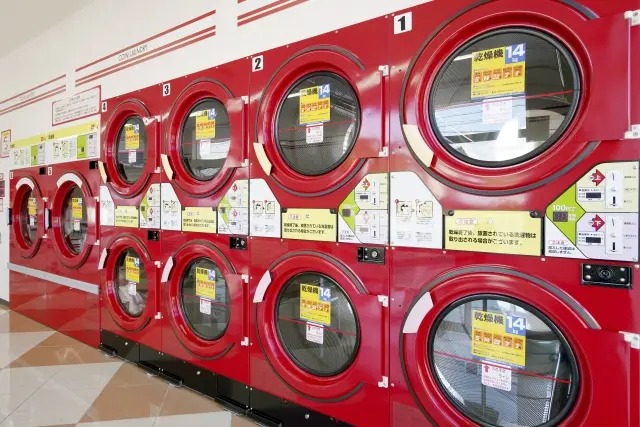
Dryer, 25 kg | ¥100 buys 6–8 min |
Dryer, 14 kg | ¥100 buys 8–10 min |
Look closely at those dryer rows, because this is where Americans get surprised. A neighborhood dryer in Japan sells you time, not a cycle. You feed it ¥100, it runs for several minutes, and you keep feeding it until your clothes are dry. For T-shirts, underwear, and socks, budget ¥300 to ¥400. Throw in jeans or a bath towel and it climbs.
Plan around an hour. Baluko puts a full wash-and-dry at roughly 60 minutes, a wash alone at about 30, and drying at 30 to 40. Pierrot gives a similar 30 minutes each.
Most coin laundries are unstaffed. Go sit in a café, or do your konbini run. What you should not do is leave your clothes and disappear for two hours. Unstaffed also means unlocked.
Paying: coins, IC cards, and apps
You used to need a pocket full of ¥100 coins. That's changing, unevenly. Pierrot takes cash, IC cards, and its own app, and its FAQ says the app gets you 5% off every time. Baluko is coin-first, with app payment and rechargeable cards at some locations. Mammy Chao runs on coins and prepaid cards; electronic money (Suica, PASMO, nanaco, iD, WAON, Rakuten Edy) works at only 46 of its stores, spread across 15 prefectures.
In other words, cashless has arrived in patches. Keep a few ¥100 coins. Many laundries have a change machine, but not all of them accept larger bills. For the wider picture, see Is Japan Cash-Only? How to Pay in Japan in 2026 (Cash, IC Cards, Contactless & QR).
All-in-one machines vs. separate washers and dryers
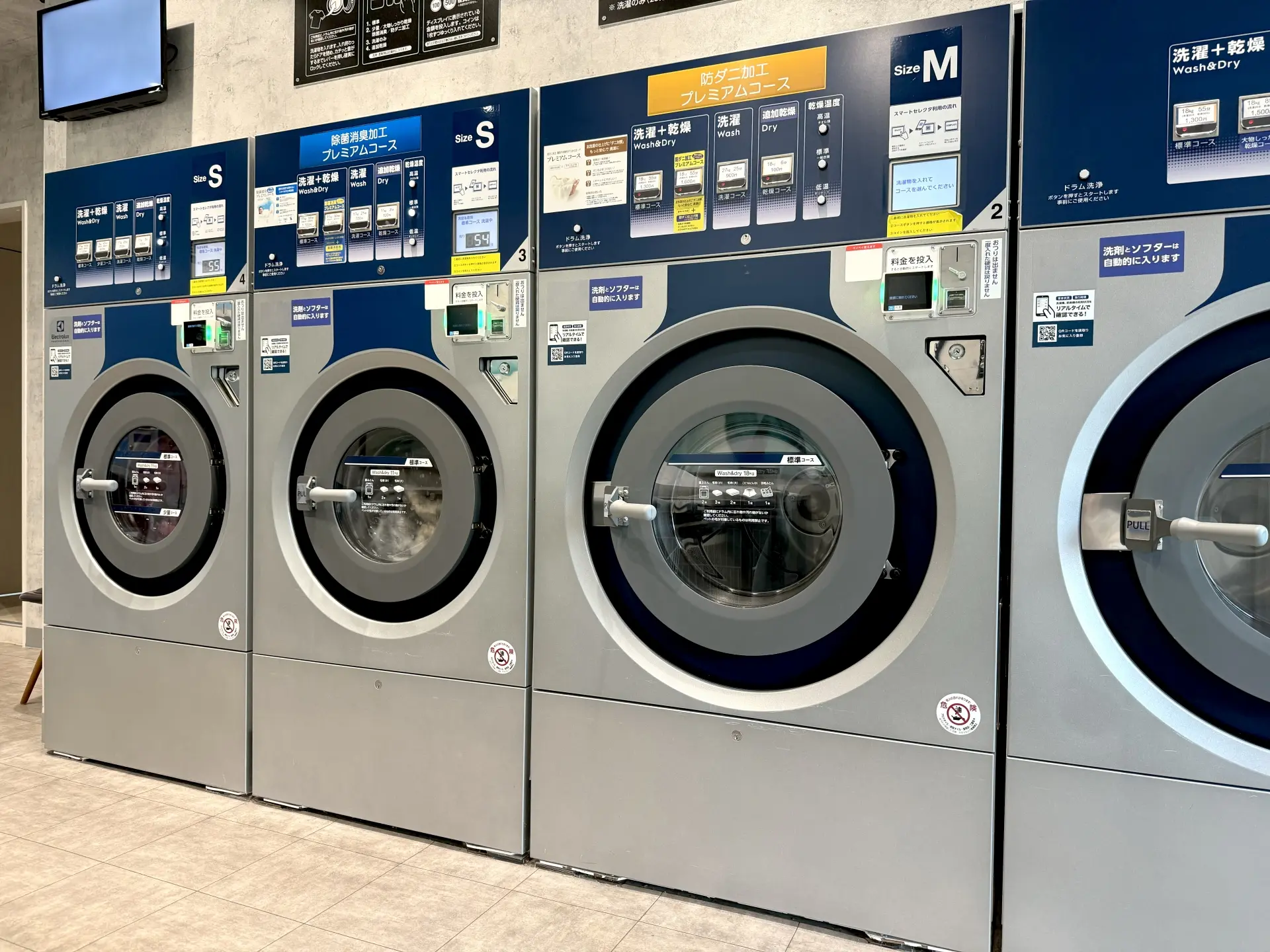
Japanese coin laundries run two kinds of machines side by side, and this trips up more visitors than the pricing does.
The first is a combo unit: load it, pay once, and it washes and dries in a single drum. Around 60 minutes, no transfer, no second decision. If you see one, use it. The second is the arrangement you know from home, washers on one wall and dryers on another. The laundry room at the Hilton Tokyo Bay is set up this way, six washers and eight dryers.
Telling them apart is easy once you know to look. A control panel offering a "wash-and-dry" course is a combo unit. A panel that only says wash, or only dry, is half the job. A room with more dryers than washers is also a giveaway.
The chains, and how to find one
The Ministry of Health, Labour and Welfare counted 16,693 coin laundry facilities nationwide in fiscal 2013. It's a dated figure, and the newest official count I can point to, but it tells you the scale. These places are everywhere. Not in the tourist core, though. Walk a few minutes from the station, onto a street where people actually live.
One search tip that will save you a walk: type コインランドリー into Google Maps, or "coin laundry." Do not search "laundromat." It's not the term used in Japan, and the map will show you less. Chain names help too. Mammy Chao has more than 500 locations, and Baluko tends toward bright interiors, sometimes with a café attached, which makes the hour bearable.
Letting the hotel handle it
Plenty of Japanese business hotels have a laundry room on site. You'll find them at Toyoko Inn, APA Hotel, Dormy Inn, Super Hotel, and Route Inn — but machines and prices differ property by property, and none of these chains publishes a single nationwide rate. Check the specific hotel's page before you book. The Hilton Tokyo Bay is one of the few that posts its numbers.
Location and hours | B1F, open 24 hours |
|---|---|
Washers | 6 × 5 kg, about 31 min, ¥600 (detergent dispensed automatically) |
Dryers | 8 × 5 kg, about 15 min, ¥200 |
Payment | Cash (¥100 coins only) or electronic payment |
The appeal is obvious: no walking through a strange neighborhood at night with a bag of dirty clothes, and you can lie down while the dryer runs. The catch is that a whole hotel usually shares a handful of machines. From late afternoon until around 9 p.m., you will be waiting. Go early in the morning, or right after you arrive.
Washing in the sink
For socks and underwear on a two- or three-night stay, the bathroom sink is genuinely fine, and I'd skip the laundry entirely. Japanese business hotel bathrooms often have a retractable clothesline strung over the tub. If yours doesn't, roll the wet clothes in a bath towel and press hard, hang them on hangers, and leave the bathroom fan running overnight. That fan matters more than you think — Japanese summer air is wet, and clothes in a closed bathroom will still be damp at breakfast.
The supplies cost almost nothing. DAISO sells a "Traveling Laundry Net" for ¥110 to ¥220 including tax; it holds small items in your suitcase and becomes a mesh laundry bag when you get home. For which hundred-yen chain to walk into, see Japan's 100-Yen Shops (2026): Daiso vs. Seria vs. Can Do, and What's Actually Worth Buying.
Yes, you can wash your sneakers
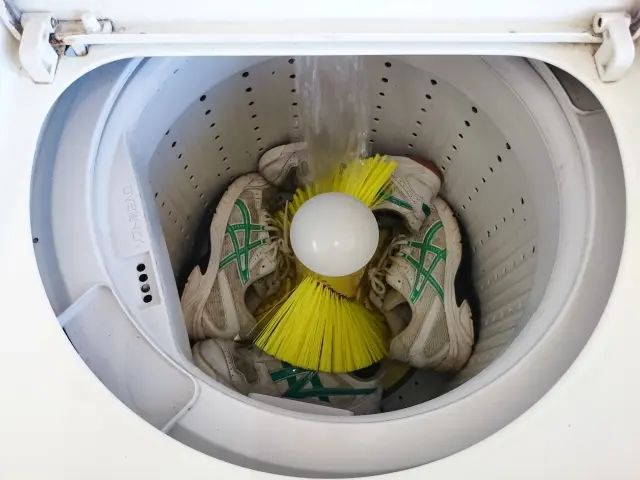
Many Japanese coin laundries have a machine built for shoes. Baluko's sneaker washer runs about 20 minutes and its sneaker dryer about 40. WASH House lists a sneaker washer at ¥200 and a sneaker dryer at ¥100 for 20 minutes.
You will walk more in Japan than you plan to. Asakusa to Ueno on foot, three temples in Kyoto, and the daily maze of transferring at Shinjuku Station. Washing your sneakers the night before you fly home is a small, disproportionate pleasure. Leather shoes stay out of the machine, obviously, as does anything labeled not machine washable.
Packing lighter, on purpose
Once laundry is part of the itinerary, the packing math changes. Three shirts. Four days of underwear. When the bag wins anyway, you can ship it: Japan's courier network moves suitcases between hotels and airports overnight, and the process is explained in Send Your Suitcase Ahead: How Japan's Takkyubin Delivery Makes Hands-Free Travel Possible. For coin lockers and same-day storage, see Tokyo Luggage Storage Guide 2026: Coin Lockers, Storage Apps & Hands-Free Sightseeing.
An hour of laundry, somewhere around day five. Your suitcase gets days lighter. For surviving the heat that made you do it, see Japan's Summer Really Is That Hot: Heatstroke Prevention & Where to Buy Cooling Gear, and for where to buy anything at 2 a.m. while the dryer runs, The Complete Japan Konbini Guide: How to Use Convenience Stores, What to Buy, ATMs & Services.
Prices, equipment, and payment options change. Check the official pages below before you count on a number.
This article was translated from the original Japanese with AI assistance and reviewed by our editorial team. The Japanese version is authoritative.